
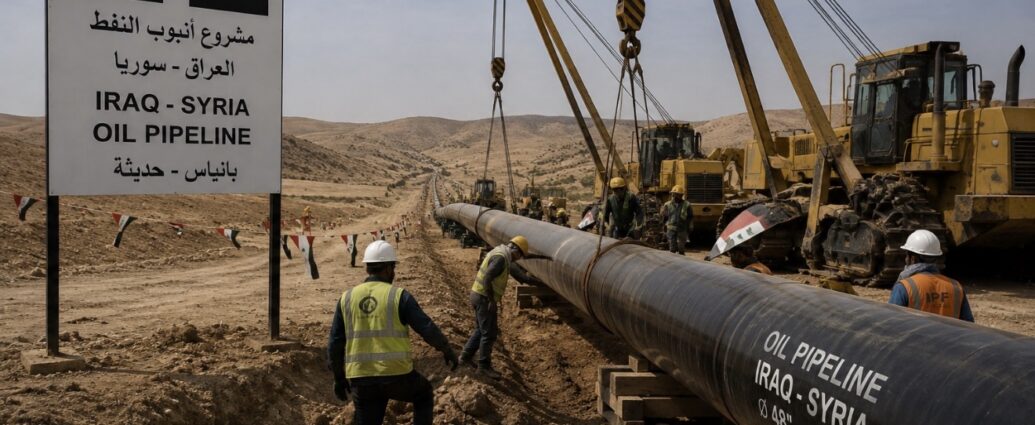
Iraq is moving toward a major new oil pipeline across Syria that could eventually carry roughly 2 million barrels a day to the Mediterranean, creating an alternative export route that would bypass the Strait of Hormuz entirely.
The project would cost at least $15 billion and require about four years to build, according to people directly involved in the planning. The proposed system would connect Iraq’s southern and northern oil fields through a central hub at Haditha before continuing west to Syria’s Mediterranean port of Baniyas.
That would give Iraq something it does not have today: a large-scale export route that can send crude directly toward Europe without forcing tankers through the Persian Gulf and Hormuz.
The urgency behind the project is obvious.
Before the latest regional conflict, roughly one-fifth of the world’s oil and liquefied natural gas moved through the Strait of Hormuz. The waterway has since become one of the most serious vulnerabilities in the global energy system, with disruptions forcing producers, governments and traders to rethink how dependent Gulf exports should remain on a single chokepoint.
Iraq already had a pipeline linking Kirkuk with Baniyas, but the old system is considered too damaged and outdated to simply restart at the scale now being discussed.
That means the current plan is effectively a new infrastructure project rather than a routine rehabilitation.
Chevron is among the companies supporting technical and financial feasibility work, together with TI Capital and Qatar-based UCC Holding. The Iraqi government has also approved preliminary agreements covering several alternative pipeline routes, including connections toward both Syria and Turkey.
If built at the proposed scale, the Syrian route would dwarf the old Kirkuk-Baniyas system, which carried about 300,000 barrels a day.
Two million barrels a day would represent a substantial share of Iraq’s export capacity and could materially change the way its crude reaches global markets.
The business implications extend far beyond Iraq.
A functioning Mediterranean outlet could reduce the risk premium attached to Iraqi oil during Hormuz disruptions. It could also create new demand for pipeline construction, pumping stations, storage terminals, port infrastructure, security systems and financing across Iraq and Syria.
For refiners in Europe, the route could shorten and simplify access to Iraqi crude compared with shipments that must first sail out of the Gulf.
But the project is nowhere near completion.
Construction could take four years even after final agreements are reached, and major questions remain around financing, land rights, security and clearing infrastructure along the Syrian route.
That timeline is important because Washington has increasingly promoted pipelines as a way to reduce the strategic importance of Hormuz much sooner.
The engineering reality is considerably slower.
What is changing already, however, is the thinking.
For decades, the Strait of Hormuz was treated as an unavoidable feature of Gulf oil exports.
Now governments and energy companies are spending billions to build around it.
If Iraq ultimately completes a 2-million-barrel-a-day route to the Mediterranean, the consequences would reach well beyond one pipeline.
It would begin changing the physical map of the global oil trade.
JBizNews Desk | Baghdad
© JBizNews.com All Rights Reserved. Reproduction or distribution without written permission is prohibited.




