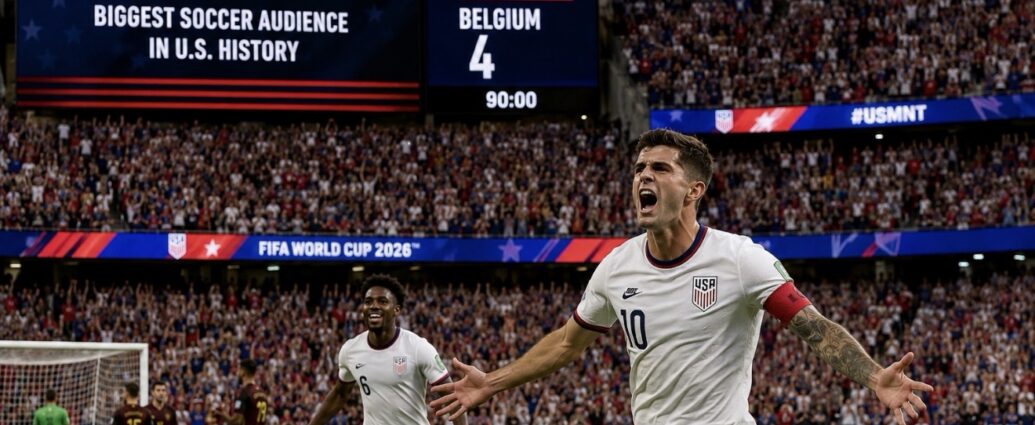
The U.S. men’s national team saw its World Cup run come to an end in front of the largest soccer audience the country has ever produced. Fox Corp. said on Tuesday, July 7, that its coverage of Monday night’s USA-Belgium round-of-16 match in Seattle drew 30 million viewers, the most-watched soccer telecast in U.S. history. Add the 12 million who watched the Spanish-language broadcast on Telemundo and Peacock, and the total American audience reached 42 million, according to preliminary Nielsen figures and Adobe Analytics data released by the networks.
That is a staggering number for a sport that spent decades on the margins of American television. It topped the record set only a week earlier, when the USA-Bosnia and Herzegovina group-stage game pulled in 26.4 million on Fox. The Belgium match peaked at 36.9 million viewers between 9:15 and 9:30 p.m. Eastern, right as Belgium pulled away in a 4-1 win that knocked the U.S. out of the tournament it is co-hosting.
The audience tells one story. The money behind it tells another.
Fox paid a reported $485 million for the English-language U.S. rights to the 2026 World Cup, a price several industry analysts have called two to three times below what those rights would fetch in an open market. The reason Fox got a bargain and is now cashing in comes down to geography. This is the first World Cup in 30 years played in U.S. time zones, which means marquee games land in prime time instead of at breakfast. Team USA’s run gave Fox its most valuable inventory of all.
Advertising rates climbed with each round. During the group stage and early knockout matches, spots ran around $300,000, sources told Front Office Sports. For later rounds, prices reached an estimated $1 million to $2 million. Fox charged close to $1 million for some commercials in Team USA’s opening games and could command more as the tournament advanced.
A new wrinkle added even more. FIFA introduced two three-minute hydration breaks per match this year, officially to protect players from summer heat. For Fox, they became a windfall. The breaks let the network run full-screen commercials inside the match itself, something soccer never allowed before. The Hollywood Reporter estimated those in-game spots sold for $200,000 to $750,000 each, and pegged the total value of the breaks across the tournament at $250 million to $600 million.
Put it all together and the two U.S. rights holders are on track for a combined $850 million in ad sales, according to estimates cited by Sportico. That is more than double the $384.3 million Fox and Telemundo booked during the 2018 tournament in Russia, the last summer World Cup.
For the sport’s American backers, Monday’s number is validation. Telemundo called its 12 million audience the largest for any U.S. men’s national team soccer match in Spanish-language history, with 6.7 million streaming on Peacock and 4.8 million watching the linear broadcast. Streaming, not just traditional TV, is carrying more of the load than in any prior tournament.
Still, it helps to keep the World Cup’s place in the American advertising market in perspective. Luke Stillman, managing director at consultancy Madison & Wall, put it bluntly: in the U.S., the World Cup is a $400 million to $500 million event inside a $60 billion to $70 billion television ecosystem. For comparison, the 2025 Super Bowl averaged 127.7 million viewers, and last month’s NBA Finals between the New York Knicks and San Antonio Spurs averaged 20.6 million on ABC and ESPN. Soccer is growing rapidly in the United States, but it has not yet reached football’s scale.
The brands showed up anyway. Official FIFA partners including Coca-Cola, Visa, Hyundai and, for the first time, Lenovo anchored the sponsor roster, while Bank of America, Verizon and American Airlines signed on as tournament sponsors. On the advertising side, Michelob Ultra, Lay’s, Home Depot, Budweiser and Quaker all ran national campaigns tied to the games.
The commercial question now is what happens without the home team. Team USA’s elimination removes the single biggest draw from Fox’s remaining schedule. The tournament runs through the July 19 final in New York and New Jersey, and later-round matches will still command premium advertising rates. But the network no longer has the one storyline that turned casual American viewers into a record-breaking audience.
For one night in Seattle, though, 42 million people proved the American appetite for soccer is real—and worth a fortune to whoever owns the broadcast.
JBizNews Desk
© JBizNews.com All Rights Reserved. Reproduction or distribution without written permission is prohibited.