
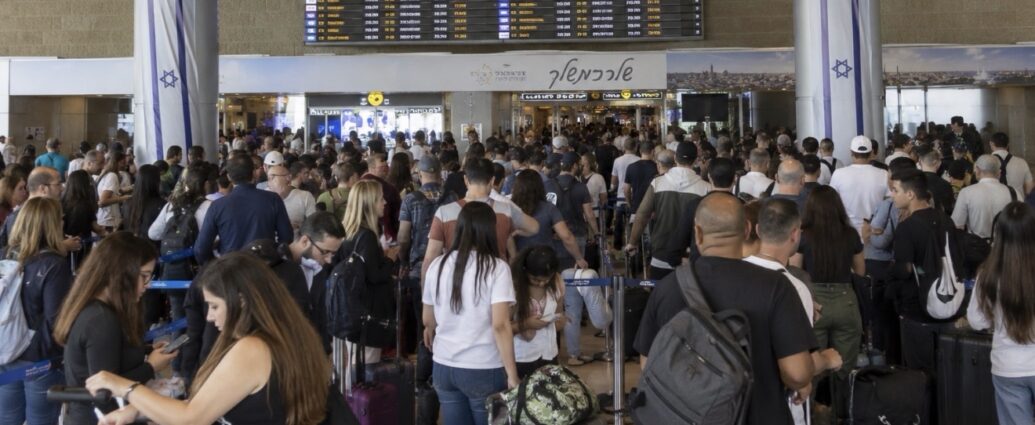
Ben Gurion Airport is pushing through one of its busiest days of the summer with roughly 90,000 passengers and about 600 aircraft movements expected Friday, but the problem is not simply volume. It is timing.
Within a span of just three hours, roughly 90 flights accumulated in a backlog, compressing arrivals and departures into a window the airport’s ground systems were not built to absorb all at once. Passengers were left sitting aboard aircraft after boarding, families waited for hours at baggage claim, and crews struggled to move luggage quickly enough to keep departures on schedule.
The Israel Airports Authority says there is no strike and no shortage of workers. Instead, it describes a traffic-jam problem in the sky that eventually becomes a traffic-jam problem on the ground.
Flights scheduled across an entire day do not necessarily arrive evenly. Restrictions in European airspace, particularly around Greece, can hold aircraft back and then release them in clusters. Add heavy August vacation traffic and continued U.S. aerial-refueling activity consuming airport capacity, and dozens of flights can suddenly arrive or attempt to depart within the same narrow window.
That is what happened Friday.
Once the wave reaches Ben Gurion, the bottleneck spreads quickly. Aircraft need parking stands. Baggage needs to be unloaded. New luggage has to be sorted and loaded. Ground crews must turn planes around, buses have to move passengers where jet bridges are unavailable, and incoming aircraft still need somewhere to go.
When 90 flights stack up in three hours, one delay begins feeding the next.
Passengers reported sitting aboard aircraft for hours after boarding because their luggage had not yet been loaded. Others who had already landed in Israel waited for extended periods beside baggage carousels, including families traveling with children just hours before the start of the Sabbath.
On a Friday in Israel, that timing matters in a way it would not on an ordinary weekday. As the Sabbath approaches, public transportation begins shutting down and observant travelers face a hard deadline to reach their homes, hotels or hosts before sundown. A delay of two or three hours can therefore become more than an inconvenience, leaving passengers without the train or bus they expected to take and forcing last-minute transportation arrangements at the same moment thousands of others are trying to do the same.
For travelers, that distinction matters. A flight can technically be operating and still leave passengers stranded for hours because the aircraft cannot be serviced, parked or cleared quickly enough to depart.
The airport’s congestion also reflects a broader capacity problem that has been building for months.
Israel Airports Authority Director General Sharon Kedmi warned in May that extensive U.S. military aerial-refueling operations at Ben Gurion were consuming a substantial portion of the airport’s available space and operational resources. At the time, he said civilian operations were effectively functioning at about one-third of normal capacity because of the military presence.
Friday’s congestion shows what happens when that reduced flexibility collides with peak summer demand.
European airspace restrictions add another layer. Greece sits directly along major flight paths between Israel and much of Europe, so disruptions there do not have to close Ben Gurion to cause trouble in Tel Aviv. Aircraft held elsewhere can arrive late together, creating precisely the type of concentrated surge that overwhelms baggage handling and parking capacity.
The Airports Authority says reinforced teams have been deployed and that available personnel are working at full capacity despite the summer heat. Transportation Minister Miri Regev described the situation as an unusually complicated combination of normal seasonal congestion, security constraints and wider aviation restrictions.
That does not make the wait shorter for passengers.
The practical lesson for anyone flying through Ben Gurion Friday is that the departure board alone does not tell the whole story. A flight showing as scheduled may still face a lengthy ground delay, while an incoming aircraft arriving late can push the next departure further behind.
For passengers arriving before the Sabbath, there is another clock running. Travelers should not assume that the train, bus or other ground transportation they planned to use will still be operating if their flight or baggage is delayed by several hours. Building extra time into the trip and having a backup transportation plan can make the difference between a difficult arrival and being stranded at the airport as the Sabbath begins.
Travelers connecting through Europe face an additional risk: delays around Greece or elsewhere can distort the entire sequence of aircraft arriving in Israel. Checking the first flight in an itinerary is therefore not enough. Each segment needs to be monitored separately.
The baggage problem can outlast the flight delay itself. When large numbers of aircraft arrive together, bags from one flight can compete for the same handlers, vehicles and carousel capacity as luggage from several others. Passengers who land on time can therefore still spend hours waiting inside the terminal.
And even after the immediate backlog clears, the airport does not simply reset. Aircraft, crews and departure slots are left out of position, meaning delays can continue rippling through the schedule long after the original surge has passed.
Ben Gurion is not closed. It may be something more frustrating for travelers: open, operating and overloaded at the same time — with the Sabbath approaching and far less room for delays than on an ordinary travel day.
JBizNews Desk | Tel Aviv, Israel
© JBizNews.com All Rights Reserved. Reproduction or distribution without written permission is prohibited.




