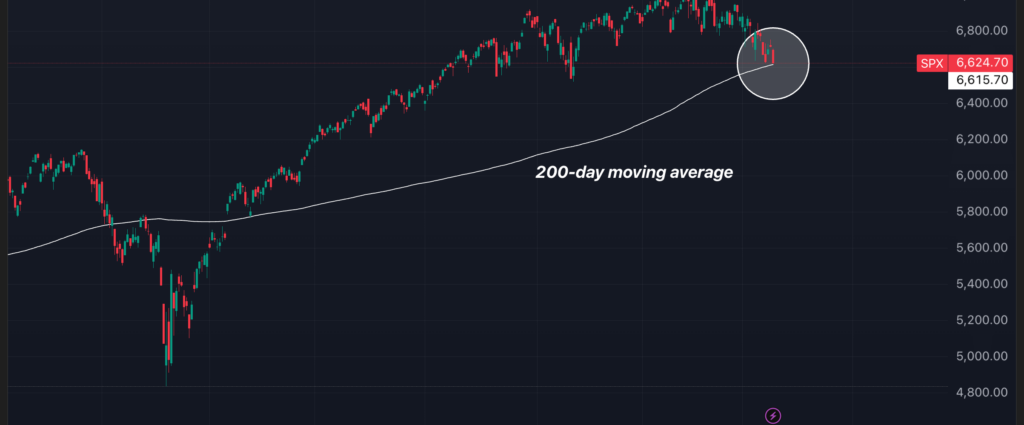
Both the S&P 500 and Nasdaq 100 are poised to break below their 200-day moving averages for the first time since March 2025.
Meanwhile, the Brent-WTI crude spread blew out to $17 per barrel early Thursday — the widest since April 2020 when WTI went negative — as Israel’s strike on Iran’s South Pars gas field triggered retaliatory missile attacks across the Gulf and markets began pricing in the risk of U.S. crude export restrictions.
Brent surged 7.11% to $115.01, while Middle East benchmarks Murban and Dubai crude exploded above $128 and $136 respectively.
Chart Of The Day
S&P 500 Could Break Below Its 200-Day Moving Average For First Time Since March 2025
Iran War Day 20: What Happened In The Last 24 Hours
- President Donald Trump said Israel “violently lashed out” at Iran’s South Pars gas field and that the U.S. “knew nothing about this particular attack.” He warned that the U.S. would “massively blow up the entirety of the South Pars gas field” if Qatar’s LNG is attacked again, and demanded no further Israeli strikes on the site unless Iran retaliates against Qatar.
- Iran retaliated with ballistic missiles against Qatar’s Ras Laffan LNG complex, which handles roughly 20% of global LNG supply. Qatar reported fires and extensive damage. Iranian drones also hit the Samref refinery in Yanbu, Saudi Arabia, and the Mina Al-Ahmadi refinery in Kuwait.
- The Fed held rates at 3.5%-3.75% in an 11-1 vote. The dot plot projects one cut in 2026. Chair Jerome Powell emphasized oil-shock uncertainty and said inflation progress had stalled.
Thursday’s Oil Market Update
WTI crude oil futures — as tracked by the United States Oil Fund (NYSE:USO) — traded at $98.35 per barrel early Thursday, up $2.03 (+2.11%). Since the start of the war on Feb. 28, WTI prices have surged roughly 45% from a pre-war level near $68 per barrel.
Brent crude — tracked via the United States Brent Oil Fund, LP ETV (NYSE:BNO) — jumped 7.11% to $115.01 per barrel following Iranian missile strikes on Gulf energy infrastructure.
Middle East benchmarks saw even sharper moves: Murban crude surged 10.34% to $128.84 per barrel, while Dubai crude spiked 11.05% to $136.42 per barrel, reflecting an acute physical supply squeeze in the region.
The Brent-WTI spread widened to approximately $17 per barrel — the widest since April 2020, when WTI famously went negative amid the pandemic storage crisis. Excluding that historic anomaly, the current spread is …