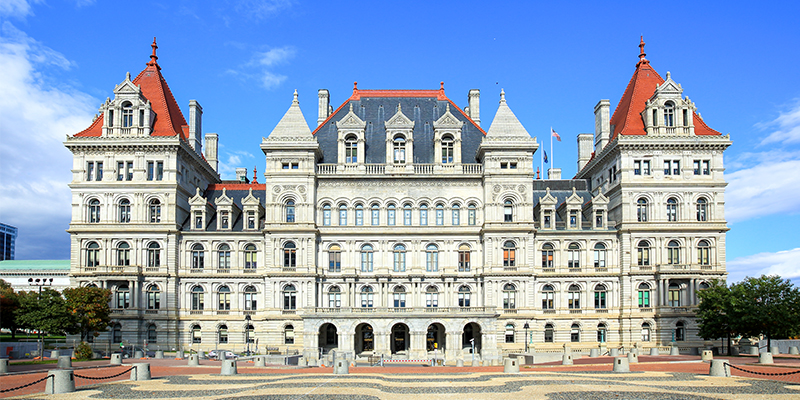
NAIOP members from the New York City Metro and Upstate New York chapters traveled to Albany in late March to engage with state lawmakers in support of our 2026 public policy priorities. Legislative action on these priorities will play an important role in advancing commercial real estate development that spurs economic growth, creates needed jobs and supports communities in providing additional housing, a centerpiece of discussions in meetings this year.
The New York chapters, comprised of hundreds of CRE developers, owners and related professionals, are strongly in support of Governor Kathy Hochul’s reforms to the State Environmental Quality Review Act (SEQRA) within her proposed 2026-2027 budget. Similar to CEQA reforms achieved in California last year, the governor’s SEQRA reforms, as part of her “Let Them Build” initiative, cuts unnecessary red tape and brings more certainty and predictability to the state’s environmental review process of housing projects.
Hochul proposes to expedite and exempt certain housing projects which do not have any significant environmental impact but which remain subject to local zoning and other state regulations and requirements, such as water usage. The expedited environmental review process is for housing projects on “previously disturbed areas” that have already been developed or improved. The governor’s SEQRA reforms will also apply to critical infrastructure projects with no impact on natural resources. The two chapters are hopeful that these commonsense SEQRA reforms will be expanded beyond housing to other property development types.
NAIOP’s New York chapters are also calling on the state Assembly to pass legislation establishing tax credit for the conversion of vacant office space to residential use. S. 9259 / A10192, which provide a 10% “office to residential conversion” tax credit to the costs of qualified office to residential projects outside of New York City, are very similar to NAIOP-supported Revitalizing Downtowns and Main Streets Act in Congress. New York City currently has its own successful conversion tax abatement program.
Qualified conversion projects include office buildings in upstate cities that are at least 50% vacant and converted to residential use in cities with populations under 1 million. The tax credit would also apply to historic rehabilitation projects with similar conversion objectives as well.
NAIOP members also expressed the need for state Assembly members to pursue energy policies designed to generate and transmit needed electricity to meet current and future demand. The state should also recognize and support steps already being taken by CRE to reduce emissions and reassess existing policies and mandates, such as the All-Electric Buildings Act, that hinder economic development and are unachievable within statutory timelines. Members also expressed support for maintaining an “all of the above” option for the source of energy for new and existing buildings.
Other priorities, particularly for the Upstate New York chapter, include:
- Revaluation of new wetlands regulations that expand wetlands and their adjacent areas from 3.5 million acres to 5.1 million acres
- State support for opportunity zones that incentives the revitalization of economically distressed areas.
- Repeal of the state’s Scaffold Law that holds the employer fully liable, with few exceptions, when a worker is injured from a fall, irrespective of if the worker is at fault.
- Transparency in how prevailing wages rates are determined and applied on projects.
New York’s legislative Day at the Capitol provided an invaluable opportunity for state lawmakers and their staff to hear directly from the industry about the challenges and solutions facing the commercial development community. Member engagement in the legislative process, advocating for the interests of CRE in state capitals across the country, can affect policy outcomes.