BEIJING — China’s economy expanded 5.0% year-over-year in the first quarter of 2026, matching Beijing’s annual growth target, according to official data released by the National Bureau of Statistics (NBS), as policymakers point to steady industrial output and consumption while warning of mounting external risks.
“The national economy got off to a stable start and maintained steady growth momentum,” NBS spokesperson Liu Aihua said at a press briefing in Beijing, adding that “the external environment is becoming more complex and severe,” with global uncertainties weighing on the outlook.
The headline figure was supported by stronger-than-expected industrial production and retail sales. Industrial output rose 6.1% year-over-year in March, while retail sales climbed 4.8%, signaling improving domestic demand, according to NBS data. Fixed-asset investment also expanded 4.2% in the first quarter, led by infrastructure spending as Beijing continues to lean on state-led investment to stabilize growth.
Still, economists caution that the apparent resilience masks underlying fragility. Tao Wang, Chief China Economist at UBS, said in a note that “while headline GDP met expectations, the recovery remains uneven, with the property sector continuing to drag on overall momentum.” China’s real estate investment remains under pressure, with developers facing liquidity constraints despite targeted policy support.
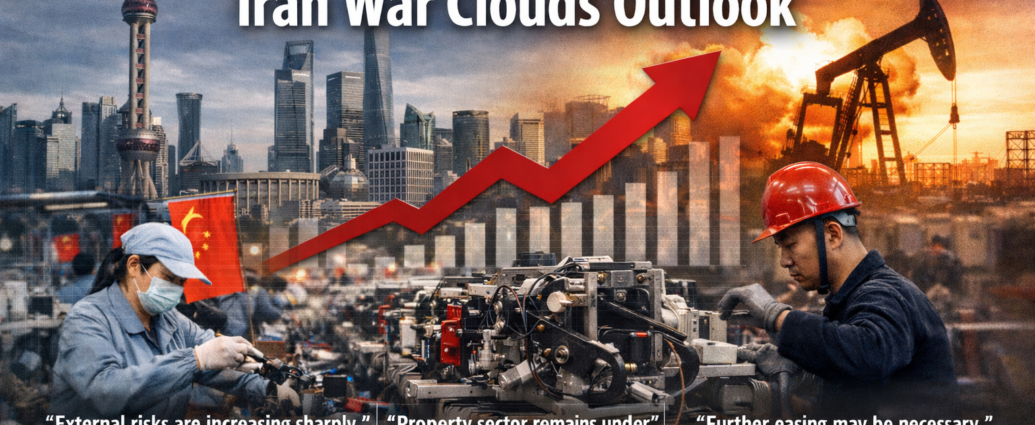
External risks are also rising sharply. Escalating tensions tied to an Iran-related conflict scenario in global markets have pushed oil price volatility higher and raised concerns about supply chain disruptions. Zhiwei Zhang, Chief Economist at Pinpoint Asset Management, warned that “geopolitical tensions in the Middle East could feed into higher energy prices, which would add pressure to China’s manufacturing sector and margins.”
That concern is echoed by global institutions. The International Monetary Fund (IMF) recently noted that while China’s near-term growth is stabilizing, “geopolitical fragmentation and trade disruptions remain key downside risks to global and Chinese growth.” Higher energy costs, in particular, could complicate Beijing’s efforts to support industrial activity while keeping inflation contained.
On the policy front, Chinese authorities signaled readiness to act if conditions deteriorate. The People’s Bank of China (PBOC) has maintained an accommodative stance, and analysts expect further targeted easing. “We anticipate additional fiscal and monetary support in coming months, especially if external shocks intensify,” said Robin Xing, Chief China Economist at Morgan Stanley, pointing to potential reserve requirement ratio (RRR) cuts and expanded infrastructure funding.
Despite meeting its growth benchmark, Beijing faces a narrowing path forward. The combination of a still-weak property sector, fragile private-sector confidence, and rising geopolitical tensions leaves the sustainability of China’s recovery in question.
What comes next will largely depend on whether policymakers can successfully offset external shocks while reigniting domestic demand—a balancing act that is becoming increasingly difficult as global uncertainty deepens.
— JBIZnews Desk –Asia