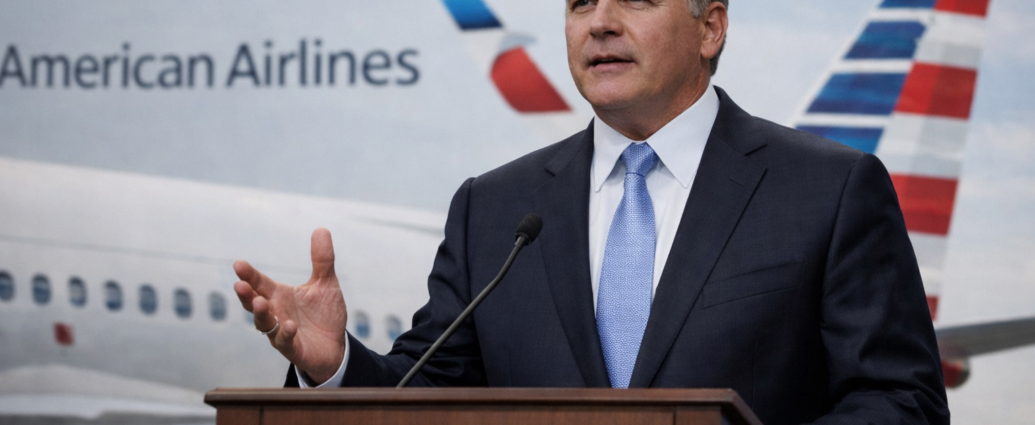
American Airlines is shutting down speculation around a potential industry mega-merger, with CEO Robert Isom making clear the carrier has no interest in combining with United Airlines, reinforcing a strategy centered on independent growth rather than consolidation.
Speaking at a recent industry forum, Robert Isom directly addressed ongoing market chatter, stating, “We are not seeking and are not interested in any merger with United Airlines,” adding that American remains focused on “strengthening our own airline and delivering the best service for our customers.” His remarks come amid renewed investor speculation about further consolidation in the U.S. aviation sector.
The comments arrive at a time when airline mergers remain under heightened regulatory scrutiny. The U.S. Department of Justice, under Assistant Attorney General for Antitrust Jonathan Kanter, has taken an aggressive stance against consolidation, previously blocking high-profile airline partnerships and signaling continued resistance to deals that could reduce competition. “We will continue to challenge mergers that harm consumers and reduce competition,” Kanter has said in prior enforcement statements.
Industry analysts say a merger between American and United would face steep regulatory hurdles, even if both companies were interested. Jamie Baker, airline analyst at JPMorgan, noted, “A deal of that scale would face extraordinary scrutiny given the concentration it would create in key domestic and international routes.” He added that current antitrust enforcement makes such a transaction “highly unlikely in the near term.”
Beyond regulatory barriers, operational and strategic differences between the two carriers also present significant challenges. Helane Becker, managing director and senior airline analyst at TD Cowen, said, “American and United have fundamentally different network strategies and corporate cultures, which would make integration complex and risky.” She emphasized that even discussing such a merger reflects broader investor curiosity rather than realistic deal-making.
Robert Isom reiterated that American Airlines sees substantial opportunity in its current structure, pointing to ongoing investments in fleet modernization, route optimization, and customer experience. “We believe there is significant value in executing on our standalone strategy and competing effectively on our own terms,” Isom said, underscoring management’s confidence in organic growth.
The broader airline industry has undergone waves of consolidation over the past two decades, leaving a handful of dominant carriers controlling the majority of U.S. air traffic. However, recent regulatory actions—including the DOJ’s challenge to the JetBlue-Spirit merger—have signaled a tougher environment for additional large-scale deals.
Scott Kirby, CEO of United Airlines, has similarly indicated a focus on internal growth, previously stating that “United is committed to executing its own long-term strategy rather than pursuing transformational mergers,” reinforcing the view that major U.S. carriers are prioritizing operational performance over consolidation.
From a market perspective, the rejection of merger speculation may help stabilize investor expectations. Savanthi Syth, airline analyst at Raymond James, said, “While consolidation can drive efficiencies, airlines today are more focused on balance sheet strength, profitability, and operational reliability.” She added that investor interest in mergers often spikes during periods of cost pressure or economic uncertainty.
For corporate America and investors, the implications extend beyond aviation. The airline sector has long served as a bellwether for regulatory attitudes toward consolidation across industries. The firm stance from both executives and regulators suggests that, at least for now, large-scale mergers among major U.S. carriers remain off the table.
Looking ahead, Robert Isom’s clear rejection of a United tie-up signals a broader industry posture: growth will come from execution, not expansion through mergers. As regulatory pressure remains high and operational complexity increases, airlines appear to be doubling down on internal performance rather than pursuing transformative deals.
—JBizNews Desk