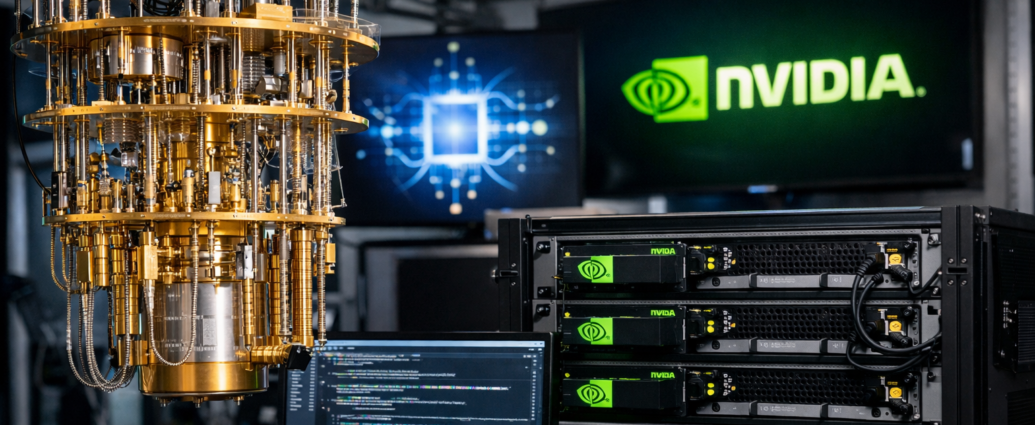
Nvidia’s accelerating push into quantum computing has minted a new billionaire almost overnight, underscoring how aggressively capital is flowing into next-generation computing as the AI boom expands beyond classical chips. The surge follows Nvidia’s high-profile partnership and investment activity tied to emerging quantum hardware and software platforms, triggering a sharp revaluation of a once-niche startup—and instantly elevating its CEO into the ranks of the ultra-wealthy.
At the center of the rally is Rigetti Computing CEO Chad Rigetti, whose company—long viewed as a speculative quantum player—saw its valuation skyrocket after aligning more closely with Nvidia’s ecosystem. Shares of quantum-related firms broadly surged following Nvidia’s latest announcements around hybrid quantum-classical computing, with Rigetti among the biggest beneficiaries. According to market estimates, the spike added hundreds of millions to Rigetti’s personal stake within days, pushing his net worth past the billion-dollar mark.
The catalyst came as Nvidia CEO Jensen Huang doubled down on the company’s vision of “quantum-accelerated supercomputing,” positioning quantum systems not as replacements for classical computing, but as powerful extensions. “Quantum computing will work alongside GPUs to solve some of the world’s hardest problems,” Huang said during Nvidia’s recent developer conference, emphasizing applications ranging from drug discovery to advanced materials and complex optimization problems.
That framing has been critical for investors. Rather than waiting decades for standalone quantum breakthroughs, Nvidia is effectively commercializing the bridge—integrating quantum simulators and hardware pipelines into its dominant CUDA ecosystem. This gives companies like Rigetti immediate relevance, even as true fault-tolerant quantum systems remain years away.
The market reaction was swift. Quantum computing stocks—including IonQ and D-Wave Quantum—also rallied sharply, but Rigetti stood out due to its closer positioning within Nvidia’s expanding developer and enterprise stack. Analysts say Nvidia’s endorsement acts as a powerful validation signal in a sector long plagued by skepticism.
“Nvidia entering this space in a serious way compresses the timeline for commercial viability—at least from an investor perception standpoint,” said Gil Luria, senior technology analyst at D.A. Davidson. “It brings credibility, tooling, and most importantly, customers.”
For Rigetti, the timing is significant. The company has spent years developing superconducting quantum processors while navigating funding challenges and volatile public markets. Nvidia’s involvement now offers a potential distribution advantage—plugging Rigetti’s capabilities into a global network of developers already building on Nvidia hardware.
Beyond individual companies, the development reflects a broader capital rotation into frontier technologies adjacent to AI. With traditional semiconductor valuations already stretched, institutional investors are increasingly looking toward quantum computing as the next asymmetric opportunity—high risk, but potentially transformative.
“We’re seeing the early stages of a quantum investment cycle similar to what AI experienced a decade ago,” said Darío Gil, Senior Vice President and Director of Research at IBM. “The difference now is that the ecosystem—from software to hardware to cloud integration—is forming much faster.”
Still, significant hurdles remain. Quantum systems today are highly sensitive, expensive, and limited in practical use cases. Most commercial deployments rely on hybrid models, where classical systems handle the bulk of computation while quantum processors tackle highly specific tasks.
That’s precisely where Nvidia is placing its bet.
By positioning its GPUs as the backbone of hybrid quantum workflows, Nvidia ensures it remains central regardless of how quickly pure quantum computing matures. Its CUDA-Q platform, designed to integrate quantum algorithms with classical processing, is already being adopted by research institutions and enterprise developers exploring early-stage applications.
For investors, the implications are clear: Nvidia is not just defending its dominance in AI—it is expanding it into the next computing frontier.
The billionaire-making surge tied to Rigetti may ultimately prove volatile—quantum stocks are known for dramatic swings—but it signals something deeper. Capital is no longer waiting on the sidelines for quantum breakthroughs. It is pricing in the infrastructure, partnerships, and ecosystems forming today.
And Nvidia is once again at the center of that shift.
Looking ahead, the key question for markets is not whether quantum computing will matter—but how quickly it integrates into existing AI and enterprise systems. With Nvidia driving that convergence, the timeline may be accelerating faster than expected.
JBizNews Desk