Aziz Sunderji, housing economist and founder of data visualization consultancy Home Economics, also provided data and analysis for this report.
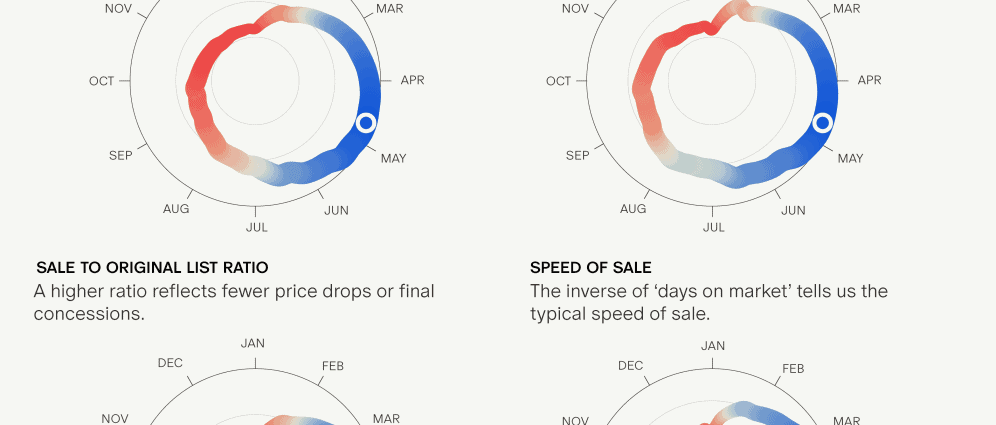
- Late April is a sweet spot for sellers; nationwide, homes listed during that period have the highest chance of selling fast and fetching more than the asking price. This is from a Redfin and Home Economics analysis.
- Real estate is local. On the West Coast, March is typically the best time to put a home on the market; on the East Coast, May tends to be best.
- The best time to sell varies by region, but the swings are bigger in some parts of the U.S. than others. Places with mild weather and more supply are generally less seasonal. Places with more extreme weather or tight supply are more seasonal.
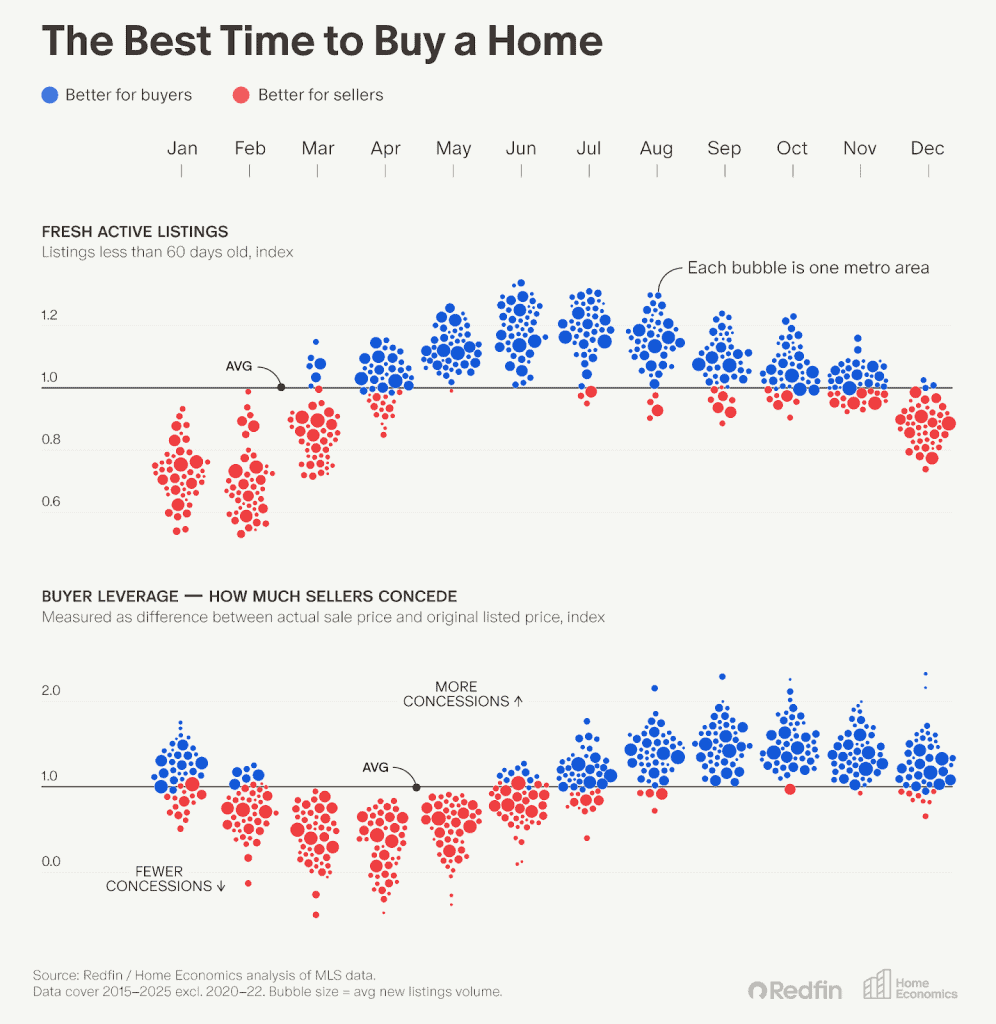
- The picture is more complex for buyers: House hunters have the most homes to choose from in late April, but they get the best deals in July.
The best time to list a U.S. home for sale is the end of April. Sellers are most likely to sell their home above the asking price, and to sell a home quickly, when they list during that period.
The advantages of listing in late April:
Sellers get stronger offers
- They’re more likely to sell above the asking price. Homes listed at the end of April are 18% more likely to sell above their original asking price than the rest of the year–the highest likelihood of all 52 weeks.
- Prices are higher. The median home-sale price is 4% higher for homes listed at the end of April than the yearly average sale price, the biggest premium of the year. That’s because there are more buyers and more competition—and also partly because better homes tend to be listed in the spring.
Homes sell faster
- They’re more likely to sell within 2 weeks. Homes are 17% more likely to sell in two weeks at the end of April than the yearly average, also the highest likelihood of the year.
- They spend less time on the market. Homes listed in late April spend about 9% fewer days on market than the yearly average.
Sellers face less competition
- There are fewer homes for buyers to choose from. Sellers face less competition at the end of April than later in the spring or over the summer. There are typically 8% fewer homes for sale at the end of April than the peak reached in late summer. As spring goes on, the total number of homes for sale increases, peaking in the summer, giving buyers more choices and upping competition among sellers.
This is according to a Redfin and Home Economics analysis of housing market data. Please see the end of this report for more on methodology
“Late April hits a sweet spot for home sellers: buyers are out in force, but the market isn’t yet flooded with competing listings,” said Aziz Sunderji, housing economist and founder of data visualization consultancy Home Economics. “For sellers, timing can meaningfully shape the outcome of their home sale. Listing in that late-April window can help generate stronger early interest and create the kind of competition that leads to faster sales and better terms. Sellers who list earlier in the spring may miss peak demand, while those who wait until later risk getting lost in a growing pool of listings. If you’re preparing to sell, it’s worth aligning your timeline—pricing, staging, and marketing—so you’re ready to hit the market during this brief but advantageous window.”
Sellers should keep in mind that this analysis identifies the best time to list their home based on general trends, and assumes a stable market. The best time could shift to a different period in a year when the market experiences dramatic, unexpected shifts.
Additionally, the best time to sell a home is different for different people. Selling (or buying) a home is typically the biggest financial decision people make in their lives, and personal factors matter in terms of timing. For someone who is offered their dream job in another state in September, for instance, listing their home in the fall probably makes more sense than listing in April.
It’s also worth noting that most home sellers are also buyers. That means many sellers factor in the best time to buy when deciding when to sell. They may want to sell earlier in the season rather than later, so they have more time to find their next home. For more on the best time to buy, see the last section of this report.
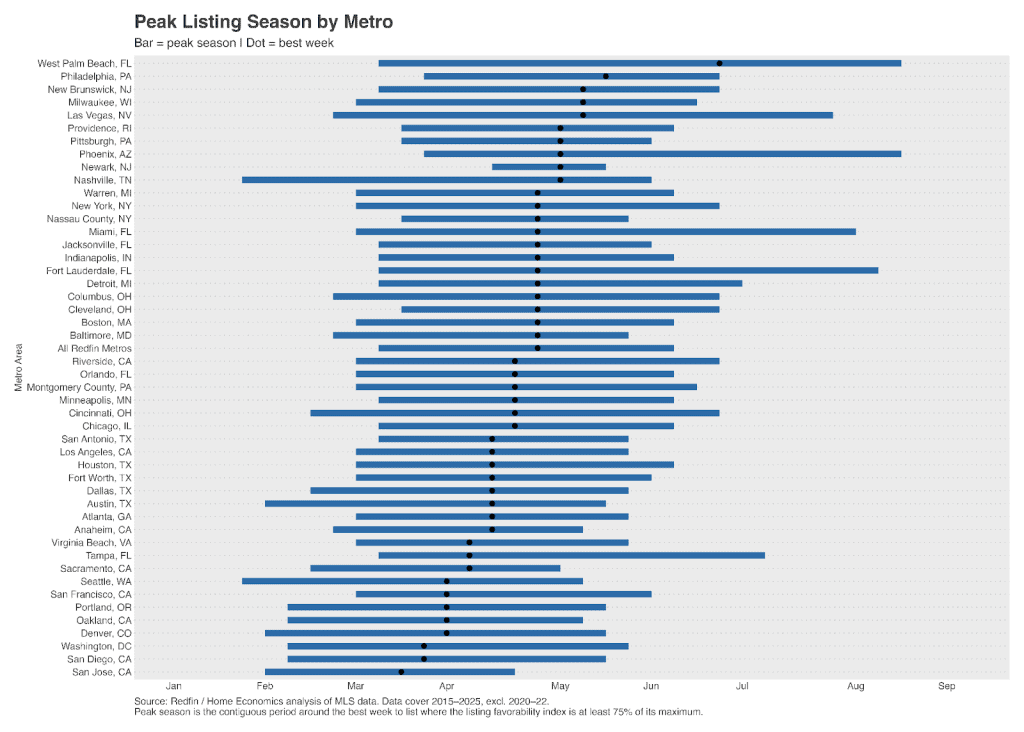
In California, the Best Time to List Is Before Spring Even Starts. In Parts of the East Coast, It’s Just Before Memorial Day.
The best time to list a home for sale varies from metro to metro. Generally, the optimal time to list is earlier on the West Coast and in Texas, and later in the Northeast and the Rust Belt. This is based on the same metrics we used to calculate the national best time to list: The time of year when sellers have the best chance of selling their home faster and for more money.
Places where the prime time to sell is March:
-
- San Jose, CA: Middle of March
- San Diego and Washington, D.C.: Mid-to-late March
- Seattle, San Francisco, Portland, OR, Oakland, CA and Denver: Late March
Places where the prime time to sell is May or June:
-
- West Palm Beach, FL: Mid-to-late June
- Philadelphia: Middle of May
- Las Vegas, Milwaukee and New Brunswick, NJ: Beginning of May
Real estate is local. In places like California and Texas, the spring market tends to kick off earlier thanks to milder weather and a longer home-shopping season, so sellers who list in March are better positioned to capture motivated buyers before competition builds. Markets in the Northeast often heat up later in the year, when the snow has melted and warmer days are bringing house hunters out of hibernation.
“The best week to list isn’t one-size-fits-all. Sellers should think locally,” Sunderji said. “Pay attention to when inventory typically ramps up, and when local buyers are most active. Listing just ahead of that surge—whether that’s March in Silicon Valley or May in Milwaukee—can help your home stand out, attract more serious buyers, and sell quickly for the price you want.”
Timing Matters—But It Matters More in Some Parts of the Country Than Others
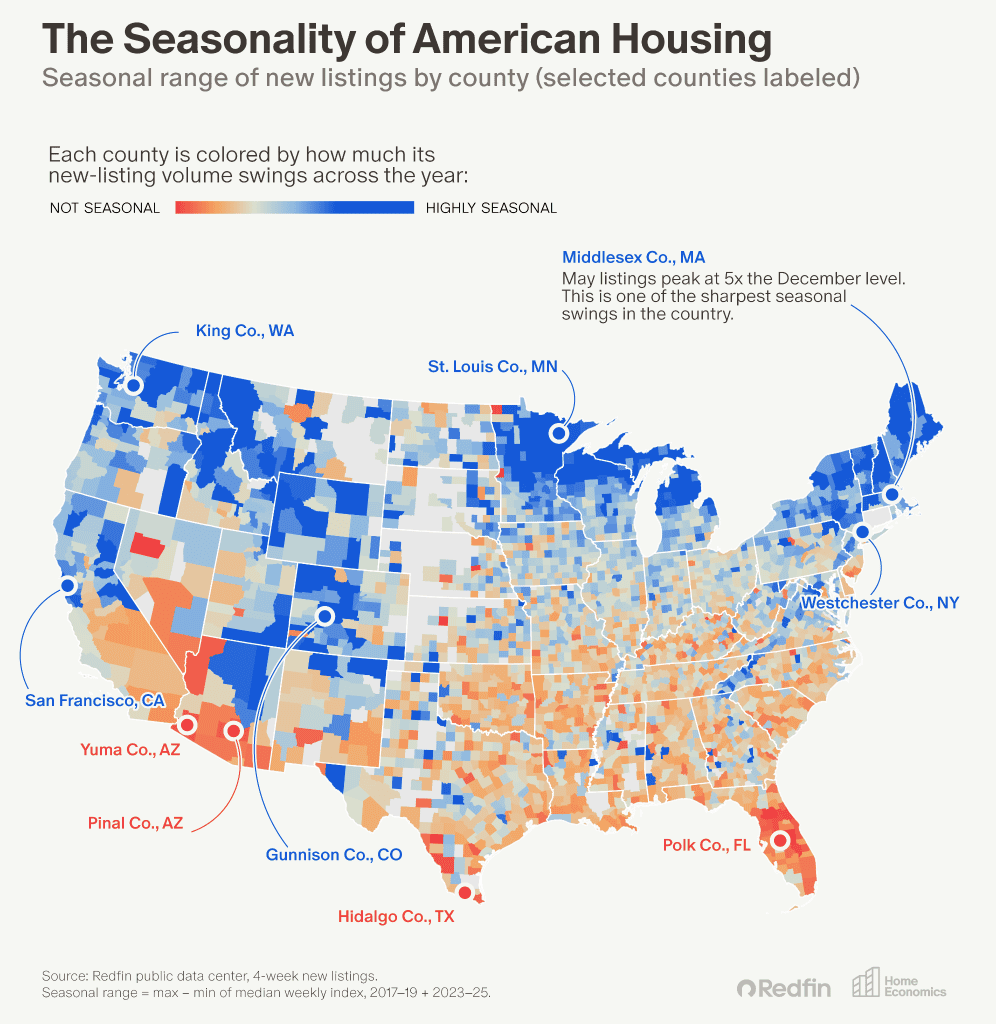
The best time to sell a home—and buy a home—varies from metro to metro, but the swings are bigger in some parts of the U.S. than others. In the southern part of the country, where weather tends to be warmer, the swing in how many new listings hit the market by season is fairly small. In the northern part of the country, which has more extreme weather, the swing in new listings is bigger. Another important factor is supply: Highly populated areas with limited supply tend to be more seasonal.
The metros with the least seasonal housing markets, i.e. where the seasonal swing in listings is smaller, are in Florida. Tampa is the least seasonal of all. Next come Fort Lauderdale, Miami, West Palm Beach and Orlando . The next two are also located in places with warm weather throughout the year: Phoenix and Las Vegas.
On the other end of the spectrum, the places with the most seasonal metros are either in colder climates or they’re in the Bay Area. San Francisco has the most seasonal market in the nation. Next come Boston, Seattle, San Jose, CA and Minneapolis.
“The fact that the Bay Area has the most seasonal housing market shows that seasonality isn’t just about weather–it’s also about supply,” said Asad Khan, a senior economist at Redfin. “In places like San Francisco and San Jose, where there are a lot of house hunters and limited inventory, timing matters a lot. It becomes a bit like musical chairs: Sellers want to list when they’ll have the best chance of finding their next home, so everyone converges during the same window. In places with more inventory, like Detroit or Columbus, OH, buyers can be more flexible, which gives sellers more flexibility, too, dampening those seasonal swings even though the winters are colder.”
Buyers Get More Choices Earlier in the Year, But Better Deals Later
The picture is more complex for homebuyers. Buyers need to balance choice and competition. More inventory to choose from improves the chance of finding the home that’s right for them. But competition creates more urgency and requires stronger offers to win a home.
To capture this tradeoff, we identify three key moments for homebuyers:
- Most new listings. The flow of new listings of homes for sale typically peaks in late spring and continues through early summer. This is when picky buyers are most likely to see the widest selection of listings right when they hit the market.
- Most inventory. The bullet point above is about brand-new listings; this one is about “fresh” listings–those that have been on the market for no more than 60 days. The number of fresh listings typically peaks in mid-summer. This is when flexible buyers with more time have the biggest selection to choose from.
- Best deals. Discounts off a home’s original asking price—through price drops and/or negotiations between buyer and seller—grow in late summer and peak in early fall. But discounts typically plateau or shrink heading into winter, even as inventory declines. This moment captures the last point when both choice and discounts are working in the buyer’s favor. Winter isn’t an ideal time for bargain hunters because by the time it rolls around, sellers may be more likely to wait for spring’s new buyers than make concessions.
“The right time to purchase a home depends on a buyer’s flexibility,” Khan said. “New listings peak in late spring, but that’s also when competition between buyers is most intense. House hunters should shop earlier if time is tight and finding the right home in the right location is the top priority. But for more flexible buyers, inventory will grow until mid-summer. Buyers also have more negotiating power heading into the fall, and while inventory is somewhat picked over, there are still quite a few homes to choose from. For many buyers, the sweet spot may be somewhere in between.”
| Best Time to Buy a Home, Metro-Level Summary
Please note that this table includes 3 key moments for buyers; it’s important for buyers to balance what’s most important for them–choice or price |
|||
| Most New Listings | Most Fresh Inventory | Best Deals | |
| Anaheim, CA | Mid May | Late June | Late August |
| Atlanta, GA | Mid May | Mid July | Early September |
| Austin, TX | Mid May | Early July | Late August |
| Baltimore, MD | Early May | Early June | Mid September |
| Boston, MA | Mid May | Mid July | Early October |
| Chicago, IL | Mid May | Early June | Early October |
| Cincinnati, OH | Mid May | Mid July | Mid October |
| Cleveland, OH | Mid May | Mid July | Late October |
| Columbus, OH | Late June | Mid July | Mid October |
| Dallas, TX | Late June | Early August | Mid September |
| Denver, CO | Mid May | Mid July | Early September |
| Detroit, MI | Early August | Early September | Mid December |
| Fort Lauderdale, FL | Early February | Late March | Mid December |
| Fort Worth, TX | Late June | Mid August | Mid September |
| Houston, TX | Late May | Mid July | Late September |
| Indianapolis, IN | Mid May | Mid July | Mid October |
| Jacksonville, FL | Early May | Mid May | Mid September |
| Las Vegas, NV | Late May | Mid June | Late September |
| Los Angeles, CA | Mid May | Mid July | Mid September |
| Miami, FL | Early February | Late March | Mid December |
| Milwaukee, WI | Mid May | Mid July | Early November |
| Minneapolis, MN | Mid May | Mid July | Early October |
| Montgomery County, PA | Mid May | Early June | Mid October |
| Nashville, TN | Mid May | Mid July | Mid September |
| Nassau County, NY | Mid May | Late June | Late August |
| New Brunswick, NJ | Mid May | Early June | Early October |
| New York, NY | Mid May | Early June | Mid August |
| Newark, NJ | Mid May | Early June | Late August |
| Oakland, CA | Mid May | Mid July | Late August |
| Orlando, FL | Early May | Mid July | Early October |
| Philadelphia, PA | Mid May | Early June | Mid October |
| Phoenix, AZ | Late March | Early April | Late October |
| Pittsburgh, PA | Mid May | Early July | Mid October |
| Portland, OR | Mid May | Mid July | Late August |
| Providence, RI | Mid May | Late June | Mid October |
| Riverside, CA | Mid May | Mid June | Early November |
| Sacramento, CA | Mid May | Mid July | Late August |
| San Antonio, TX | Late May | Mid July | Mid September |
| San Diego, CA | Mid May | Mid July | Mid September |
| San Francisco, CA | Late September | Late October | Late September |
| San Jose, CA | Mid May | Early June | Late August |
| Seattle, WA | Mid May | Mid July | Early September |
| Tampa, FL | Late March | Early April | Early November |
| Virginia Beach, VA | Early May | Mid June | Mid October |
| Warren, MI | Mid May | Late August | Late October |
| Washington, DC | Early May | Early June | Late September |
| West Palm Beach, FL | Early February | Late March | Mid December |
Here’s a video from Daryl Fairweather, Redfin’s chief economist:
Methodology
This is according to a Redfin and Home Economics analysis of housing market data.
- We created a seasonal index for each week within a given year and region by dividing the weekly value of each metric by that year’s annual average. For median sale prices, the seasonal index was computed on a series detrended using OLS.
- We then average the seasonal index for each week-of-year between 2015-2019 and 2023-2025; we excluded 2020-2022 because the pandemic skewed seasonal effects during that time.
- For the seasonality map, we measured the seasonal range of new listings by county as the difference between the maximum and minimum of the seasonal index for new listings.
- To identify the best time to list, we normalize four seller-relevant metrics (share sold in 2 weeks, share sold above list, days on market, sale-to-original-list ratio) to 0–1 within each metro and average them into a single composite score per week. The peak of this composite is the “best week to list” for that metro.
- To identify the best time to buy, we focus on the seasonal indexes for three metrics: new listings, fresh inventory, and the average discount.
- Most new listings: the week when the flow of new listings is greatest relative to the annual average.
- Most fresh inventory: the week the stock of active listings with 60 days or less on market is greatest relative to the annual average.
- Best deals: To identify the period with the “best deals” we identify the moment when the average discount (original list price divided by final sale price) reaches an “inflection point,” meaning it slows or shrinks heading into late fall or winter. We characterize this moment as reflecting the best deals since buyers typically have ample inventory to choose from while discounts approach a local maximum. To identify these moments, we first fit a smoothed curve to the average discount seasonal index for each region to remove week-to-week noise. Starting from the spring trough—the week when homes sell closest to (or above) their list price—we find the week of maximum slope, representing the period of fastest improvement in the average discount. We then identify the first subsequent week where the slope falls below 10% of that maximum, marking the point where average discounts have largely plateaued. For metros where the slope never drops below this threshold (i.e., discounts continue to grow aggressively through year-end), we use the week of the overall peak discount instead.
The post Late April Is the Best Time to List a Home For Sale appeared first on Redfin Real Estate News.