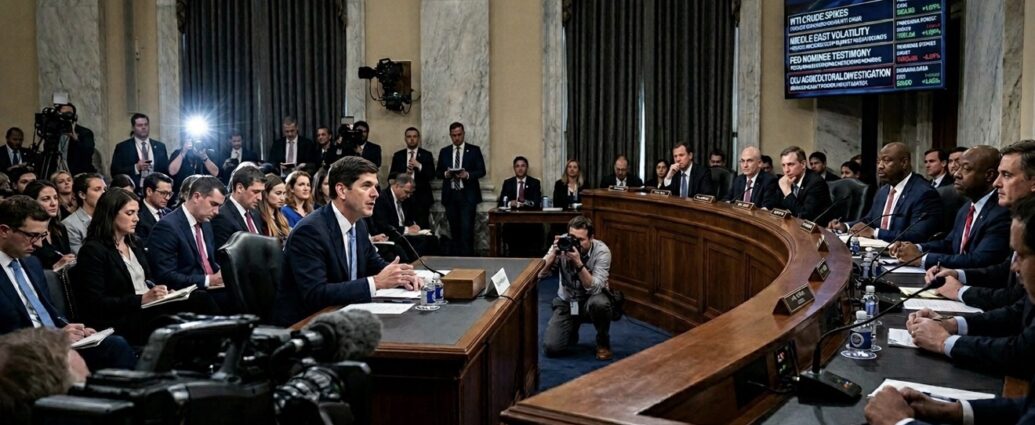
WASHINGTON — The Senate Banking Committee on Tuesday pressed Kevin Warsh, President Trump’s nominee to lead the Federal Reserve, in a closely watched confirmation hearing unfolding against a backdrop of rising geopolitical tensions and market volatility. Opening the session, Senator Tim Scott (R-S.C.) said the next Fed chair must restore price stability while sustaining growth. “The stakes are extremely high given current conditions,” said Michael Gapen, Chief U.S. Economist at Bank of America, noting that leadership at the Fed is now directly tied to market confidence.
Democrats raised immediate concerns over independence, with Senator Elizabeth Warren (D-MA) warning against political pressure on monetary policy. Warsh, a former Fed governor, told lawmakers he would “act in the long-term interest of the economy.” “Markets are looking for reassurance that the Fed won’t become politicized,” said Krishna Guha, Vice Chairman at Evercore ISI, adding that credibility remains the institution’s most valuable asset.
Lawmakers also focused on Warsh’s policy stance as he seeks to replace Jerome Powell when his term ends in May. While historically viewed as a hawk, Warsh has recently signaled flexibility in responding to changing conditions. “There’s a balancing act here between maintaining discipline and adapting to new risks,” said Diane Swonk, Chief Economist at KPMG, pointing to the complexity of the current macro environment.
At the same time, markets were reacting to developments outside Washington. WTI crude hovered near $87 a barrel, reflecting ongoing tensions in the Middle East and concerns about supply disruptions. “Energy is once again driving the inflation narrative,” said Helima Croft, Head of Global Commodity Strategy at RBC Capital Markets, noting that oil prices are becoming a key variable for central bank policy.
Treasury markets signaled caution, with the 10-year yield holding around 4.28% as investors reassessed inflation risks. “Bond markets are telling you that uncertainty is still elevated,” said Priya Misra, Portfolio Manager at JPMorgan Asset Management, highlighting that yields remain sensitive to both geopolitical developments and Fed expectations.
Equities showed resilience despite the backdrop, with the S&P 500 edging higher during midday trading. Gains were led by defense and energy stocks, sectors seen as beneficiaries of prolonged geopolitical tension. “There’s a clear rotation into areas tied to global risk,” said Art Hogan, Chief Market Strategist at B. Riley Wealth, noting that investors are repositioning portfolios accordingly.
Warsh’s financial disclosures also came under scrutiny, with lawmakers questioning potential conflicts of interest tied to his past roles in the financial sector. Warsh said he would comply fully with ethics requirements, including divestments where necessary. “Transparency will be critical to securing confirmation,” said Sarah Binder, Senior Fellow at the Brookings Institution, who specializes in congressional oversight and Fed governance.
For policymakers, the broader challenge is navigating an economic landscape increasingly shaped by external shocks. Warsh acknowledged that global developments are playing a larger role in shaping domestic outcomes. “The Fed is no longer operating in a purely domestic framework,” said Eswar Prasad, Professor of Economics at Cornell University, emphasizing the growing influence of geopolitics on monetary policy.
The confirmation process is expected to continue through the week, with additional questioning likely to focus on interest rates, financial regulation, and labor market conditions. Investors are watching closely for signals on how Warsh would approach policy in the near term. “The market wants clarity, not just on rates but on reaction function,” said Matthew Luzzetti, Chief U.S. Economist at Deutsche Bank, referring to how the Fed responds to incoming data.
Looking ahead, Warsh faces the challenge of convincing both lawmakers and markets that he can lead the Federal Reserve through a period of heightened uncertainty. With inflation risks, geopolitical pressures, and policy expectations all converging, the outcome of the confirmation process could have far-reaching implications. “This is about more than one nomination—it’s about the future direction of U.S. monetary policy,” said Jan Hatzius, Chief Economist at Goldman Sachs.
JBizNews Desk