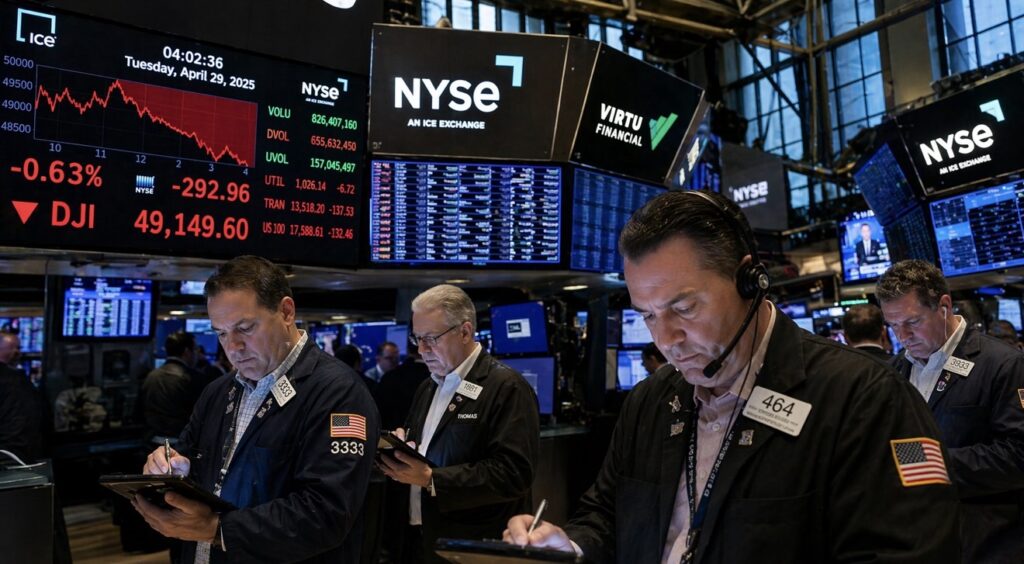
U.S. equity markets closed sharply lower Tuesday as investors reacted to escalating geopolitical risk, mounting uncertainty around Federal Reserve leadership, and a major corporate transition at Apple. The S&P 500 fell 0.63% to 7,064.02, the Dow Jones Industrial Average dropped 292.96 points to 49,149.60, and the Nasdaq Composite declined 0.59% to 24,259.97, while the Russell 2000 slid 1.16% to 2,760.47. The CBOE Volatility Index (VIX) surged 9.75% to 20.71, signaling heightened hedging activity. “The market is repricing geopolitical risk in real time,” said Art Hogan, Chief Market Strategist at B. Riley Financial.
The primary driver of the selloff was the deteriorating outlook for U.S.-Iran ceasefire negotiations ahead of a critical deadline. Iranian Foreign Ministry spokesperson Esmaeil Baghaei said Tehran’s hesitation stems from “contradictory messages, contradictory behaviors, and unacceptable actions by the American side,” according to statements carried by Iranian state media. Meanwhile, Pakistan Information Minister Attaullah Tarar said “a formal response from the Iranian side… is still awaited,” underscoring uncertainty around the planned talks in Islamabad.
At the White House, senior officials moved into emergency discussions as the timeline narrowed. President Donald J. Trump said it is “highly unlikely” he would extend the ceasefire, adding he expects “to be bombing” if no agreement is reached—remarks that intensified market anxiety. Oil prices surged in response, with U.S. crude rising 5.00% to $91.79 per barrel, reflecting fears over continued closure of the Strait of Hormuz. “Energy markets are reacting directly to the risk of supply disruption,” said Helima Croft, Global Head of Commodity Strategy at RBC Capital Markets.
Simultaneously, investors tracked a contentious confirmation hearing on Capitol Hill for Kevin Warsh, nominated to serve as Chair of the Federal Reserve. Testifying before the Senate Banking Committee, Warsh stressed that “central bank independence is essential,” as lawmakers pressed him on the implications of a Justice Department investigation into current Fed Chair Jerome Powell. “The economy’s potential is growing quite quickly,” Warsh added, pointing to artificial intelligence-driven productivity gains as a factor that could support lower rates.
The hearing quickly turned confrontational. Sen. Elizabeth Warren (D-Mass.) warned that the investigation into Powell is “designed to threaten all the members of the Fed to do Trump’s bidding,” while Sen. Thom Tillis (R-N.C.) stated, “Let’s get rid of this investigation, so I can support your confirmation.” With Powell’s term nearing its end on May 15, the unresolved probe leaves the nomination timeline uncertain and injects further instability into monetary policy expectations.
Adding to the day’s pressure, Apple (AAPL) shares fell 2.7% after the company announced a sweeping leadership transition. In an official statement, Apple confirmed that Tim Cook will become Executive Chairman, with John Ternus, Senior Vice President of Hardware Engineering, stepping in as CEO effective September 1, 2026. “It has been the greatest privilege of my life to be the CEO of Apple,” Cook said in the release.
Apple’s board emphasized continuity but acknowledged the magnitude of the shift. Arthur Levinson, Apple’s Chairman, said Cook’s “integrity and values are infused into everything Apple does,” while incoming CEO John Ternus said he is “humbled to step into this role,” pledging to uphold the company’s long-standing principles. “Leadership transitions at this scale inevitably introduce uncertainty in the near term,” said Dan Ives, Managing Director at Wedbush Securities.
By the closing bell, markets were contending with three converging risks: a potential breakdown in Middle East diplomacy, uncertainty at the Federal Reserve’s highest levels, and leadership change at one of the world’s most influential companies. “When geopolitical, policy, and corporate risks align, markets tend to de-risk quickly,” said Mark Haefele, Chief Investment Officer at UBS Global Wealth Management.
With the ceasefire deadline approaching and no confirmed diplomatic breakthrough, traders are bracing for near-term volatility. The next catalyst could arrive within hours—either a last-minute agreement that stabilizes energy markets or an escalation that further disrupts global risk sentiment heading into the next phase of earnings season.
JBizNews Desk