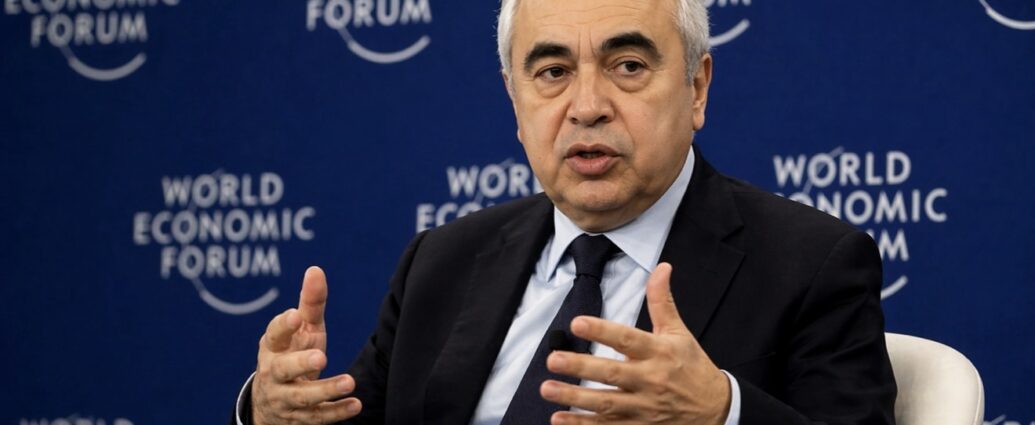
LONDON — Fatih Birol, Executive Director of the International Energy Agency (IEA), issued one of his starkest warnings yet on the global economic fallout from war, cautioning that the current disruption to energy and commodity flows could surpass the combined impact of the 1970s oil crises and the 2022 supply shock.
Speaking in an interview with Le Figaro, Birol said he is “very pessimistic,” describing the conflict as blocking “one of the arteries of the world economy.” He emphasized that the disruption extends far beyond crude oil and natural gas, reaching into fertilizers, petrochemicals, helium, and other critical industrial inputs that underpin global production.
“If we look at the three major oil and gas crises of the past, the current crisis is more serious than those of 1973, 1979, and 2022 combined,” Birol told Le Figaro, framing the moment as a compound shock rather than a traditional commodity cycle. The IEA, created in the aftermath of the 1973 oil embargo and now advising major consuming nations, has repeatedly warned in its market reports that geopolitical disruptions can ripple simultaneously across transport, manufacturing, and food systems.
The warning comes as policymakers and investors navigate an already fragile energy landscape. In recent IEA assessments, Birol has stressed that supply risks remain elevated even when global inventories appear stable. “We are facing a major energy shock that combines an oil shock, a gas shock, and a food shock,” he said, underscoring how tightening across fuel and feedstock markets can cascade into logistics, chemicals, consumer goods, and heavy industry.
Multilateral institutions have echoed similar concerns. Kristalina Georgieva, Managing Director of the International Monetary Fund (IMF), has warned in recent outlooks that geopolitical commodity shocks can “raise inflation and lower growth,” while Indermit Gill, Chief Economist of the World Bank, has cautioned in commodity market updates that energy price spikes often spill into food costs through fertilizer and transport channels. Those assessments align with Birol’s warning that the current disruption extends well beyond hydrocarbons.
The comparison to the oil crises of 1973 and 1979 carries particular weight. Those events reshaped global energy policy and led to the creation of the IEA itself. By invoking those periods, Birol signaled that today’s challenges may require more than short-term intervention, especially as governments confront simultaneous pressure on household energy bills, industrial competitiveness, and food affordability.
European officials have also flagged structural vulnerabilities. Ursula von der Leyen, President of the European Commission, has repeatedly warned that reliance on external energy supply routes exposes the bloc to “price volatility and supply disruptions,” while Kadri Simson, European Commissioner for Energy, has emphasized the need to diversify supply and strengthen resilience. In the United States, Joe DeCarolis, Administrator of the U.S. Energy Information Administration (EIA), has noted in market commentary that geopolitical outages can tighten both crude and refined product markets even when global production appears resilient.
For companies, the issue is no longer just price—it is predictability. Analysts including Dariusz Kowalczyk, Senior Economist at Crédit Agricole CIB, have pointed out in public research that fertilizer shortages can hit crop yields, while petrochemical constraints can feed into packaging, plastics, and industrial materials. Birol’s description of the conflict as a blockage in a core economic artery reflects how disruptions in one commodity corridor can quickly translate into margin pressure across sectors.
The crisis also raises urgent questions about how quickly governments can diversify supply and accelerate alternatives. The IEA has argued in multiple reports that long-term energy security depends on a broader mix of domestic generation, infrastructure investment, and efficiency gains. Birol has frequently said that clean energy investment can strengthen security as well as reduce emissions, but his latest remarks suggest near-term volatility may intensify before structural solutions take hold.
For central banks and policymakers, the stakes are rising. Jerome Powell, Chair of the U.S. Federal Reserve, has warned that energy-driven inflation can complicate monetary policy decisions, while Christine Lagarde, President of the European Central Bank, has highlighted the risk that supply shocks could keep inflation elevated even as growth slows. That dynamic reinforces Birol’s central message: the world is not facing a routine price spike but a multi-dimensional supply disruption.
As Birol told Le Figaro, the current crisis represents more than an energy challenge—it is a systemic shock that could reshape global energy strategy, industrial costs, and food markets well beyond the immediate conflict.
JBizNews Desk- London