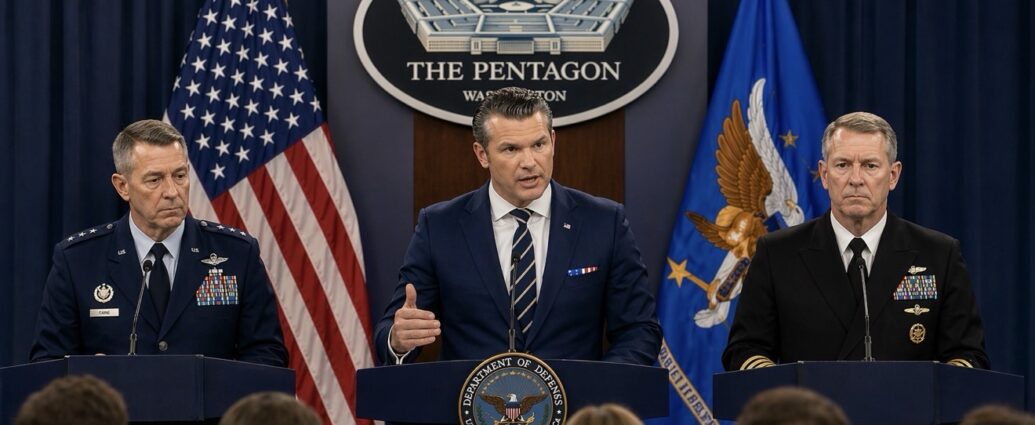
WASHINGTON, April 22, 2026 — Defense Secretary Pete Hegseth delivered a blunt warning to Iran’s leadership Thursday, saying Tehran faces a narrowing window to strike a deal with the United States or risk sustained military and economic escalation, as Washington intensifies pressure across multiple fronts.
Speaking alongside Chairman of the Joint Chiefs Gen. Dan Caine and U.S. Central Command Commander Adm. Brad Cooper, Hegseth framed the confrontation as fundamentally asymmetric. “This is not a fair fight,” Hegseth said, directing his remarks at Iran’s Islamic Revolutionary Guard Corps and Supreme Leader Ayatollah Ali Khamenei. “While you are digging out of bombed-out and devastated facilities, we are only getting stronger.”
Hegseth said U.S. forces are actively rebuilding capacity during the ceasefire period, emphasizing both military readiness and intelligence advantages. “We are reloading with more power than ever before and better intelligence,” he said. “We are locked and loaded on your critical dual-use infrastructure, on your remaining power generation and on your energy industry.”
Strait of Hormuz at Center of Standoff
The Pentagon’s message extended directly to Iran’s posture in the Strait of Hormuz, a vital global shipping lane that carries roughly 20% of the world’s oil supply. Rejecting Tehran’s claims of control, Hegseth characterized Iranian threats against commercial vessels as unlawful. “You can’t control anything,” he said. “Threatening commercial ships in international waters—that’s not control, that’s piracy. That’s terrorism.”
Hegseth added that U.S. enforcement operations remain limited in scope relative to overall American capability. “We’re doing this with less than 10% of our naval power,” he said, contrasting it with what he described as Iran’s diminished maritime capacity.
“Operation Economic Fury” Targets Tehran
Beyond military measures, the administration is moving to intensify financial pressure. Hegseth confirmed that Treasury Secretary Scott Bessent is launching “Operation Economic Fury,” a coordinated effort to tighten sanctions and restrict Iran’s economic activity across global markets.
The strategy signals a synchronized campaign combining naval enforcement, sanctions pressure, and diplomatic negotiations aimed at forcing Tehran back to the table under constrained conditions.
Ultimatum: Deal or Escalation
Hegseth framed the U.S. position as a binary choice for Iran. “Your energy is not moving and will not move—but it’s not destroyed yet,” he said, outlining what he described as a “golden bridge” toward economic recovery if Iran agrees to terms.
At the same time, he reiterated a hardline stance on Iran’s nuclear ambitions. “At the direction of President Trump, the War Department will ensure that Iran never has a nuclear weapon—never,” Hegseth said. “We’d prefer to do it the nice way… or we can do it the hard way.”
China Concerns Addressed
Responding to reports that China could supply weapons to Iran during the ceasefire, Hegseth said the administration has received direct assurances from Beijing. He pointed to President Donald Trump’s relationship with Chinese President Xi Jinping, stating that China has indicated such transfers “are not going to happen.”
Global Economic Stakes Rising
Hegseth acknowledged the broader economic implications of the standoff, particularly for global energy markets. While noting that the U.S. is less dependent on oil flowing through Hormuz, he highlighted the exposure of key allies. “Asia does, Europe does, and much of the rest of the world does,” he said, adding pointedly that when tensions escalated, “our allies weren’t there.”
The remarks underscore growing concern that prolonged disruption in the region could fuel inflation, strain supply chains, and weigh on global growth — particularly in energy-importing economies.
Talks Resume Next Week
Diplomatic efforts are continuing in parallel. A new round of negotiations led by Vice President JD Vance, Special Envoy Steve Witkoff, and Jared Kushner is expected to resume Tuesday in Islamabad, a meeting viewed by markets as a critical near-term catalyst.
With military pressure mounting and economic constraints tightening, the coming days are likely to determine whether the crisis moves toward de-escalation — or a deeper global shock.
— JBizNews Desk -Washington D.C.