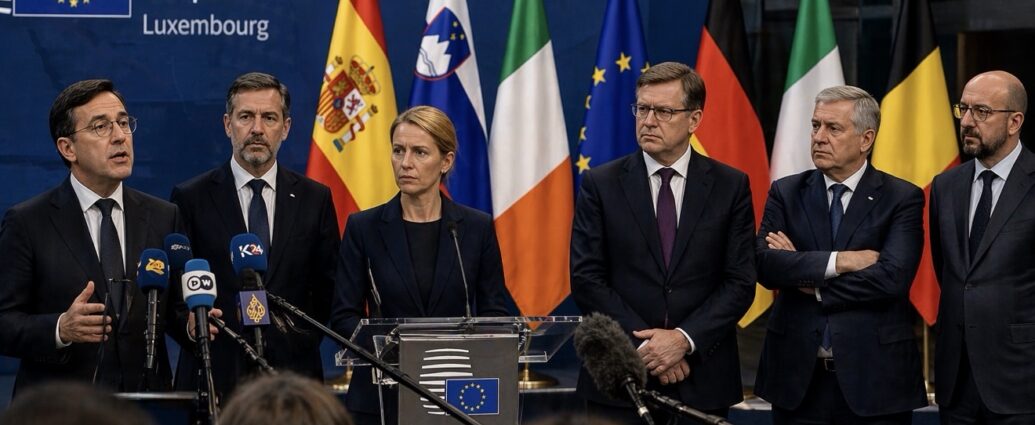
LUXEMBOURG, April 22, 2026 — A sharp divide emerged within the European Union on Tuesday as Germany and Italy moved to block a proposal by several member states to suspend the EU-Israel Association Agreement, underscoring deepening fractures in Europe’s approach to Israel amid ongoing regional tensions.
The proposal, led by Spain, Slovenia, and Ireland, called for formal discussions on suspending the decades-old trade and cooperation agreement with Israel. Spanish Foreign Minister José Manuel Albares confirmed ahead of the meeting that the issue had been placed on the agenda for deliberation among EU foreign ministers.
Germany swiftly rejected the move. German Foreign Minister Johann Wadephul described the proposal as “inappropriate,” arguing that the European Union should maintain engagement with Israel through “critical, constructive dialogue” rather than punitive economic measures.
Italy aligned with Berlin’s position. Italian Foreign Minister Antonio Tajani indicated that no immediate action would be taken, stating “no decision will be taken today,” effectively delaying further consideration of the proposal until the next Foreign Affairs Council meeting scheduled for May 11.
Other member states signaled a more critical stance. Belgium called Israeli conduct “unacceptable” and advocated for a partial suspension of the agreement, reflecting a middle-ground approach within the bloc.
EU foreign policy chief Kaja Kallas acknowledged the lack of consensus, stating, “I have seen no change in positions around the table,” highlighting the entrenched divisions among member states.
Economic Stakes
At the center of the debate is the EU-Israel Association Agreement, in force since 2000, which governs billions of dollars in bilateral trade and provides Israel with preferential access to European markets. The agreement underpins key Israeli export sectors, including technology, pharmaceuticals, and agriculture.
Any suspension—full or partial—would represent one of the most significant economic actions taken by the EU against Israel in recent years and could have ripple effects across supply chains and investment flows between Israel and Europe.
Growing Policy Divergence
Some countries have already taken unilateral steps. Slovenia has banned imports from Israeli settlements, while Spain enacted similar restrictions through a decree implemented at the start of 2026.
Israel strongly rejected the initiative. Israeli Foreign Minister Gideon Saar called the proposal “absurd and distorted,” arguing that it unfairly targets Israel “at a time when it is in an existential war.”
Diplomatic officials noted that Israel’s role in broader regional security dynamics, particularly in relation to Iran, has strengthened its position with several EU governments—contributing to the bloc that opposed Tuesday’s push.
What Comes Next
With no agreement reached, the issue is expected to return for further discussion at the May 11 meeting of EU foreign ministers, where divisions within the bloc are likely to remain a central challenge.
For businesses and investors, the outcome could carry significant implications for trade flows, regulatory frameworks, and geopolitical risk exposure across European and Middle Eastern markets.
— JBizNews Desk- Europe