On April 3, 2026, President Trump released his proposed Fiscal 2027 Budget. It was two months late. Strikingly, Trump proposed to increase defense spending by over 40% and cut non-defense discretionary spending by about 10%. Yet, even after slashing everything from environmental protection and scientific research to housing and small-business support, government spending will surge, the deficit will balloon, and the ratio of debt held by the public to GDP will climb to peacetime highs and remain above 100%.
Overall, the Trump administration’s proposed budget is an extension of what has become, particularly during the last three administrations, fiscal folly. Indeed, tax policy has become shambolic and spending discipline is non-existent. The numbers make clear that no relief is in sight.
The Congressional Budget Office (CBO) projects where we are and where we are likely to be headed, with government metrics expressed as percentages of the total value of goods and services produced (GDP).
Before viewing the CBO’s metrics, it is worth stressing that we don’t want to engage in quibbles about the veracity of the CBO’s metrics and forecasts. As it turns out, the CBO’s macro forecasts tend to be more accurate than the Administration’s budget forecasts and the private Blue-Chip consensus, and at least as accurate as the Survey of Professional Forecasters.
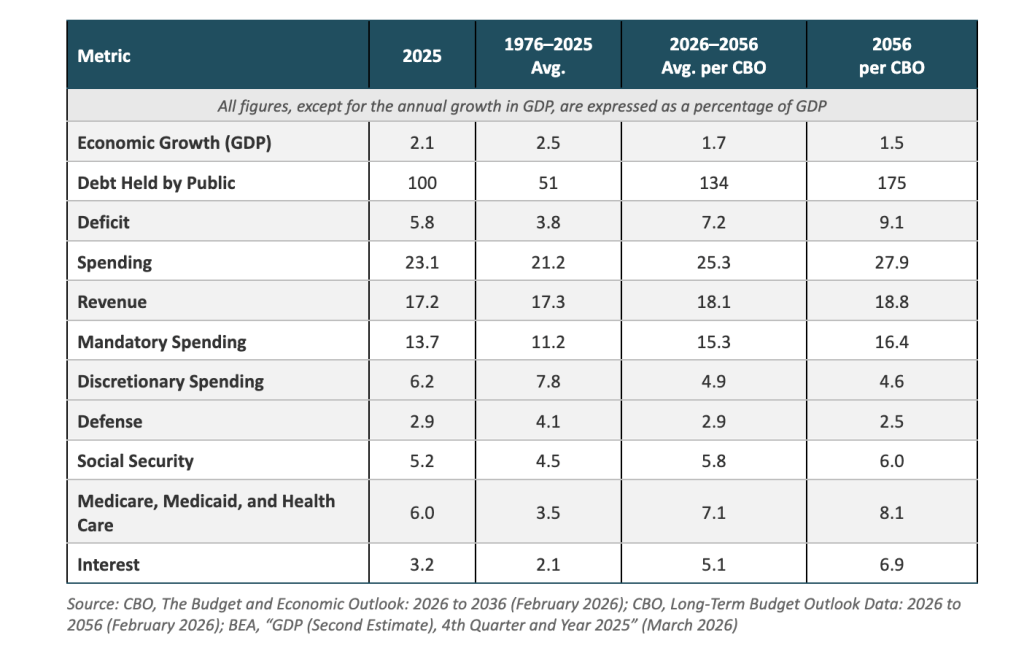
The metrics shed light on what is Uncle Sam’s fiscal folly:
- Economic growth is projected to slow and to fall well below its 1976–2025 average.
- The federal government is expected to continue growing more rapidly than the private sector.
- Current federal revenues are about the same as they have been during the past 50 years, and are projected to grow only moderately.
- Federal deficits are significantly higher than during the past 50 years, and are projected to increase significantly in the future.
- Mandatory spending has grown dramatically, from 6% of GDP in 1946, to 13.7% today, and is projected to increase significantly in the future.
- Discretionary spending has declined significantly, from 18.2% of GDP in 1946, to 6.2% today, and is expected to continue to decline. Notably, all of the express and enumerated federal government responsibilities envisioned by our nation’s founders fall into the discretionary spending category.
- Defense spending has declined from a 1976–2025 average of 4.1% of GDP to 2.9% today, and is expected to continue to decline over time. The trajectory of defense spending will no doubt be amended, at least in the short-term, to reflect Trump’s proposal for a dramatic increase in defense expenditures.
- Social Security spending has increased from its average over the past 50 years, and is expected to continue to increase.
- Medicare, Medicaid, and other federal health care spending has increased dramatically from its average during the past 50 years, and is expected to increase significantly in the future.
- Net interest has increased significantly over the past 50 years, and is expected to increase dramatically in the future. Interestingly, interest expense is the federal government’s fastest growing expense and one for which taxpayers receive nothing.
While all the trends that accompany the fiscal folly are edifying, there is one underlying feature that stands out: the yawning gap between government spending and revenues and the resulting fiscal deficits. Deficit finance, which is nothing more than a Houdini-esque act, creates a “fiscal illusion” that obscures the true cost and consequences of the government’s propensity to spend. Those deficits exist because they are a politician’s dream of spending now and taxing later.
A significant chunk of today’s government expenditures are financed by putting future generations in bondage and saddling them with the costs. This is irresponsible, inequitable, and immoral. Fiscal deficits are nothing more than deferred taxes that will be paid by those who aren’t even voting today, as well as many who are yet to be born.
It’s time to put an end to the fiscal folly by amending the U.S. Constitution to include a fiscal responsibility requirement. The American Republic was initially informed by Adam Smith’s principle of fiscal responsibility: Government should not spend without imposing taxes. Let’s put that principle in writing.
The opinions expressed in Fortune.com commentary pieces are solely the views of their authors and do not necessarily reflect the opinions and beliefs of Fortune.
This story was originally featured on Fortune.com





This post was originally published here