JBizNews Desk | April 22, 2026
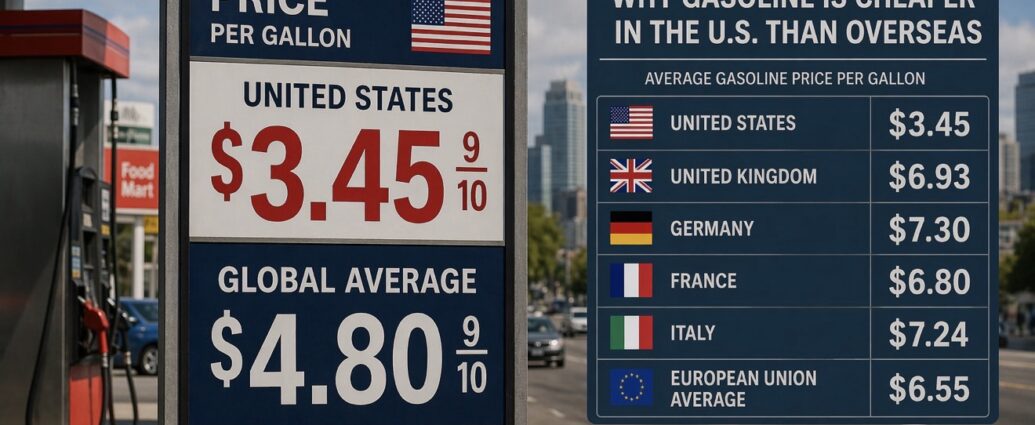
American drivers paying roughly $3.45 per gallon may feel squeezed when oil prices rise—but compared with much of the world, they are still paying significantly less. As of April 2026, the global average gasoline price stands near $1.50 per liter, placing the United States well below most advanced economies, a gap driven largely by tax policy, domestic production strength, and long-standing political decisions.
The biggest dividing line is taxation. According to the U.S. Energy Information Administration (EIA), the federal gasoline tax remains fixed at 18.3 cents per gallon, unchanged since 1993. In contrast, European governments impose substantially higher levies. The European Commission mandates a minimum excise duty of €0.359 per liter—roughly $1.60 per gallon—with most countries charging above that threshold. Combined with value-added taxes, fuel taxes account for more than half of pump prices across the European Union, with Italy (55%), Germany (54.5%), France (53%), and Spain (45%) among the highest, according to Commission data.
Jacob Macumber-Rosin, Excise Tax Policy Analyst at the Tax Foundation, has noted that Europe’s baseline fuel tax alone exceeds the total gasoline tax burden in most U.S. states. Even in California, which has the highest combined federal and state gas taxes in the U.S., the total reaches about $1.25 per gallon—still below European minimums.
Beyond taxes, the United States benefits from a powerful structural advantage: it produces much of its own oil. The EIA’s Short-Term Energy Outlook shows U.S. crude production hit a record 13.6 million barrels per day in 2025, led by the Permian Basin, which accounted for nearly half of total output. That domestic capacity reduces reliance on imports and limits exposure to transportation costs that weigh heavily on Europe and Asia.
Energy economists say that production economics also support sustained output. Data from the Federal Reserve Bank of Dallas Energy Survey indicates breakeven costs in key U.S. shale regions hover around $61–$62 per barrel, allowing producers to remain profitable even during price downturns. Garrett Golding, Assistant Vice President for Energy Programs at the Dallas Fed, has emphasized that this cost discipline is a key factor underpinning U.S. energy resilience.
Industry groups point to the broader transformation of the U.S. energy sector. The American Energy Alliance has highlighted that advances in hydraulic fracturing and horizontal drilling have turned the U.S. into the world’s largest oil producer and a net petroleum exporter, strengthening supply security and helping stabilize domestic prices relative to global markets.
Looking ahead, price forecasts remain sensitive to geopolitical developments. The EIA’s April 2026 outlook projects gasoline prices will average $3.70 per gallon in 2026 and $3.46 in 2027, up from $3.10 in 2025, while diesel is expected to remain elevated near $4.80 per gallon due to tighter global supply. Steve Nalley, Acting Administrator of the EIA, has said the agency expects prices to moderate over time, though recent Middle East tensions have pushed projections higher.
Trade policy is another variable shaping the outlook. According to the American Fuel & Petrochemical Manufacturers, about 60% of U.S. crude imports come from Canada and 7% from Mexico. The Trump administration’s tariffs—25% on Mexican crude and 10% on Canadian crude—have so far had limited impact due to a global supply surplus, but could become more consequential if markets tighten.
Ultimately, the price Americans pay at the pump reflects policy as much as market forces. While countries draw from the same global oil supply, governments determine final costs through taxes, subsidies, and regulatory frameworks. European leaders have long defended higher fuel taxes as tools for funding infrastructure and advancing climate goals, while U.S. policymakers have historically avoided significant increases due to political sensitivity.
As Garrett Golding has observed, gasoline prices tend to rise quickly and fall slowly—“like a falling feather”—with much of the profit concentrated upstream among producers and refiners rather than at retail stations. The takeaway is clear: relatively low U.S. gasoline prices are not accidental, but the result of deliberate policy choices, robust domestic production, and a sustained political preference for keeping fuel affordable.
— JBizNews Desk