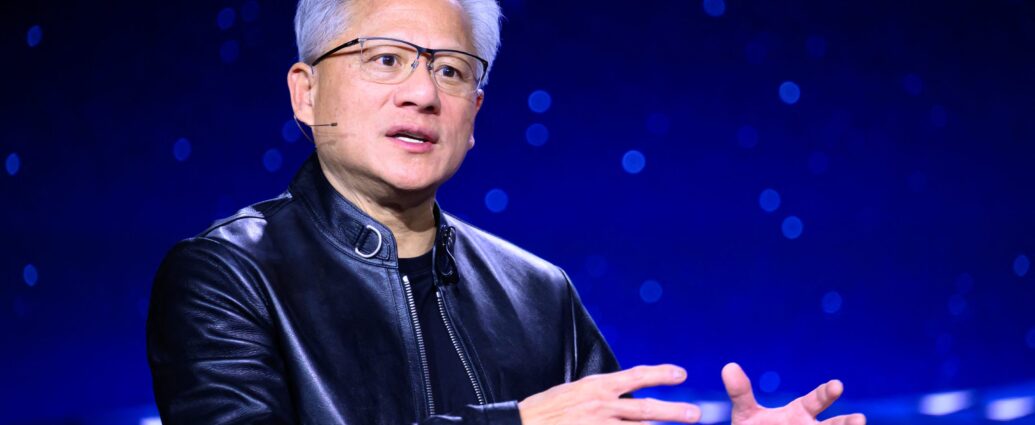
The warnings about AI’s impact on jobs echo from Silicon Valley to Wall Street to Washington, D.C. But Nvidia CEO Jensen Huang thinks you should worry less about the robots and more about your coworker, the one quietly “tokenmaxxing,” or using AI to do in minutes what takes you hours.
In a recent interview with former national security advisor H.R. McMaster at the Stanford Graduate School of Business alongside Rep. Ro Khanna (D-CA), Huang said AI won’t exactly replace you. Instead, it’s possible you’ll be replaced by the worker who’s boosted their productivity by using AI.
“It is unlikely most people will lose a job to AI,” Huang said in the interview published last week. “It is most likely that most people will lose their job to somebody who uses AI. And so, we have to make sure that everybody uses AI.”
The statement is a break from what other business leaders have warned about the technology. Anthropic CEO Dario Amodei said the technology will wipe out half of all entry-level white collar workers. Microsoft AI chief Mustafa Suleyman has said the same, and gave it about 18 months until that becomes a reality.
At the same time, there’s a growing discontent among workers about AI adoption. KPMG found in November four in 10 workers fear AI could take their job. And a report from AI enterprise platform Writer found that 29% of workers are actively sabotaging their company’s AI strategy, with about one-third of those citing fear of AI for doing so.
Huang versus the doomsayers: Why Nvidia’s CEO believes AI will create jobs
While other business leaders are adamant AI will lead to a wider labor market disruption, the 63-year-old billionaire has remained steadfast in his assertion the technology won’t lead to mass layoffs. In an interview last May, Huang said the technology could actually put up to 40 million people back into the workforce. And in March, the CEO mapped out exactly how AI could transform the technology, predicting 100 AI agents working alongside every human worker.
Huang’s prediction is already playing out in the labor market, according to the Writer report. In the survey, 60% of executives said they’re considering cutting employees who refuse to adopt AI. Moreover, workers using AI are three times as likely to have gotten a promotion and pay raise last year compared to workers dragging their feet on AI adoption.
Still, a recent Anthropic study argues AI is already theoretically capable of performing the majority of tasks associated with white-collar professions, such as law, business, engineering, and management. But Huang explained that while AI automates specific tasks, it doesn’t necessarily eliminate that profession.
“Your job, the purpose of your job, and the tasks that you do in your job are related but not the same,” he said.
How Nvidia puts AI adoption into practice
Huang shared some insights into how AI adoption looks at Nvidia. He said the most successful employees are those who embrace the tool.
“The software engineers who know how to work with AI are the most popular software engineers.” He adds the software engineers are actually busier than ever.
The tech firm is putting its money where its mouth is, according to Huang. In his keynote address at the Nvidia GTC conference in March, the CEO said in order to attract top talent, the company is offering an unusual incentive: AI tokens for engineers—the fundamental units of data used to process and generate text—worth nearly half their salary.
But it’s not just engineers. Huang is seeking AI pros across the board. He said companies are looking for recent college grads with sophisticated AI knowledge.
“Whether it’s [an] expert at using AI for marketing or finance or engineering or software engineering, we are looking for expert AI users,” he said.
This story was originally featured on Fortune.com





This post was originally published here