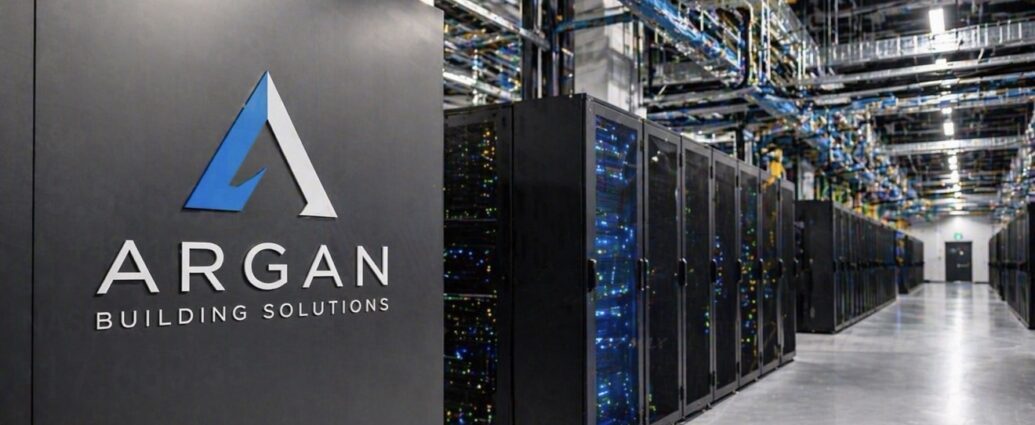
Argan’s latest results have put a small engineering and construction company at the center of a much bigger market theme: whether the next round of corporate earnings can justify the intense investor focus on power, data centers and AI-linked infrastructure. In a release issued March 27, Argan said fiscal fourth-quarter revenue rose 12.7% to $232.5 million and net income climbed to $49.2 million, or $3.47 a share, figures that sharply exceeded Wall Street expectations tracked by FactSet and cited by MarketWatch. Argan Chief Executive David Watson said in the company’s statement that the business “delivered record quarterly and annual revenues” and entered the new fiscal year with “significant opportunities” tied to its project pipeline, according to the company release.
The earnings surprise mattered because Argan, through its power-industry construction operations, has become a closely watched proxy for the scramble to add electricity capacity for data centers and other large industrial users. In its earnings release, Argan said full-year revenue reached a record $874.2 million, up 32.3% from the prior year, while adjusted EBITDA rose to $102.9 million from $63.8 million. Watson said the company’s results reflected “strong project execution” and demand across its core markets, while Argan also reported a year-end backlog of about $1.4 billion, a figure investors often treat as a signal of future revenue visibility.
The broader backdrop helps explain why the company’s report drew outsized attention. Goldman Sachs said in an April 2024 note that U.S. power demand, after years of stagnation, could rise meaningfully by the end of the decade, driven in part by data centers and electrification. Goldman Sachs analysts wrote that data center power demand alone could increase by 160% by 2030, a forecast that has echoed across Wall Street research and corporate commentary. Bloomberg has reported that utilities, equipment suppliers and engineering firms tied to grid expansion and generation additions have benefited from that shift as hyperscale operators race to secure power.
That demand story has increasingly shown up in executive remarks across the sector. Constellation Energy Chief Executive Joe Dominguez said on the company’s earnings call in February, according to a transcript published by AlphaSense and widely cited by financial media, that “the market has changed dramatically” because large customers now seek “around-the-clock, reliable, clean energy” at a scale utilities had not seen in years. NextEra Energy Chief Executive John Ketchum told analysts on his company’s January earnings call, according to the transcript and company materials, that the U.S. is entering “the early stages of a power demand supercycle,” a phrase investors have seized on as evidence that generation and transmission spending could stay elevated.
For Argan, the opportunity sits less in owning power assets than in building the facilities and related infrastructure needed to meet that surge. The company said its Gemma Power Systems unit continues to serve natural gas-fired power projects, a segment that many utilities still view as essential for reliability even as renewable generation expands. In its annual report filed with the U.S. Securities and Exchange Commission, Argan said its strategy centers on “engineering, procurement, construction, commissioning, operations and project development services” for the power market, and it cautioned that project timing can create quarterly volatility even when long-term demand remains intact.
Investors have had plenty of reminders that earnings season can reward companies with visible growth and punish those that miss. Reuters reported in recent coverage of U.S. equities that markets have become increasingly selective, with traders favoring companies able to show durable revenue growth and margin resilience despite high interest rates and uneven macro data. Strategists at Morgan Stanley, in a note cited by CNBC, said the next phase of the market likely depends less on broad multiple expansion and more on “earnings revisions breadth,” meaning whether more companies can lift guidance rather than simply clear lowered bars.
That makes the quality of the beat especially important. The consensus among analysts tracked by FactSet, as cited by MarketWatch, called for quarterly earnings of $1.98 a share on revenue of $226.4 million, leaving Argan well ahead on both counts. In the company’s release, Watson said management remains focused on “disciplined execution” and on converting opportunities in its pipeline into booked work, a formulation that suggested confidence without promising a straight-line growth path. The company also declared a regular quarterly dividend and a special cash dividend, underscoring a balance sheet strong enough to return capital while still pursuing expansion.
The market’s reaction reflected more than one company’s numbers. Reuters and Bloomberg have both reported over the past year that investors increasingly group together companies exposed to AI infrastructure, from chipmakers and server manufacturers to utilities, contractors and cooling specialists. JPMorgan analysts wrote in a recent note, cited by Barron’s, that the AI buildout has broadened from semiconductors into “second-derivative beneficiaries,” including firms tied to power availability and physical project delivery. That framing helps explain why a relatively small-cap contractor can suddenly matter to portfolio managers searching for earnings leverage to a durable capital-spending cycle.
What comes next now matters more than the quarter already reported. As reporting season gathers pace in mid-April, investors will look for confirmation from utilities, industrial suppliers and large technology companies that data center expansion plans remain on track and that power constraints continue to support new project awards. Argan said in its filing that the timing of major awards and construction starts can affect near-term comparisons, but the company’s latest results and backlog suggest the underlying demand signal remains strong. If upcoming earnings from across the power and AI supply chain reinforce that message, the market could reward a wider set of infrastructure names; if not, the recent enthusiasm around the theme may face a tougher test.
JBizNews Desk