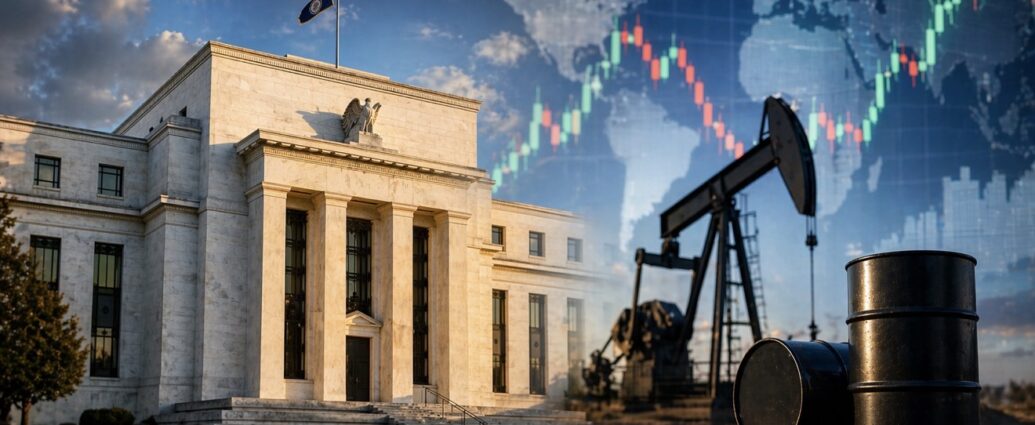
Federal Reserve officials still expected interest-rate cuts later this year even as fighting in the Middle East threatened to lift oil prices and complicate the inflation outlook, underscoring a central bank trying to balance geopolitical risk against signs of softer demand. In minutes from the March 17-18 meeting released by the Federal Reserve, policymakers said “most participants” saw a prolonged conflict as a potential drag on growth if higher energy costs squeezed household spending, a view that echoed reporting from Reuters and coverage by Bloomberg on the market implications of rising crude.
The Fed left its benchmark rate unchanged at 3.5% to 3.75% at that meeting, and the minutes said officials judged that “the risks around the economic outlook had increased,” with energy markets a particular concern, according to the official record published Tuesday by the Board of Governors of the Federal Reserve System. Chair Jerome Powell had already signaled after the meeting that policymakers did not need to rush, saying at his press conference that the central bank remained focused on incoming data and that uncertainty around inflation and growth still argued for patience, according to the Federal Reserve transcript and statement.
What stood out in the minutes, however, lay in the conditional case for easing. The document said “most participants raised the concern that a protracted conflict in the Middle East could lead to a further softening in labor market conditions, which could warrant additional rate cuts,” while also noting that substantially higher oil prices could “reduce households’ purchasing power, tighten financial conditions, and reduce growth abroad,” according to the Federal Reserve. That framing matters for investors because it suggests officials still view an oil shock less as a reason to tighten than as a risk that could weaken consumption and hiring if the hit to real incomes proves large enough, a dynamic economists at firms cited by CNBC and Reuters have flagged in recent weeks.
The tension for policymakers remains clear: energy-driven inflation can lift headline prices even as it slows the broader economy. Economists at Goldman Sachs, in a note cited by Reuters, said oil spikes tied to geopolitical events often create a “stagflationary impulse,” raising near-term inflation while weighing on activity. Oxford Economics has made a similar point in public commentary, saying higher fuel costs act like a tax on consumers, and that assessment aligns with the minutes’ warning that household purchasing power could erode if crude stays elevated, according to the Federal Reserve release.
Markets have spent much of the year recalibrating how quickly the Fed might move, and the minutes are unlikely to settle that debate on their own. Futures pricing tracked by CME Group has shifted repeatedly with each inflation print and each move in oil, while strategists quoted by Bloomberg said the central bank’s reaction function now hinges on whether energy costs bleed into broader inflation expectations or simply sap demand. Jerome Powell has repeatedly said, including in remarks published by the Federal Reserve, that officials pay close attention to longer-term inflation expectations because temporary commodity shocks do not automatically justify a policy response unless they threaten to become embedded.
Recent economic data help explain why officials still kept rate cuts on the table. In prior releases, the Bureau of Labor Statistics said job growth had moderated from last year’s pace, while inflation, though still above the Fed’s 2% target, showed uneven progress across core categories. Analysts at Wells Fargo, in research cited by MarketWatch, said the central bank faces a “difficult trade-off” if gasoline prices rise sharply into the summer because consumers tend to cut back elsewhere, potentially weakening discretionary spending and business confidence even if headline inflation temporarily moves higher.
The global backdrop adds another layer of caution. The minutes said higher oil prices could “reduce growth abroad,” and that concern fits with warnings from institutions such as the International Monetary Fund, which has said in recent outlooks that geopolitical fragmentation and commodity shocks remain key threats to the world economy. Reporting from Reuters on energy markets has shown how quickly crude benchmarks can react to disruptions in the Middle East, and executives across transport, chemicals and manufacturing have told investors in earnings calls that sustained fuel inflation can pressure margins and delay capital spending.
For corporate America, the message from the minutes is less about an imminent move than about the conditions that could force one. If oil prices retreat and inflation remains sticky, the Fed could stay on hold longer; if energy costs keep climbing and consumers pull back, officials appear more open to easing to cushion the labor market, according to the March record from the Federal Reserve. That leaves coming inflation reports, payroll data and developments in the Middle East carrying unusual weight for boards, investors and borrowers alike, because they will shape whether the central bank’s next move reflects persistent price pressure or a broader slowdown.
JBizNews Middle East Desk