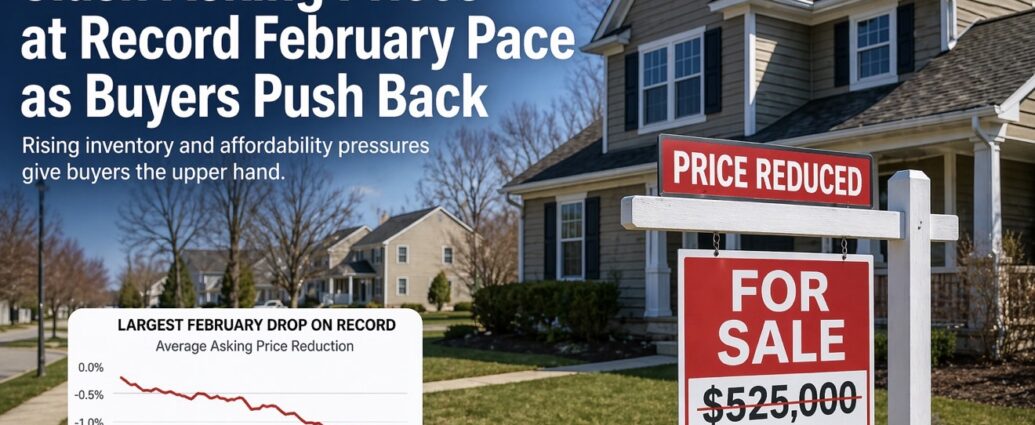
U.S. home sellers cut asking prices in February at the fastest rate for that month in more than a decade, a sign that buyers still hold unusual leverage in a housing market constrained by high mortgage rates and stretched affordability. In an April report, Redfin said 34.2% of homes for sale had at least one price reduction in February, the highest share for any February since the brokerage began tracking the data in 2012, and the company said the shift reflected “growing competition” for a limited pool of buyers.
The pricing reset underscores how sharply the market has changed from the pandemic-era frenzy, when sellers routinely received multiple offers above asking price. Redfin reported that the typical seller who cut a listing price reduced it by $40,915, or 7.3%, which the company said marked the biggest February discount since 2023. In comments published with the report, Redfin agents said many homeowners still enter the market “testing” ambitious prices, only to adjust after weak traffic and slower-than-expected offers.
The broader backdrop remains punishing for would-be buyers. Freddie Mac said in its latest weekly survey that the average 30-year fixed mortgage rate stayed near levels that continue to strain affordability, with Chief Economist Sam Khater saying in a recent release that “mortgage rates continue to be elevated,” a dynamic that keeps monthly payments high even if home-price growth cools. That financing pressure has become central to seller strategy, because buyers who might have stretched in a lower-rate environment now have far less room to absorb aggressive asking prices.
Fresh industry data point in the same direction. National Association of Realtors Chief Economist Lawrence Yun said in the group’s recent housing commentary that “housing affordability remains a challenge,” even as inventory improves in parts of the country. According to NAR, more homes coming onto the market should help moderate price growth, but Yun has also cautioned that elevated borrowing costs continue to suppress transaction volumes, leaving sellers to compete more directly on price, concessions and time on market.
That competition has become more visible in listing data. In a recent market update, Zillow said sellers increasingly need to “price competitively from the start” as buyers gain more options and become more selective. Zillow economists have noted that while demand has not disappeared, it has become highly payment-sensitive, meaning homes that miss the market on price can sit longer and require cuts to attract attention. The result, especially in formerly overheated metros, has been a more negotiated market rather than a broad-based collapse in values.
Economists at Realtor.com have described a similar pattern. In one recent analysis, Realtor.com Chief Economist Danielle Hale said sellers are “adjusting expectations” as inventory rises and buyers face budget constraints. The company’s market trackers have shown a growing share of listings with price reductions, particularly in regions where new supply and pandemic-era migration booms left sellers with less pricing power than they enjoyed two years ago. That matters for builders, brokers and mortgage lenders because a market that clears through discounts rather than bidding wars typically produces slower turnover and thinner margins.
The trend does not mean home prices are falling everywhere, and several measures still show national values holding up better than sales activity. S&P Dow Jones Indices and CoreLogic have both reported that home-price appreciation remains positive in many markets, though the pace has cooled from prior peaks. In public comments accompanying recent housing data, Federal Reserve Chair Jerome Powell has said shelter inflation and housing supply remain important parts of the broader inflation picture, while acknowledging that high rates have weighed on residential activity. For sellers, that combination creates a difficult trade-off: prices remain historically high, but the buyer pool able to transact at those prices has narrowed.
Regional differences also matter. Redfin and other housing platforms have repeatedly shown that Sun Belt markets with larger inventory rebounds have seen more frequent markdowns than supply-starved Northeast markets. In prior reporting by Reuters and Bloomberg on the U.S. housing slowdown, economists said areas that saw the biggest pandemic run-ups often face the sharpest normalization once rates stay higher for longer. That helps explain why a record share of sellers can be cutting prices even without a nationwide crash in home values: the market has become fragmented, local and highly sensitive to financing conditions.
For buyers, the shift could open room to negotiate not only on price but also on closing costs, repairs and mortgage-rate buydowns. For sellers, the message from brokers and economists has become more blunt. Redfin said in its report that homes priced too high are increasingly likely to linger, while Zillow and Realtor.com have each emphasized that realistic pricing now matters more than spring-season optimism. The next few months will show whether lower rates or stronger demand can rescue asking prices, but if borrowing costs stay elevated and inventory keeps building, more sellers may have little choice but to keep cutting until buyers step in.
JBizNews Desk