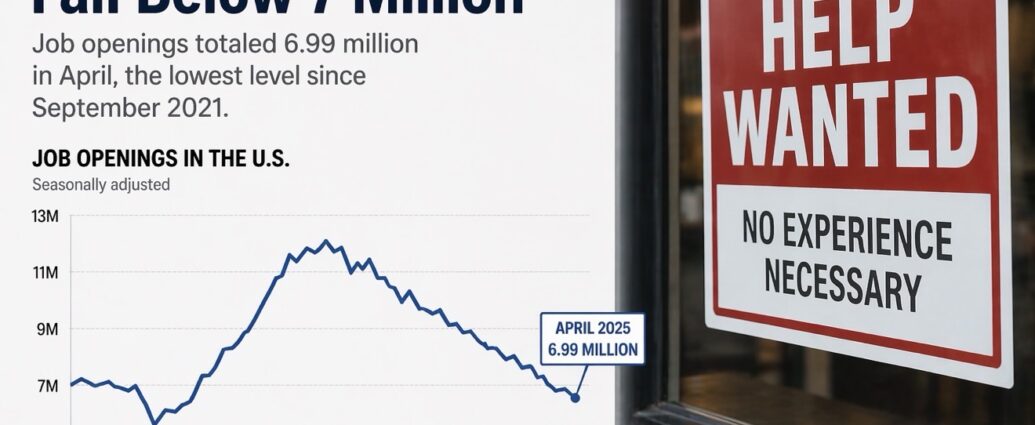
U.S. labor demand softened in February as job openings fell below 7 million for the first time in months, a sign the hiring market continues to cool even as layoffs remain relatively contained. In data released Monday, the U.S. Bureau of Labor Statistics said job openings dropped to 6.882 million from an upwardly revised 7.24 million in January, a decline that Reuters and other outlets said came in slightly below economists’ expectations for about 6.92 million and reinforced evidence of a more balanced labor market.
The latest Job Openings and Labor Turnover Survey, or JOLTS, pointed to weakness in several cyclical sectors, with the Bureau of Labor Statistics reporting that vacancies fell sharply in accommodation and food services and also declined in manufacturing, mining and logging, and health care. Economists cited by Bloomberg and Reuters said the figures fit a broader pattern of employers turning more cautious on expansion plans as borrowing costs stay elevated and demand normalizes after the post-pandemic hiring surge.
The report matters because Federal Reserve officials have repeatedly said labor-market rebalancing could help bring inflation lower without a steep rise in unemployment. Jerome Powell, the Fed chair, said after the central bank’s recent policy meeting that the labor market had “come into better balance” and no longer looked like “a significant source of inflationary pressure,” according to remarks published by the Federal Reserve. Monday’s openings data offered fresh support for that view, even if the level of vacancies still sits above pre-pandemic norms.
Hiring itself showed a more mixed picture. The Bureau of Labor Statistics said the hiring rate held relatively steady, suggesting companies still need workers even as they post fewer new roles, while the quits rate remained subdued compared with the peak of the so-called Great Resignation. Economists at Wells Fargo said in a research note cited by CNBC that a lower quits rate typically signals workers feel less confident about finding better-paying jobs quickly, a dynamic that can ease wage pressure and reduce turnover costs for employers.
The decline in openings also arrives ahead of the government’s closely watched monthly payrolls report, which investors and policymakers use to gauge whether labor demand continues to cool in an orderly way. Analysts surveyed by Dow Jones and reported by CNBC said Friday’s employment report will carry added weight because it could shape expectations for the timing of any Federal Reserve rate cuts. Kathy Bostjancic, chief economist at Nationwide, said in a note reported by MarketWatch that a slower pace of hiring and fewer openings would be “consistent with a labor market that is gradually downshifting, not collapsing.”
For businesses, the sector breakdown may prove as important as the headline number. The Bureau of Labor Statistics said accommodation and food services accounted for a large share of the monthly drop, while manufacturing openings also moved lower, underscoring softer demand in industries tied closely to discretionary spending and goods production. Economists cited by Financial Times have said service-sector labor shortages had remained unusually persistent, so any easing there could help reduce wage growth in customer-facing industries that have struggled with staffing and margin pressure.
Markets have treated labor-market cooling as a double-edged signal: good news for inflation and interest rates, but a potential warning for growth if the slowdown deepens too quickly. Following recent labor and inflation releases, strategists quoted by Bloomberg said investors remain focused on whether the economy can deliver a “soft landing,” with slower hiring and fewer vacancies offset by still-low layoffs and steady consumer activity. The JOLTS report did little to suggest a sudden break in employment conditions, but it added to the case that the era of exceptionally tight labor demand has faded.
What comes next now hinges on whether payroll growth, wage gains and unemployment continue to moderate in tandem. Federal Reserve officials have said future policy decisions remain data dependent, and economists across Reuters, Bloomberg and CNBC have argued that labor-market indicators such as openings, quits and hiring rates will stay central to that debate. If job openings keep drifting lower without a surge in layoffs, companies may get relief on labor costs and the Fed may gain confidence that inflation can keep cooling; if the decline accelerates, concerns about a broader economic slowdown could quickly move back to the center of the market narrative.
JBizNews Desk