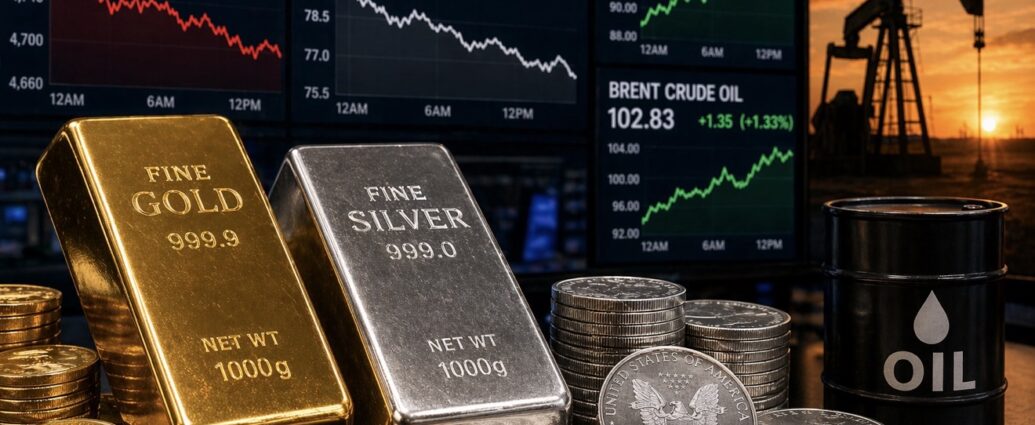
Gold and silver prices declined sharply Thursday morning, as a surge in global oil prices and stalled U.S.-Iran negotiations redirected investor focus away from traditional safe-haven assets and toward energy markets, underscoring how geopolitical risk is being priced in across commodities.
Spot gold fell to approximately $4,707 per troy ounce, extending losses after briefly climbing above $4,750 a day earlier following President Donald Trump’s extension of the Iran ceasefire. The pullback reflects a combination of near-term headwinds, including a firmer U.S. dollar, rising oil prices, and uncertainty surrounding the Senate confirmation process for Federal Reserve Chair nominee Kevin Warsh, whose policy stance could reshape the interest rate outlook.
Silver experienced an even steeper decline. Spot silver dropped to around $76.97 per ounce, marking a roughly 2% fall over the past 24 hours. The metal is now down more than 15% since the onset of the U.S.-Iran conflict, reflecting a sharp reversal from its earlier rally as both safe-haven demand and expectations for near-term industrial growth weaken.
The selloff comes despite what would typically be a supportive macro backdrop for precious metals. Over the past year, gold has surged more than 41%, reaching a record high of $5,602.22 per ounce on January 28, 2026. Silver similarly hit an all-time high of $121.67 one day later before geopolitical developments began to alter market dynamics. The divergence highlights how rapidly capital flows can shift when competing macro forces intensify.
At the center of the current market rotation is inflation — and more specifically, energy-driven inflation. Brent crude rose to $102.83 per barrel, while West Texas Intermediate climbed to $93.80, as Iran maintained control over the Strait of Hormuz and continued restricting maritime traffic. Reports of Iranian forces firing on commercial vessels this week, combined with ongoing U.S. enforcement actions in the region, have reinforced concerns about supply disruptions in one of the world’s most critical energy corridors.
Gaurav Garg, a research analyst at Lemonn Markets, said the move reflects a broader repositioning across asset classes. Traders, he noted, are recalibrating portfolios as oil prices climb and the ceasefire remains uncertain, creating a volatile mix of currency movements and commodity shifts that have weighed on gold and silver despite elevated geopolitical risk.
The key variable, however, remains the Federal Reserve. Elevated energy prices risk keeping inflation higher for longer, potentially forcing policymakers into a more restrictive stance. Higher interest rates typically reduce the appeal of non-yielding assets such as gold and silver, amplifying downside pressure even in periods of uncertainty.
Silver has also been particularly sensitive to developments in Washington. During his Senate confirmation hearing, Kevin Warsh emphasized the need for an independent and disciplined monetary policy framework to address persistent inflation, comments that markets interpreted as potentially hawkish. The prospect of tighter financial conditions added to selling pressure across precious metals.
Even with the latest declines, long-term performance remains striking. Gold is still up more than 41% year-over-year and nearly 6% over the past month, while silver has surged approximately 131% over the same annual period. The gold-to-silver ratio widened to 61.1, reflecting silver’s sharper pullback and its dual exposure to both industrial demand and monetary policy expectations — a pattern analysts say is common during periods when energy shocks dominate market sentiment.
Market participants increasingly view the current environment as a competition between fear trades. While gold has traditionally served as the primary hedge against instability, oil has taken center stage as the more immediate risk signal, driven by tangible supply constraints and real-time geopolitical escalation.
The path forward for precious metals will likely hinge on developments in the Middle East. Any credible progress toward reopening the Strait of Hormuz or easing tensions could quickly redirect capital flows back into gold and silver. Conversely, sustained disruption in energy markets may continue to suppress metals in favor of oil-linked assets.
For now, markets are making a clear statement: in the hierarchy of global risk, energy security is taking precedence over monetary hedging. At $102 per barrel, the pressure point is not in the gold vault — it is in the oil supply chain.
J-BizNews Desk -MARKETS & COMMODITIES