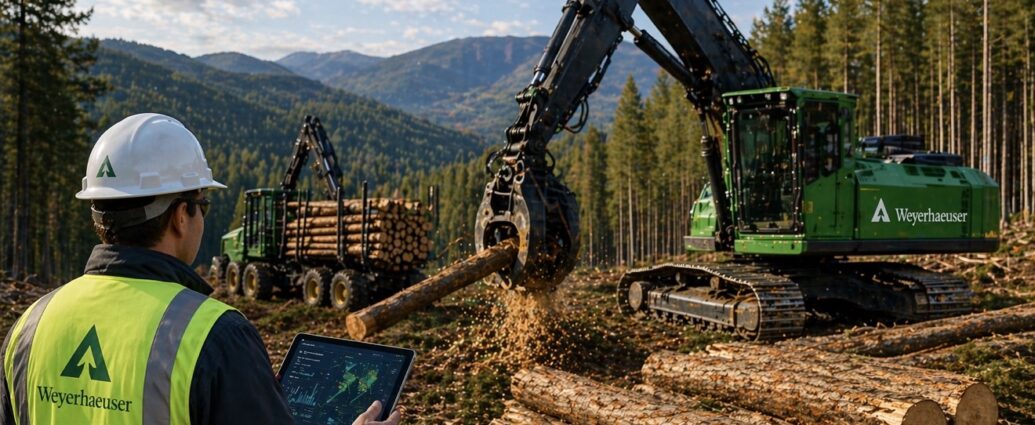
America’s largest private landowner is pushing aggressively into artificial intelligence and automation, aiming to modernize one of the oldest industries in the U.S. economy while targeting $1.5 billion in incremental earnings by the end of the decade. For Weyerhaeuser Co., the strategy represents a fundamental shift: turning timber from a cyclical commodity business into a data-driven, precision-managed enterprise.
The Seattle-based company, which manages millions of acres of timberland across North America, is deploying AI across both its forests and manufacturing operations. Devin W. Stockfish, President and Chief Executive Officer of Weyerhaeuser, has emphasized that the company’s scale gives it a unique advantage, noting that its vast land holdings generate enormous datasets that can be leveraged to optimize growth, harvest timing, and operational efficiency. Industry analysts increasingly view that data as a competitive moat.
At the center of the strategy is an ambitious financial target. Weyerhaeuser expects to generate $1.5 billion in additional Adjusted EBITDA by 2030, compared with a 2024 baseline, through a series of operational and technological initiatives. The company has outlined specific contributions across business segments, including approximately $440 million from Wood Products, $230 million from Strategic Land Solutions, $180 million from enterprise-wide initiatives, and $150 million from Timberlands, according to company disclosures. Notably, executives have stressed that these gains are designed to materialize regardless of fluctuations in lumber prices—a key departure from the industry’s traditional earnings model.
Artificial intelligence is already being deployed on the factory floor. At Weyerhaeuser’s oriented strand board facility in Heaters, West Virginia, the company implemented a machine-learning system developed with AI2Infinity to optimize dryer operations handling roughly 200,000 pounds of wood strands per hour. The system continuously adjusts operating conditions in real time, improving efficiency beyond what human operators can achieve. A similar system has since been introduced at the company’s engineered wood products facility in Eugene, Oregon, where it is optimizing veneer press performance.
“This technology is self-learning, so it will just get better and better over time,” a company official said in a corporate update, highlighting how AI can dynamically refine processes. “The AI is faster at determining when to modify the settings than humans are.”
Beyond the mill, Weyerhaeuser is digitizing the forest itself. The company has developed a Next Generation Water Mapping tool that uses internally collected high-resolution LiDAR data to generate one-meter-resolution stream and terrain maps across its timberlands. According to company engineers, the system provides significantly greater accuracy than publicly available datasets, enabling more precise environmental management and harvest planning.
The company is also integrating LiDAR, drone imagery, and GIS analytics to refine planting density, thinning cycles, and harvest timing. Analysts say these tools can yield incremental productivity gains of 1% to 2% annually in key regions such as the U.S. South, where pine plantations dominate. Over time, even modest gains at that scale could translate into substantial financial impact.
Partnerships are playing a role as well. Weyerhaeuser has been working with Treeswift, a drone-based analytics firm, to measure timber inventory and estimate carbon volumes across its land portfolio—capabilities that could become increasingly valuable as carbon markets develop and environmental reporting standards tighten.
At the enterprise level, management has identified roughly $180 million in value creation tied to automation and advanced analytics. These initiatives include real-time forest monitoring, predictive maintenance in mills, optimized logistics, and reduced material waste. The company describes its approach as combining “best-in-class culture and technology platforms” to drive sustained operational improvement.
For investors, the broader significance lies in Weyerhaeuser’s attempt to redefine how a resource company generates returns. By embedding AI into both land management and manufacturing, the company is effectively seeking to decouple earnings growth from volatile commodity cycles—a longstanding challenge in the timber and broader materials sectors.
Analysts at firms including Goldman Sachs and RBC Capital Markets have noted that while execution risk remains, the strategy positions Weyerhaeuser closer to an industrial technology operator than a traditional timber REIT. The combination of proprietary land data, automation, and long-term biological growth cycles creates a unique platform that competitors may struggle to replicate at scale.
The outcome of that bet will take years to fully materialize. But if successful, Weyerhaeuser could reshape not only its own earnings profile but also expectations for the entire forestry sector—demonstrating that even the most traditional industries can be reengineered through data, automation, and disciplined capital allocation.
JBizNews Desk