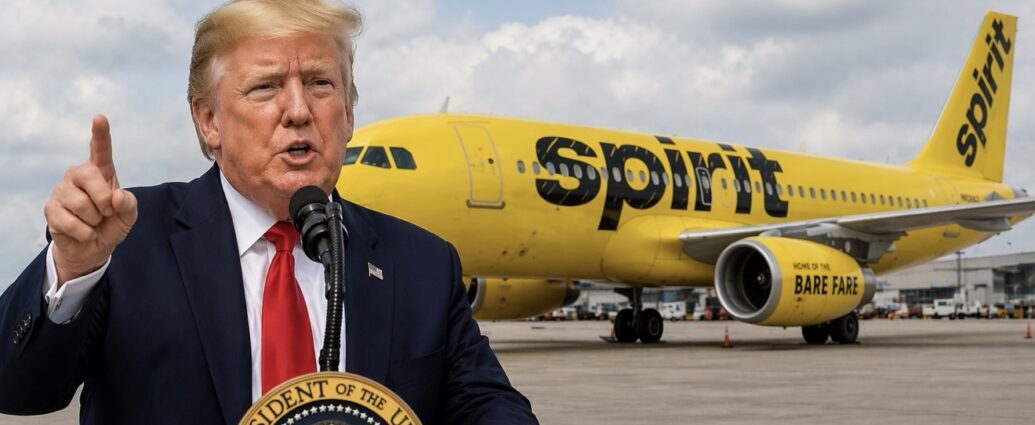
WASHINGTON, D.C. — President Donald Trump is openly entertaining an extraordinary federal intervention in the U.S. airline industry, signaling that the government could take control of bankrupt Spirit Airlines Inc. and later sell it for a profit, as his administration moves closer to finalizing a $500 million rescue package aimed at preventing the discount carrier’s collapse.
“I think we’d just buy it,” Trump said in an interview with CNBC on Tuesday, framing the potential move as both a jobs-saving measure and a strategic investment. “You know, Spirit’s in trouble, and I’d love somebody to buy Spirit. It’s 14,000 jobs, and maybe the federal government should help that one out,” he added, underscoring the administration’s willingness to intervene in a sector historically left to private markets.
People familiar with the negotiations say the Trump administration is now in advanced talks to structure a financing package that would keep Spirit operating through bankruptcy, with terms that could ultimately hand Washington a controlling equity stake. The proposed deal centers on roughly $500 million in government-backed financing, structured initially as a loan that would later convert into a longer-term instrument upon Spirit’s emergence from Chapter 11.
According to individuals briefed on the plan, the financing would likely include warrants that could give the U.S. government up to a 90% ownership stake in Spirit Airlines — a level of control rarely seen outside of crisis-era bailouts. Administration officials argue the structure mirrors past interventions designed to stabilize critical industries while preserving taxpayer upside, with one senior official noting the goal is to “protect jobs now and recover value later.”
Confirmation that a deal is imminent came during a bankruptcy court hearing Thursday, where a Spirit Airlines attorney told the court the company is “close to securing” a federal rescue package. A person familiar with the negotiations said an announcement could come within days, ahead of a tentative April 30 court hearing where the terms of the agreement may be formally reviewed.
The proposal, however, is already exposing divisions within the administration. Transportation Secretary Sean Duffy publicly raised concerns about the risks of committing taxpayer funds to a carrier that has struggled to achieve sustained profitability. “What we don’t want to do is put good money after bad,” Duffy said. “There’s been a lot of money thrown at Spirit, and they haven’t found their way into profitability,” he added, reflecting broader skepticism among some policymakers about the long-term viability of ultra-low-cost carriers under current market conditions.
The White House has pushed back forcefully, placing responsibility for Spirit’s financial distress on prior regulatory decisions. Kush Desai, a White House spokesman, said in a statement that “Spirit Airlines would be on a much firmer financial footing had the Biden administration not recklessly blocked the airline’s merger with JetBlue,” referring to the antitrust challenge that derailed the proposed consolidation — a deal industry analysts had argued could have provided Spirit with scale and financial stability.
Beyond regulatory headwinds, macroeconomic pressures have sharply intensified the airline’s challenges. Administration officials and industry analysts point to the ongoing Iran conflict as a major driver of rising costs, particularly jet fuel. According to energy market data, jet fuel prices have roughly doubled since the escalation of hostilities, compressing margins across the airline industry and disproportionately impacting lower-cost carriers like Spirit that operate with thinner financial buffers.
“Fuel is the single biggest swing factor for these airlines,” said one aviation analyst familiar with Spirit’s restructuring efforts. “When you combine that with debt from prior restructurings and failed merger attempts, it creates a very narrow path forward without external support,” the analyst added.
Spirit’s financial trajectory has been particularly volatile. The airline has entered bankruptcy proceedings twice since 2025 following the collapse of merger efforts with JetBlue Airways Corp., leaving it struggling to stabilize operations amid mounting costs and competitive pressures. The company had been aiming to exit Chapter 11 by early summer, but deteriorating market conditions and higher fuel expenses have complicated those plans.
A successful government-backed restructuring would allow Spirit to continue operating and avoid what would be the first major U.S. airline liquidation in more than two decades — a scenario that industry observers warn could ripple across regional labor markets and low-cost travel segments. “Losing a carrier like Spirit would have real consequences for pricing and accessibility, especially for budget-conscious travelers,” one industry executive said.
Still, the scale and structure of the proposed intervention raise broader questions about the role of government in private markets. While supporters argue the move is justified to preserve jobs and maintain competition, critics warn it could set a precedent for future bailouts in industries facing cyclical pressures rather than systemic collapse.
For now, all eyes are on the upcoming bankruptcy court proceedings, where the contours of the deal are expected to come into sharper focus. If finalized, the Spirit rescue would mark one of the most aggressive federal interventions in the airline industry since the post-9/11 era — and potentially reshape how Washington approaches distressed private-sector companies in a higher-cost, geopolitically volatile economic environment.
What comes next will be critical: whether the government can stabilize Spirit without distorting the competitive landscape — and whether taxpayers ultimately see a return on what could become one of the most unconventional airline investments in modern U.S. history.
JBizNews Desk