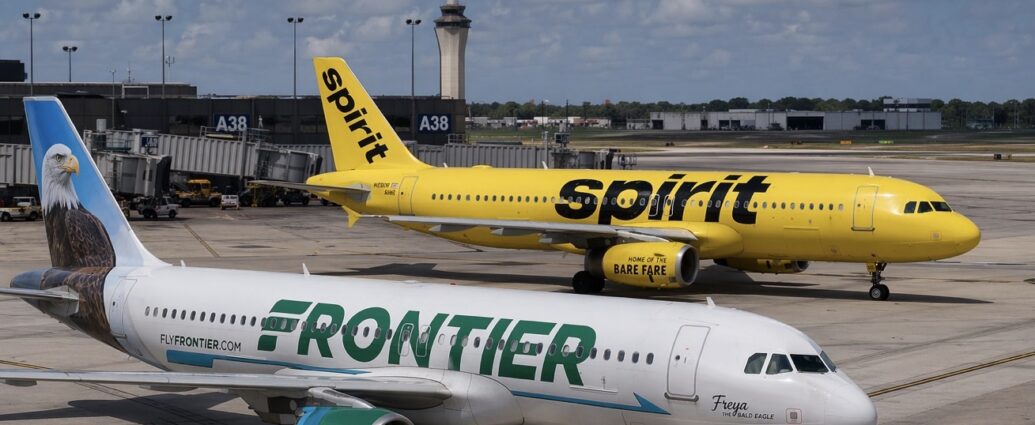
Frontier Group Holdings Inc. shares slid sharply this week as investors reacted to mounting indications that rival Spirit Airlines is nearing a federal rescue package that could keep the ultra-low-cost carrier alive — and upend the competitive dynamics Frontier had been positioning for. The prospect of government intervention, rather than market-driven consolidation, is forcing a rapid reassessment across the airline sector.
Spirit Airlines is close to securing roughly $500 million in federal support, according to people familiar with the matter, with discussions centered on a structure that could leave the U.S. government holding a significant equity stake in the company once it exits bankruptcy. Commerce Secretary Howard Lutnick has been among the leading voices inside the administration advocating for an ownership position, arguing that preserving low-cost capacity is critical to maintaining competitive pricing for U.S. consumers, according to individuals briefed on the talks.
The immediate market reaction was swift. Frontier shares dropped as investors priced in the reduced likelihood that Spirit would exit the market through liquidation — a scenario that would have allowed Frontier to capture routes, aircraft, and price-sensitive passengers. Analysts at multiple firms warned that a government-backed Spirit could intensify fare competition, with one note describing the outlook for both Frontier and JetBlue Airways Corp. as “more precarious” if the bailout proceeds.
The timing of Spirit’s financial distress has been exacerbated by macro pressures. Jet fuel prices have surged since the onset of the Iran conflict, materially raising operating costs across the industry. Analysts at JPMorgan Chase & Co. estimated that if fuel prices remain near $4.60 per gallon through the remainder of 2026, Spirit could face approximately $360 million in incremental expenses — exceeding the $337 million in cash the airline reported at the end of 2025. That imbalance has complicated the carrier’s efforts to emerge from its second bankruptcy restructuring since 2024.
What sets the current negotiations apart is the scale of potential government involvement. Under one scenario being discussed, the federal government could end up owning as much as 90% of Spirit’s equity post-bankruptcy — an extraordinary step for a private U.S. airline. The proposal has triggered bipartisan concern in Washington, with Senator Ted Cruz, Senator Tom Cotton, and Senator Elizabeth Warren each raising objections to deploying taxpayer capital to support a company with a long history of financial instability.
Industry leaders have also voiced skepticism. United Airlines CEO Scott Kirby said during a recent analyst call that Spirit’s challenges were structural rather than cyclical, stating the airline’s business model was “fundamentally flawed” and not solely the result of geopolitical shocks. His comments underscore a broader concern among legacy carriers that intervention could distort competition by artificially sustaining weaker operators.
Within the administration itself, there are signs of debate. Transportation Secretary Sean Duffy questioned whether federal support would simply postpone an inevitable failure, warning that the government could be left holding a majority stake in an airline unable to achieve sustainable profitability. That internal tension highlights the broader policy dilemma: balancing short-term consumer benefits against long-term market discipline.
President Donald Trump, however, signaled openness to an aggressive approach, telling reporters that the administration is considering multiple options, including outright acquisition. “We’re looking at helping them out — meaning bailing them out or buying it, just buy it,” Trump said, indicating a willingness to expand beyond traditional loan guarantees or debtor-in-possession financing.
For Frontier, the stakes are immediate. The Denver-based carrier had been widely expected to benefit from any retrenchment by Spirit, particularly in overlapping leisure routes where both airlines compete aggressively on price. A stabilized Spirit, especially one backed by federal capital, could instead prolong fare wars and pressure margins at a time when cost inflation is already squeezing profitability across the low-cost segment.
A bankruptcy court hearing is tentatively scheduled for April 30, where stakeholders are expected to review the framework of a potential rescue deal. The outcome could redefine not only Spirit’s future, but also the boundaries of government involvement in the U.S. airline industry — setting a precedent that extends well beyond a single carrier.
JBizNews Desk