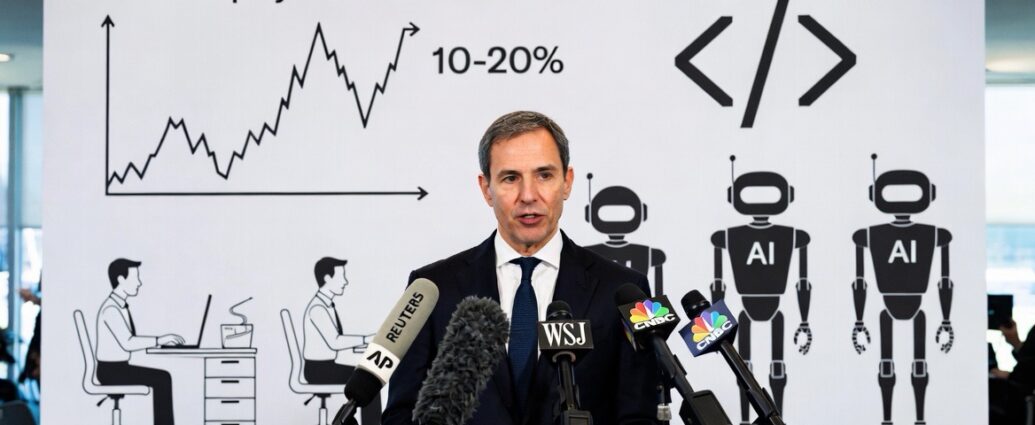
A stark warning from inside the artificial intelligence industry is sending new shockwaves through corporate America and policy circles, as Dario Amodei, CEO of Anthropic, cautioned that rapid advances in AI could eliminate a significant share of entry-level white-collar jobs within the next five years — potentially pushing U.S. unemployment to levels not seen in decades.
Speaking in an interview covered by Fortune and other major outlets, Dario Amodei said that the same systems driving unprecedented productivity gains are also poised to replace core functions traditionally handled by junior employees. Tasks such as data analysis, report drafting, and research synthesis — long considered foundational to early-career roles — are increasingly being handled by AI systems with growing accuracy and efficiency.
The sectors most exposed include finance, consulting, and technology, where entry-level employees typically perform structured, repeatable work. According to Dario Amodei, these are precisely the types of tasks that AI systems excel at. “The capabilities are improving faster than many people expected,” he said, warning that initial augmentation of jobs could quickly transition into outright replacement.
Early indicators suggest the shift is already underway. Data from venture capital firm SignalFire shows that hiring of new graduates by major technology companies has declined sharply compared with pre-pandemic levels. Meanwhile, outplacement firm Challenger, Gray & Christmas reported that tens of thousands of layoffs in 2025 were directly linked to AI-driven efficiency measures.
Academic research reinforces the concern. A study by the Massachusetts Institute of Technology (MIT) found that AI systems are already capable of performing tasks associated with a meaningful portion of the U.S. workforce, with potential cost savings reaching into the trillions annually. These findings suggest that the economic incentives for automation are only increasing.
Anthropic’s own internal research provides a detailed map of exposure. Peter McCrory, head of economics at Anthropic, said the company’s analysis of real-world usage data shows roles such as software developers, financial analysts, and customer service representatives among the most vulnerable. “The impact of this technology will be shaped by the choices that we make,” he said.
Despite the risks, Dario Amodei emphasized that AI also offers significant upside, including breakthroughs in medicine, energy, and scientific discovery. But he stressed that these benefits do not negate the need for preparation. “We may indeed have a serious employment challenge,” he said, particularly as the pipeline for entry-level roles begins to shrink.
For businesses, the shift presents a strategic dilemma. Companies must balance the immediate cost advantages of automation with the long-term need to develop talent. Without entry-level roles, the traditional pathway for training future leaders becomes uncertain.
For policymakers, the challenge is even more complex. The speed of AI adoption is outpacing existing frameworks for workforce development and economic policy, raising questions about education, retraining, and potential safety nets.
The timeline, according to Dario Amodei, is no longer theoretical. The transformation is already underway — and accelerating.
The question now is not whether AI will reshape the labor market, but how quickly — and whether institutions are prepared for the scale of disruption ahead.
JBizNews Desk- Technology