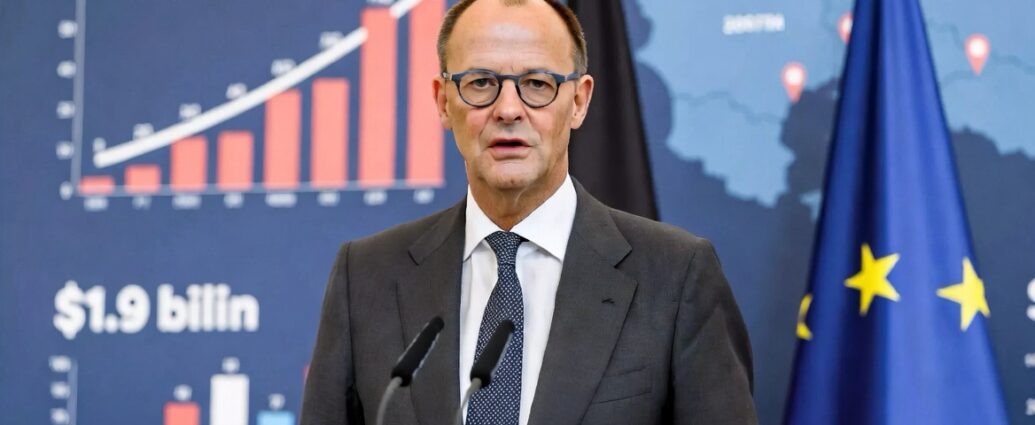
German Chancellor Friedrich Merz has unveiled a €1.6 billion ($1.9 billion) fuel relief package aimed at shielding households and businesses from surging energy costs triggered by the Iran conflict, as Europe’s largest economy grapples with the growing fallout from global supply disruptions.
The package, announced following coalition discussions within the German Federal Government, includes temporary reductions in fuel taxes and provisions allowing employers to provide tax-free bonuses to workers. The measures are designed to offset rising inflation and stabilize economic activity amid a rapidly shifting energy landscape.
“The war is the root cause of the problems we face,” Friedrich Merz said, directly linking Germany’s economic challenges to disruptions in global oil markets. His remarks underscore the extent to which geopolitical developments are influencing domestic policy decisions.
Fuel prices across Europe have surged following disruptions tied to the Strait of Hormuz, according to data from the International Energy Agency (IEA). Germany, as a major industrial economy, is particularly sensitive to energy costs, which feed directly into production, transportation, and consumer prices.
Economic forecasts are already being revised downward. Leading institutions including the Ifo Institute and DIW Berlin have cut their outlook for Germany’s 2026 growth, citing higher energy costs and weakening industrial output.
Katherina Reiche, Germany’s Economy Minister, is pushing additional support measures, including expanded subsidies for energy-intensive industries, highlighting concerns about competitiveness and employment.
The impact extends beyond Germany. Governments across Asia, including the Philippines Department of Energy, have declared energy emergencies, while countries such as Thailand have introduced conservation measures and remote work policies to reduce fuel consumption.
Despite the scale of intervention, Friedrich Merz acknowledged the limits of government action. “The state cannot absorb all uncertainties, not all risks, not all disruptions,” he said, signaling that further economic adjustments are likely.
Critics argue that the package is a short-term solution to a structural problem, as Europe continues to grapple with dependence on global energy markets. At the same time, fiscal constraints limit the government’s ability to provide broader support without undermining long-term policy goals.
The broader implication is clear: the Iran conflict is no longer a regional issue — it is a global economic shock affecting growth, inflation, and policy decisions across continents.
For Germany, the coming months will test its ability to navigate that reality while maintaining economic stability.
The energy crisis is evolving — and its full impact is still unfolding.
JbizNews Desk – Europe