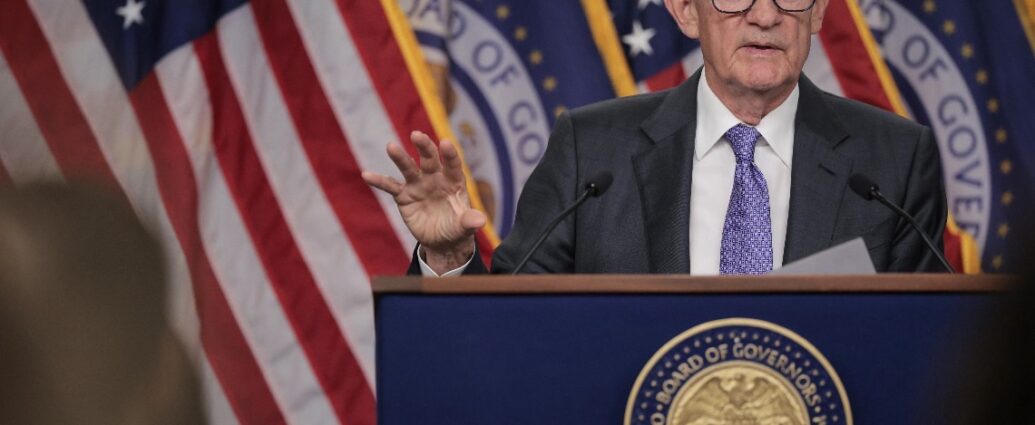
The U.S. Department of Justice on Friday dropped its criminal investigation into Jerome Powell, removing a major obstacle to the Senate confirmation of Kevin Warsh and intensifying scrutiny over the future direction of U.S. monetary policy at the Federal Reserve, where leadership turnover now appears imminent.
Jeanine Pirro said her office would close the probe and shift oversight of a multibillion-dollar renovation of Federal Reserve buildings to the central bank’s inspector general, stating in a public post that the review would assess “building cost overruns — in the billions of dollars — that have been borne by taxpayers,” while warning the Justice Department could reopen the case if new facts emerge.
The reversal by the Justice Department came days after Pirro indicated the investigation remained active, underscoring the political sensitivity surrounding the Federal Reserve as Donald Trump has pressed for lower interest rates, with the probe having focused on a renovation project approved by the Fed’s Board of Governors in 2017 that grew from roughly $1.9 billion to $2.5 billion, according to figures cited by the Federal Reserve and reported by major outlets including NBC News.
Powell, who has led the Federal Reserve since 2018, said earlier this year that subpoenas issued by prosecutors should be viewed in the context of broader pressure from the administration, while a federal prosecutor acknowledged in court that there was no evidence of criminal wrongdoing, a dynamic that raised concerns among economists and policymakers about potential encroachment on central bank independence.
The decision has immediate implications for the Senate Banking Committee, where Thom Tillis had blocked Warsh’s nomination, telling the nominee during a confirmation hearing that ending the investigation was a prerequisite for his support, effectively halting progress in a closely divided committee controlled by Republicans.
Tim Scott, chairman of the Senate Banking Committee, said in a CNBC interview that shifting oversight to the Federal Reserve’s inspector general would allow lawmakers to access more information while advancing the nomination, adding that findings from the review could still lead to further action if warranted, including potential criminal referrals.
The White House, through spokesperson Kush Desai, said the inspector general review would provide “answers about the Federal Reserve’s fiscal mismanagement,” while expressing confidence that the Senate would move quickly to confirm Warsh, a former Fed governor who has advocated changes to the central bank’s approach to interest rates and balance sheet policy.
Democratic lawmakers sharply criticized the move, with Elizabeth Warren arguing that closing the probe while leaving open the possibility of reopening it creates ongoing pressure on the Federal Reserve, warning that the development reflects broader efforts to influence monetary policy decisions at a time of heightened economic uncertainty.
The dispute has also intersected with a separate legal battle involving Lisa Cook, whose position has been challenged by the administration, highlighting the extent to which the Federal Reserve’s leadership structure has become a focal point of political contention in Washington.
Warsh, who served as a Federal Reserve governor from 2006 to 2011 and was originally nominated by President George W. Bush, told lawmakers during his confirmation hearing that “monetary policy independence is essential,” while signaling that he would pursue what he described as a shift in how the central bank conducts policy, including a greater reliance on interest rates rather than large-scale asset purchases.
The Federal Reserve’s balance sheet, which remains near $6.7 trillion following years of quantitative easing, has been a central point of criticism for Warsh, who previously opposed expansionary policies during his tenure and has indicated he may scale back forward guidance and public communications practices introduced under Powell.
Market participants are now assessing whether Warsh would align with the administration’s push for rate cuts or maintain a more traditional, inflation-focused stance, with Janet Yellen noting in recent remarks that any significant policy shift would require consensus within the Federal Open Market Committee, which includes multiple voting members beyond the chair.
The economic backdrop further complicates expectations, as policymakers at the Federal Reserve continue to monitor inflation pressures tied to geopolitical developments and trade policy, factors that have led the central bank under Powell to maintain elevated interest rates longer than many market participants had anticipated.
Powell’s term as chair is set to expire on May 15, though he could remain on the Federal Reserve’s Board of Governors through 2028, leaving open questions about continuity and influence within the institution as leadership transitions unfold.
The Federal Reserve’s Office of Inspector General said it is actively reviewing the renovation project and expects to provide findings to Congress and the public, a process that could shape perceptions of governance at the central bank even as the immediate legal threat has receded.
For financial markets, the end of the Justice Department probe removes a key source of uncertainty that had weighed on expectations for monetary policy leadership, but investors are likely to focus closely on signals from Warsh and lawmakers in the coming weeks as the confirmation process advances and the Federal Reserve approaches a pivotal transition.
JBizNews Desk