Senate Advances $70 Billion DHS Enforcement Plan as Shutdown Drags Past 70 Days
The U.S. Senate approved a Republican budget blueprint authorizing up to $70 billion in funding for immigration enforcement agencies, a procedural step that moves forward Donald Trump’s border agenda but leaves unresolved a record-long shutdown at the Department of Homeland Security, where funding gaps and workforce strain continue to disrupt operations across key agencies including the Transportation Security Administration.
The measure passed 50–48 following an overnight session led by John Thune, with Republican senators Lisa Murkowski and Rand Paul voting against the plan, highlighting the narrow margin facing Republican leadership as the legislation heads to the U.S. House of Representatives for approval before detailed spending legislation can be drafted.
The funding divide has exposed operational imbalances within DHS, where U.S. Immigration and Customs Enforcement and U.S. Customs and Border Protection employees have continued to receive pay under prior multi-year appropriations, while TSA workers remain unpaid due to reliance on annual funding cycles, a disparity that Markwayne Mullin has warned is unsustainable as emergency funds near depletion.
Under legislation passed in 2025 backed by Trump, approximately $75 billion was allocated to ICE operations over four years, including $45 billion for detention capacity and $30 billion for workforce expansion, allowing enforcement agencies to maintain payroll during the shutdown even as other DHS units, including TSA, operate without appropriated funding, according to data cited by PBS NewsHour and federal budget documents.
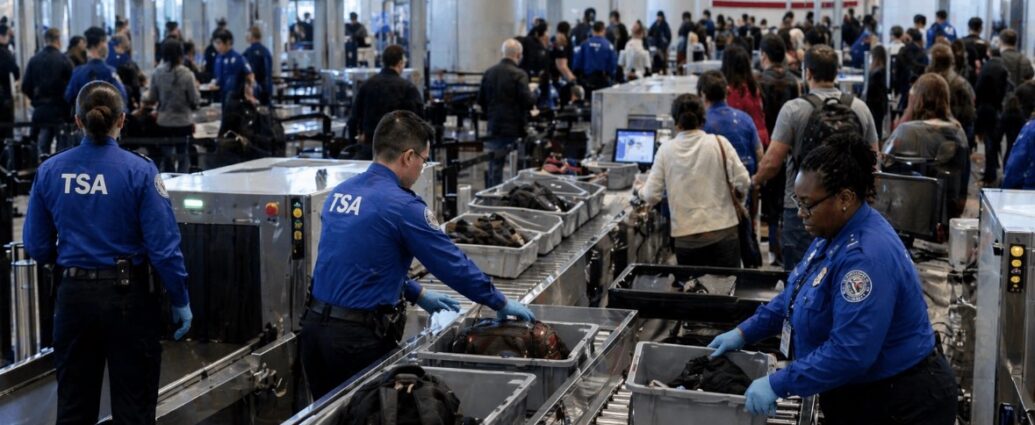
The consequences have been acute for TSA, where acting administrator Ha Nguyen McNeill told lawmakers that more than 838 officers have resigned since the shutdown began, with absentee rates exceeding 40% at major airports, forcing extended wait times and emergency staffing measures as workers struggled with unpaid wages and rising living costs.
In response, Trump authorized the deployment of ICE personnel to assist at major airports, a move acknowledged by border enforcement official Tom Homan, who said ICE agents lack specialized training for screening operations but could support perimeter and crowd management as TSA staffing levels deteriorated.
The shutdown, which began on February 14 after a continuing resolution expired, has been shaped by competing policy demands following fatal enforcement incidents that prompted Democratic lawmakers to seek operational restrictions on immigration agencies, including warrant requirements and expanded oversight measures, proposals that Republican leadership rejected as limiting enforcement authority.
Mike Johnson has aligned with conservative members of his conference, including Andy Harris, in opposing any partial funding bill that excludes ICE and CBP, arguing that separating enforcement funding risks weakening border security efforts, a stance that has stalled bipartisan appropriations legislation already passed by the Senate.
At the same time, Senate Budget Committee Chair Lindsey Graham is advancing a reconciliation strategy that would allow immigration enforcement funding to pass with a simple majority, bypassing Democratic opposition, though the narrow Senate margin leaves little room for additional defections following the Murkowski and Paul votes.
Financial pressure is mounting as DHS emergency reserves dwindle, with Mullin warning that available funds — estimated at roughly $1.4 billion as of mid-April according to the Office of Management and Budget — are insufficient to cover the department’s approximately $1.6 billion biweekly payroll beyond early May, raising the risk of renewed payment disruptions even after temporary relief measures.
Republican lawmakers, including Senate Appropriations Committee Chair Susan Collins, have criticized Democrats for linking funding to policy conditions, arguing that failure to fund enforcement agencies undermines national security, while the DHS press office has described the situation as avoidable and damaging to frontline workers.
Democratic leaders, led by Senate Minority Leader Chuck Schumer and House Minority Leader Hakeem Jeffries, have countered that the shutdown stems from Republican insistence on expanding enforcement funding without accompanying reforms, with Schumer warning that Congress should not approve what he described as “blank check” funding for immigration agencies.
The legislative path forward requires the House to adopt the Senate’s blueprint before committees can draft reconciliation legislation, a process that must navigate Senate rules limiting non-budgetary provisions, while any changes by House lawmakers would require renewed Senate approval, extending timelines amid already strained agency operations.
Operational challenges are also intensifying ahead of the 2026 FIFA World Cup, where TSA expects a surge in passenger traffic, with agency officials noting that new hires require up to six months of training, limiting the ability to offset workforce attrition in the near term.
For financial markets and industries tied to travel and logistics, the prolonged shutdown introduces uncertainty around airport throughput, labor availability, and federal operations, while lawmakers in both parties face increasing pressure to resolve the impasse before funding gaps deepen and operational disruptions expand further across the homeland security system.
JBizNews Desk