Defense & Energy | Friday, April 24, 2026 | JBizNews Desk
The Pentagon signaled a major escalation in U.S. strategy toward Iran on Friday, as Secretary of Defense Pete Hegseth outlined a sweeping expansion of naval enforcement operations that now extend far beyond the Middle East, transforming what began as a regional containment effort into a global pressure campaign targeting Tehran’s economic lifelines.
Speaking at a Pentagon briefing alongside Air Force Gen. Dan Caine, Chairman of the Joint Chiefs of Staff, Hegseth described the operation—dubbed Operation Epic Fury—as “ironclad,” with U.S. naval forces now actively enforcing restrictions on Iranian-linked shipping routes across multiple oceans. “They can watch their regime’s fragile economic state collapse under the unrelenting pressure of American power,” Hegseth said, framing the blockade as a calculated effort to cut off Iran’s ability to export oil, generate foreign currency, and sustain core government functions.
The expanded operation reflects a strategic shift from geographic containment at the Strait of Hormuz to a broader interdiction model. U.S. Navy forces are now monitoring and, where necessary, turning back vessels tied to Iranian ports or cargo flows regardless of location. Pentagon officials confirmed that 34 non-Iranian vessels have been cleared to proceed after inspections, while multiple tankers have been stopped and boarded since enforcement began.
The global reach of the campaign was underscored this week by the interception of two Iranian “Dark Fleet” vessels in the Indo-Pacific, according to Pentagon officials. These ships—part of a loosely regulated network used to transport sanctioned oil outside traditional monitoring systems—had departed Iranian ports prior to the enforcement window but were nonetheless seized. The move signals Washington’s intent to enforce restrictions well beyond traditional chokepoints and into open ocean transit routes.
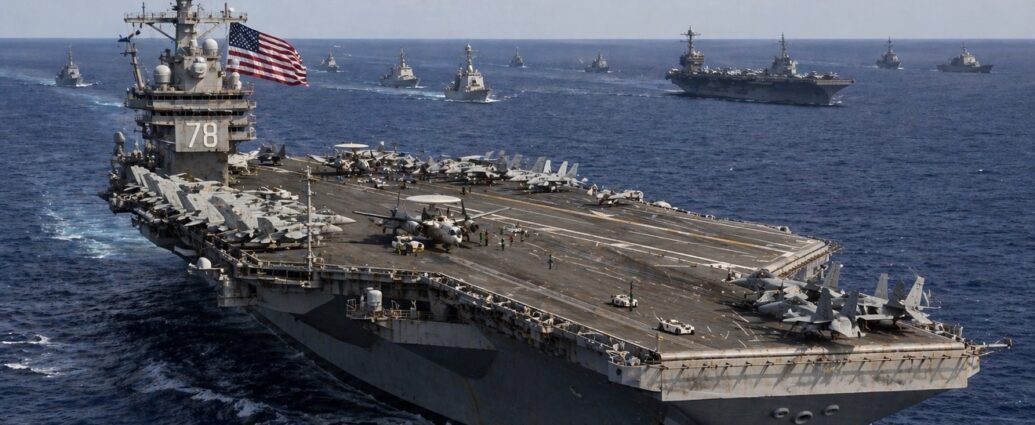
At the same time, U.S. military posture in the region continues to intensify. Hegseth confirmed that a second U.S. aircraft carrier will join the operation in the coming days, adding to an already substantial presence that includes the USS Abraham Lincoln, USS Gerald R. Ford, and USS George H.W. Bush carrier strike groups. Collectively, the deployment represents one of the largest concentrations of U.S. naval power in the region in decades, with more than 200 aircraft and approximately 15,000 personnel operating across multiple theaters.
Hegseth emphasized that the current approach is designed to achieve strategic objectives without immediate escalation into broader direct conflict. “The blockade is the polite way this can go,” he said, signaling that economic and logistical pressure is intended to force a shift in Tehran’s nuclear posture. At the same time, he made clear that military options remain active, noting U.S. forces are prepared to act if necessary under directives from President Donald Trump.
The briefing also included a firm warning on maritime security. “We will shoot to destroy. No hesitation,” Hegseth said, referring to Iranian efforts to deploy naval mines or threaten commercial shipping lanes. Pentagon officials indicated that rules of engagement have been tightened to allow rapid response against any perceived threats to international shipping, particularly in and around the Strait of Hormuz.
Energy markets are already reflecting the impact. Brent crude prices have climbed above $102 per barrel, as traders assess the risk of prolonged disruption to one of the world’s most critical energy corridors. According to data from the U.S. Energy Information Administration, roughly 20% of global oil and a significant portion of liquefied natural gas flows through the Strait of Hormuz—most of it bound for U.S. allies in Asia.
Hegseth also directed pointed remarks toward international partners, urging greater participation in enforcement efforts. “The time for free riding is over,” he said, noting that Europe and Asia remain significantly more dependent on Gulf energy flows than the United States. The comments come as several economies—including Germany and key Southeast Asian nations—face mounting energy pressures linked to ongoing disruptions.
The broader economic implications are beginning to materialize across global supply chains. Shipping costs, insurance premiums, and fuel prices have all moved higher in recent weeks, creating ripple effects for industries ranging from manufacturing to aviation. Analysts say the longer the current restrictions remain in place, the more deeply those costs will embed into global pricing structures.
For Washington, the objective remains clear: leverage economic pressure and military positioning to force a strategic recalibration in Tehran without triggering a wider conflict. For markets and multinational businesses, however, the situation introduces a new layer of uncertainty—one where geopolitical risk is directly shaping the cost and flow of global trade.
As the operation expands and additional forces come online, attention will shift to whether Iran responds through escalation, negotiation, or alternative trade channels. The outcome will not only determine the next phase of the conflict but also set the tone for how economic warfare is deployed in future geopolitical confrontations.
JBizNews Desk