Berkshire Hathaway is drawing renewed attention from value-focused investors even as its shares continue to lag the broader market. The conglomerate, long a benchmark for steady performance under Warren Buffett, is experiencing one of its most pronounced periods of underperformance against the S&P 500 in decades.20
Berkshire Hathaway shares have fallen roughly 6-7% year-to-date in 2026, while the S&P 500 has advanced about 4%. Over the past 12 months, the gap widens significantly, with Berkshire trailing the index by around 30-40 percentage points in some measures. This stretch marks one of the widest divergences since Buffett took control in 1965.27
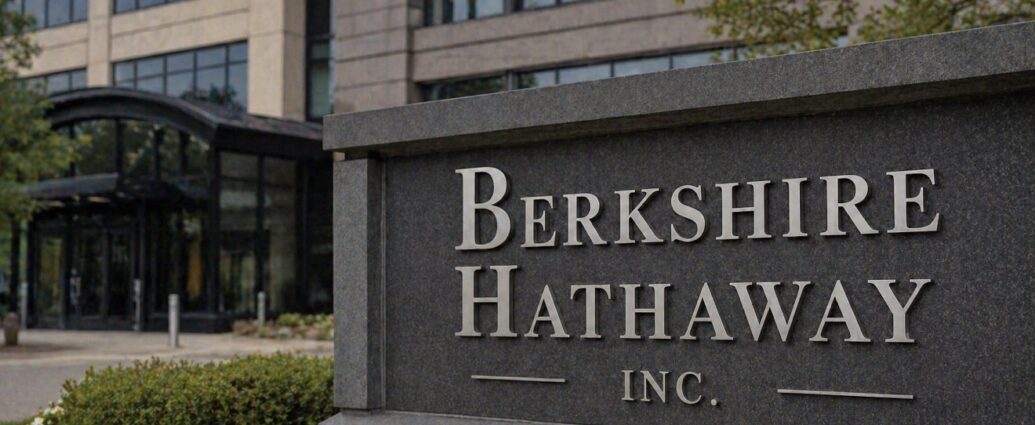
Highly realistic high-resolution news photograph of Berkshire Hathaway headquarters building in Omaha, Nebraska on a clear sunny daytime. Modern corporate campus style with brick and glass architecture, green lawns, trees, American flag, professional documentary photo style like Bloomberg or Reuters for business finance article.landscape
The underperformance has accelerated since Buffett announced his planned departure as CEO in 2025, with Greg Abel now leading operations. Berkshire Hathaway’s heavy cash position — exceeding $300 billion — has acted as a drag in a market dominated by high-growth technology stocks. While the cash provides a defensive buffer and earning power through Treasury investments, it has limited participation in the S&P 500’s recent rally.23
Analysts note that Berkshire Hathaway resumed share repurchases in early 2026, signaling confidence in its valuation. Greg Abel has also personally invested in the stock. Despite these moves, the company’s diversified portfolio of insurance, railroads, utilities, and consumer businesses has not kept pace with the tech-heavy index. Insurance underwriting results have faced headwinds, and organic growth in operating subsidiaries has been modest.11
Yet this very weakness is what is attracting fresh interest. At current levels, Berkshire Hathaway trades near 1.4 times book value — closer to historical norms — and offers an earnings yield in the mid-5% range when including look-through earnings from its equity portfolio. Some observers argue that not much needs to go right for the stock to deliver market-beating returns going forward, even in a post-Buffett era.35
Berkshire Hathaway’s massive cash hoard positions it to act decisively when opportunities arise. The company has historically excelled in deploying capital during periods of market stress. With valuations elevated in many sectors, patient capital like Berkshire’s could prove advantageous if economic conditions shift.19
The transition to Greg Abel remains a focal point. While he has deep operational experience running Berkshire’s energy and utilities businesses, investors are still assessing his capital allocation style compared to Buffett’s legendary track record. The stock’s recent weakness may reflect some uncertainty around this handover, though Abel has largely maintained the same conservative approach.
From a broader market perspective, Berkshire Hathaway’s lag highlights the dominance of a handful of mega-cap technology names in the S&P 500. The index’s concentration in companies like Nvidia, Apple, Microsoft, and others has driven outsized gains, leaving more diversified or value-oriented names behind. Berkshire holds significant stakes in several of these names but has been a net seller of equities in recent quarters.22
Long-term investors point out that Berkshire Hathaway has underperformed the S&P 500 in full calendar years only about 20 times since 1965. Many of those periods were followed by strong relative recoveries, especially when the market eventually rotated away from high valuations.34
Berkshire Hathaway also benefits from its insurance float, which provides low-cost leverage, and its collection of stable cash-generating businesses. These attributes make it resilient in downturns — a quality that could regain favor if inflation concerns, geopolitical risks, or a market correction materialize.
Wall Street’s view is mixed but increasingly constructive on valuation. While some analysts caution that Berkshire still needs to demonstrate stronger growth to justify current levels, others see it as one of the more attractively priced large-cap options in an expensive market. The resumption of buybacks and the potential for opportunistic acquisitions add to the appeal.23
For individual investors, Berkshire Hathaway Class B shares (BRK.B) offer a straightforward way to gain exposure to a diversified empire without the high per-share price of Class A shares. The stock’s current discount to recent highs, combined with its fortress balance sheet, is prompting many to take a closer look.
As the market digests the post-Buffett reality, Berkshire Hathaway’s underperformance may ultimately create a compelling entry point for those with a long-term horizon. Whether the company can narrow the gap with the S&P 500 will depend on capital deployment success, insurance results, and broader economic conditions.
JbizNews Desk