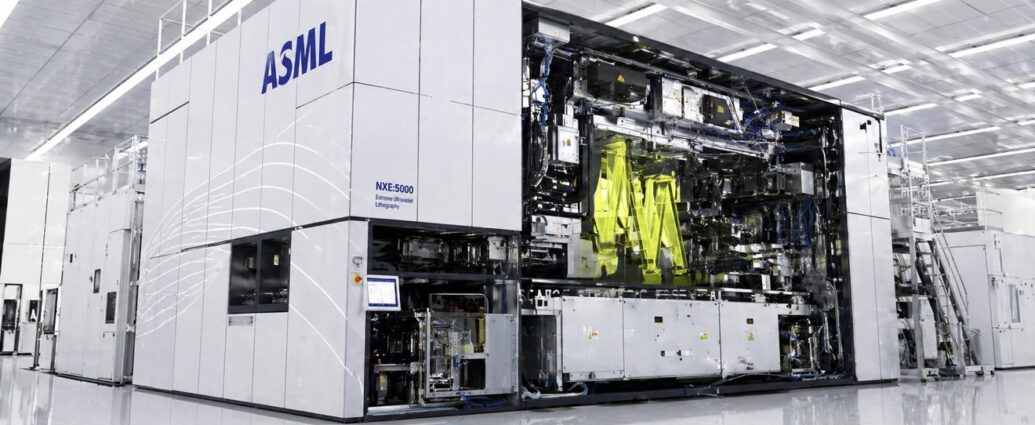
VELDHOVEN, Netherlands — ASML Holding remains the world’s only supplier of the specialized machines required to manufacture cutting-edge artificial intelligence chips at commercial scale. As big tech giants pour hundreds of billions into AI infrastructure, the Dutch company finds itself at the epicenter of the global semiconductor boom.
ASML’s extreme ultraviolet (EUV) lithography systems enable the production of the most advanced processors that power popular AI models like OpenAI’s ChatGPT and Google’s Gemini. Without these machines, the rapid scaling of high-performance AI chips would not be possible.
Highly realistic news photograph of the ASML headquarters and factory complex in Veldhoven, Netherlands on a bright sunny day. Modern high-tech industrial architecture with glass facades, steel structures, corporate signage visible, clean professional documentary style suitable for business finance news article.landscape
Demand has accelerated dramatically. On April 15, 2026, ASML reported strong first-quarter results with €8.8 billion in net sales and a 53% gross margin. The company raised and narrowed its full-year 2026 revenue guidance to between €36 billion and €40 billion (approximately $42 billion to $47 billion), citing surging AI-driven orders.20
ASML is racing to expand capacity. The company plans to produce at least 60 of its standard Low-NA extreme ultraviolet machines in 2026 — a roughly 25-36% increase over 2025 levels — and aims for at least 80 units in 2027. It is building new facilities, repurposing existing cleanrooms, and optimizing production lines while adding engineers to its workforce. Leadership roles in certain areas have been streamlined to speed up decision-making.24
Christophe Fouquet, ASML’s Chief Executive Officer, made the company’s priorities clear: “We do not want to be the bottleneck for our customers.” The firm has learned from previous demand surges and is deploying every available tool to scale output without compromising quality or reliability.20
This momentum stems directly from explosive spending by major technology companies. Microsoft, Meta Platforms, Amazon.com, and Alphabet’s Google are collectively planning more than $600 billion in capital expenditures this year for AI data centers and related infrastructure. That spending is flowing downstream to chip manufacturers such as Taiwan Semiconductor Manufacturing Co. (TSMC), which in turn are increasing orders for ASML’s equipment.24
The boom has elevated ASML to Europe’s most valuable company by market capitalization, surpassing traditional luxury powerhouses like LVMH and Hermès. Its near-monopoly on EUV technology gives it unmatched strategic importance in the semiconductor supply chain.
ASML executives acknowledge the complexity of scaling such sophisticated equipment. Each machine represents years of engineering precision, involving hundreds of thousands of components and extreme cleanliness standards. Despite these challenges, the company reports strong progress in increasing output rates quarter by quarter.
Looking ahead, ASML is also advancing its next-generation High-NA EUV systems, which promise even greater resolution for future chip nodes. These tools are moving toward high-volume manufacturing and will play a key role in sustaining long-term growth.
Geopolitical factors remain a variable. Ongoing export restrictions, particularly related to China, introduce some uncertainty. However, management has built flexibility into its 2026 guidance to account for various regulatory outcomes.
For the broader market, ASML’s performance serves as a real-time indicator of the AI buildout’s health. Its ability to ramp production will help determine how quickly the industry can meet demand for advanced AI accelerators. With a substantial backlog and strong order momentum, the company appears well-positioned — though the margin for error stays narrow in a sector where every machine shipped directly impacts global computing capacity.
As artificial intelligence continues to reshape industries, ASML’s machines represent one of the most vital pieces of infrastructure in the modern economy. The Dutch firm’s expansion efforts underscore both the opportunities and the immense pressure of being the indispensable link in the AI supply chain.
JbizNews Desk