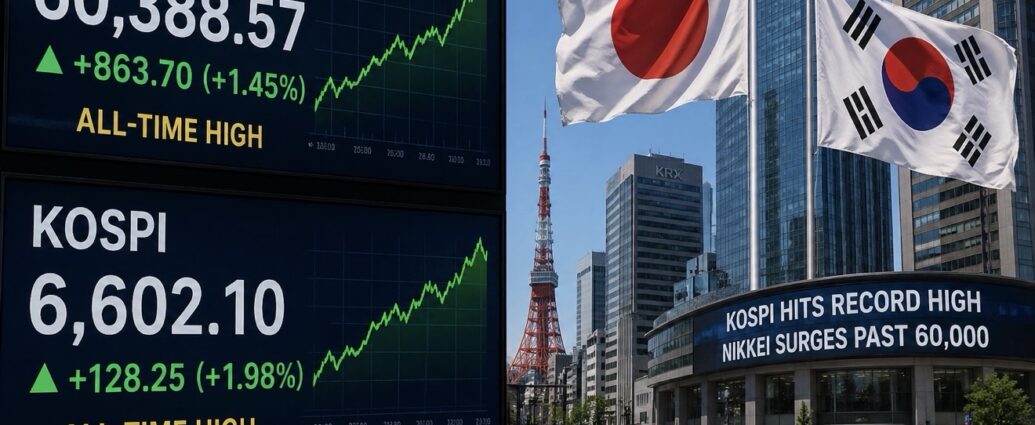
TOKYO / SEOUL — April 27, 2026 — Asian markets pushed to historic highs Monday as investors doubled down on the global artificial intelligence boom, brushing aside stalled U.S.-Iran negotiations and elevated oil prices to drive equities in Japan and South Korea to record levels.
Japan’s Nikkei 225 surged as much as 1.45%, breaking above the 60,000 mark intraday and trading near 60,585 before closing around 60,388 — a milestone that underscores the market’s deepening alignment with global AI-driven growth. The rally was led by export-heavy technology names tied to semiconductor demand, even as Brent crude hovered above $100 per barrel, reflecting ongoing tensions in the Middle East.
“AI and chip supply chains remain the dominant theme,” said Masashi Hashimoto, equity strategist at Nomura Securities. “Japanese exporters are benefiting from resilient global demand that has little to do with the Strait of Hormuz right now.”
In South Korea, the Kospi index climbed nearly 2%, reaching a fresh all-time high near the 6,600 level, driven by heavyweight semiconductor firms including Samsung Electronics and SK Hynix. The rally reflects surging global demand for high-bandwidth memory (HBM) — a critical component powering next-generation AI infrastructure.
Government officials in Tokyo and Seoul signaled cautious optimism. Bank of Japan policymakers, led by Governor Kazuo Ueda, continue to monitor inflation risks tied to higher energy prices while maintaining an accommodative stance that supports equity markets. Meanwhile, South Korea’s export data showed accelerating semiconductor shipments, reinforcing the strength of the country’s tech-led recovery.
Despite the strong momentum, analysts warn that the current disconnect between markets and geopolitics may not hold indefinitely. “Markets are shrugging off the news for now, but prolonged disruption in oil flows would eventually pressure importers like Japan and South Korea,” said Eunice Park, Asia macro strategist at Goldman Sachs. “Still, the AI capital expenditure cycle appears durable enough to absorb near-term volatility.”
The rally comes even as diplomatic efforts between Washington and Tehran stall. President Donald Trump canceled a planned envoy trip over the weekend, citing lack of progress on key issues including nuclear limits and regional security. Iranian officials have rejected recent proposals, and tensions remain elevated around critical shipping routes, particularly the Strait of Hormuz.
Yet markets across Asia have effectively decoupled from the headlines. The MSCI Asia Pacific Index rose approximately 1.3%, tracking gains on Wall Street where U.S. technology earnings continue to exceed expectations despite mixed economic signals.
Underpinning the surge are structural tailwinds. Japan’s corporate sector has benefited from governance reforms, stronger shareholder returns, and a weaker yen that boosts exporter earnings. In South Korea, policy shifts under President Lee’s administration aimed at supporting strategic industries have helped unwind the long-standing “Korea Discount,” drawing renewed foreign capital into equities.
“Semiconductor revenues are growing at double-digit rates,” said Rajiv Shah, head of Asia equity strategy at JPMorgan Chase. “That growth more than offsets the drag from higher energy costs.”
Still, the risks are real. Analysts estimate that a sustained increase in oil prices could shave up to 0.5 percentage points off GDP growth in both economies. Japan and South Korea remain heavily dependent on energy imports, leaving them exposed to prolonged geopolitical disruptions.
For now, however, the momentum is firmly with technology. Traders in Tokyo described Monday’s session as a “classic decoupling” — geopolitical headlines dominated screens, but capital continued flowing aggressively into semiconductor and AI-linked names. Market volumes remained strong without signs of speculative excess, suggesting conviction rather than short-term trading.
The coming days will test whether that conviction holds. A wave of U.S. corporate earnings — particularly from major technology firms — could reinforce or challenge the AI-driven narrative. At the same time, any escalation in the Middle East could quickly shift sentiment.
For now, the message from Asia’s two largest tech-driven markets is unmistakable: the AI boom is powerful enough to override geopolitical uncertainty — at least for the moment.
JBizNews Desk