One year after Beijing’s export curbs, efforts intensify to loosen its grip
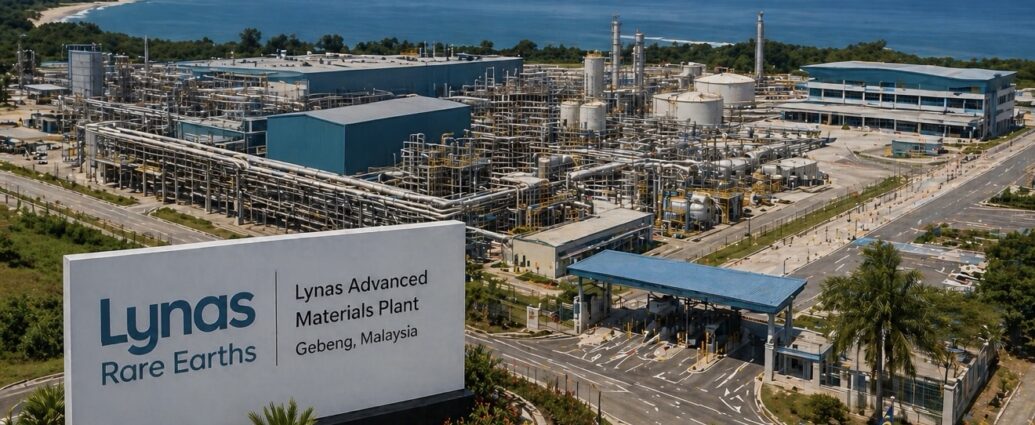
KUANTAN, Malaysia — April 27, 2026 — On Malaysia’s eastern coastline, far from Washington and Beijing, a sprawling industrial complex has quietly become one of the most critical nodes in the global balance of power. The Lynas Advanced Materials Plant, operated by Lynas Rare Earths Ltd., is now at the center of the Pentagon’s urgent push to break China’s grip on the rare earth supply chain — a dependency long viewed as one of America’s most dangerous strategic vulnerabilities.
Stretching across more than 220 football fields and powered by a workforce of roughly 850 engineers and chemists, the facility executes more than 1,300 production steps to isolate 15 rare earth elements — including samarium, terbium, and dysprosium, essential inputs for high-performance magnets used in advanced weapons systems, fighter jets, and missile guidance technologies.
The timing is no coincidence. After China imposed sweeping export restrictions on rare earth materials last year, global supply chains were shaken within weeks. Automakers from Ford Motor Co. in the United States to Suzuki Motor Corp. in Japan were forced to slow or halt production, exposing just how deeply the modern industrial economy depends on a narrow set of materials largely controlled by Beijing.
“Rare earths represent one of the most acute vulnerabilities in U.S. defense preparedness,” said Mike Cadenazzi, Assistant Secretary of Defense for Industrial Base Policy, speaking at the NDIA Pacific Operational Science and Technology Conference in Honolulu. He noted that China controls roughly 30% of global manufacturing output and dominates the processing of critical minerals essential to modern warfare.
Nowhere is that dominance more evident than in heavy rare earths — where 98% to 99% of global processing capacity remains inside China. Until recently, even Western producers had no alternative. Lynas itself, the largest rare earth miner outside China, was forced to send key materials back to Chinese refiners for final separation.
That changed in 2025, when the Malaysian plant became the first facility outside China capable of commercially separating heavy rare earth oxides at scale — a breakthrough that has rapidly elevated its geopolitical significance.
The Pentagon has responded with unusual urgency. The U.S. Department of Defense has backed Lynas with direct financial support and long-term procurement commitments, including a $110-per-kilogram price floor on key materials under a multi-year offtake agreement. The goal is clear: eliminate China’s ability to manipulate prices and choke off Western competitors.
“Price suppression has been one of China’s most effective tools,” said Amanda Lacaze, CEO of Lynas Rare Earths. “A guaranteed floor price ensures that Western production remains viable regardless of market fluctuations.”
The strategy is being coordinated across allies. Japan has adopted a similar pricing mechanism, creating a unified front designed to neutralize Beijing’s longstanding tactic of undercutting global prices to drive competitors out of business.
At the same time, the U.S. is extending the supply chain back home. The Pentagon has committed $258 million to support Lynas in building a rare earth processing facility in Texas, while also investing in domestic players including MP Materials, where it has taken a direct equity stake to accelerate U.S.-based production.
The broader push spans multiple continents. During recent diplomatic engagements, the U.S. secured agreements with Malaysia, Thailand, Japan, and Australia to expand rare earth exploration, processing, and stockpiling — part of a coordinated effort to rebuild a supply chain that had quietly migrated to China over decades.
The urgency is driven by a hard deadline. Under U.S. defense policy, starting January 1, 2027, no Chinese-origin rare earth materials can be used in American weapons systems. The rule follows a 2022 incident in which a Chinese-made magnet was discovered in an F-35 fighter jet, triggering a temporary production halt and exposing the depth of U.S. reliance on adversarial supply chains.
That deadline is forcing rapid action across the defense-industrial base. Companies like REalloys, backed by senior defense officials including former Pentagon Chief of Staff Joe Kasper and retired General Jack Keane, are racing to build domestic capabilities in rare earth metal production — one of the most technically challenging segments of the supply chain.
Yet even as investments surge, the challenge remains immense. Analysts estimate that rebuilding a fully independent Western rare earth ecosystem could take years, if not decades — particularly given China’s scale, cost advantages, and entrenched infrastructure.
For now, Malaysia has emerged as the unexpected frontline.
In a global contest increasingly defined not just by military power but by control over supply chains, the Lynas facility in Kuantan represents more than an industrial site — it is a strategic pivot point in the effort to rebalance economic and national security power away from Beijing.
Whether the West can translate urgency into sustained production before China reasserts its dominance may prove to be one of the defining industrial and geopolitical questions of the decade.
JBizNews Desk