April 27, 2026 | JBizNews Desk
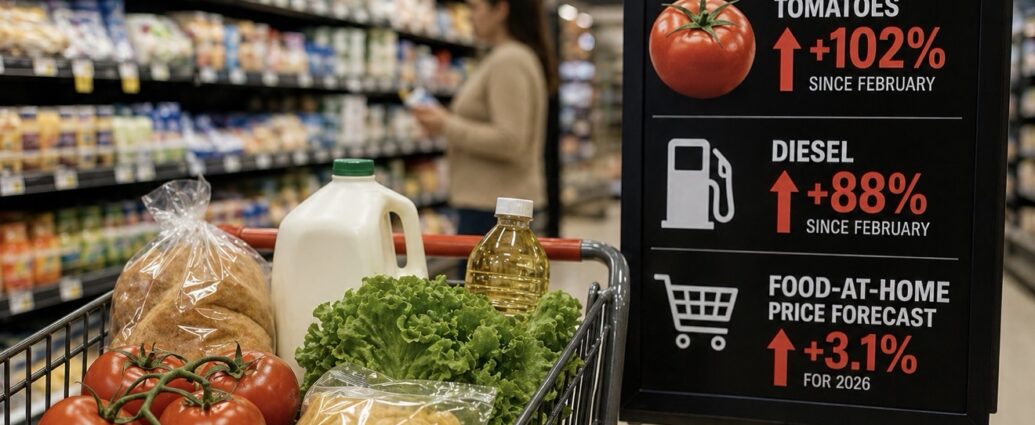
American consumers already feeling pressure at the grocery store may be facing a second, more severe wave of food inflation. While headline numbers are already striking—wholesale tomato prices up 102% and diesel costs soaring 88% since late February—economists and federal officials warn that the full impact of the Middle East crisis has yet to reach U.S. households.
The disruption traces back to the Strait of Hormuz, a critical global artery through which roughly 20% of the world’s oil supply and nearly one-third of globally traded fertilizer flows. Following the outbreak of conflict on February 28, closures and instability triggered what the International Energy Agency described as the largest oil supply shock in modern history. The result is a cascading effect on food prices that unfolds in stages—energy first, fertilizer next, and ultimately crop yields—each layer compounding the next.
Tyler Schipper, an economist at the University of St. Thomas, explained the mechanism clearly: “Pretty much everything you buy off a shelf is delivered by a truck that uses diesel. It’s the transmission belt from an energy shock to consumer prices.” Diesel, which powers both transportation and farm equipment, surged to over $5.60 per gallon in March and has continued climbing, with cumulative increases approaching 88% across key regions and wholesale markets.
That surge is now working its way through the supply chain. David Ortega, a food economist at Michigan State University, noted that diesel impacts every stage of production and distribution. “Tractors run on diesel. Most food moves by truck. These higher fuel costs translate directly into higher prices—and eventually, the consumer feels it.” Perishable goods, which rely on refrigerated transport, are being hit first and hardest.
Nowhere is that more visible than in tomatoes. Often viewed as a bellwether for produce inflation, tomatoes have become the clearest early indicator of stress in the system. At the retail level, prices have climbed to roughly $2.25 per pound, an 18.6% increase since February, according to David Branch of the Wells Fargo Agri-Food Institute. But wholesale dynamics are far more dramatic. Distributors report prices jumping from $25 to over $80 per 25-pound box in just weeks—a more than 200% increase in some cases.
The surge reflects a convergence of factors. Domestic supply was already constrained after Florida crops were hit by winter freezes, while Mexico’s production suffered from disease and weather disruptions. The added pressure from rising fuel costs has intensified the spike, particularly for a product that is highly perishable and heavily reliant on trucking.
Critically, economists emphasize that these increases are only partially reflected at the retail level. Ricky Volpe, an agribusiness professor at California Polytechnic State University, warned that the pricing pipeline is still catching up. “There’s more pain ahead,” he said, noting that it typically takes one to two months for energy-driven cost increases to fully reach grocery shelves.
Beyond transportation, a second and potentially more damaging wave is building at the farm level. A recent American Farm Bureau Federation survey found that 70% of farmers cannot afford all the fertilizer they need, while nearly 60% report worsening financial conditions. Fertilizer prices have surged sharply, with urea up 49%, UAN up 38%, and anhydrous ammonia up 32%, according to analyst Josh Linville.
For farmers, the economics are increasingly unsustainable. Matt Frostic, a Michigan-based operator, said nitrogen fertilizer has jumped from $350 per ton to nearly $600 in just a few months. Meanwhile, the U.S. Department of Agriculture estimates that corn costs approximately $5 per bushel to produce, yet sells for around $4.20, while soybeans cost $12.27 to produce and fetch just $10.30. That gap is forcing farmers to cut inputs—decisions that could reduce yields and tighten supply later this year.
Agriculture Secretary Brooke Rollins acknowledged the growing strain, stating that “everything is on the table” to support farmers. However, with only 20% to 25% of farmers exposed to current fertilizer prices—the rest having locked in earlier—the full impact is expected to materialize during the upcoming harvest cycle.
The USDA now projects food-at-home prices to rise 3.1% in 2026, nearly double earlier forecasts. Yet analysts caution that even this revised estimate may understate what’s coming, as it does not fully account for sustained energy volatility or reduced agricultural output.
Lydia Boussour, senior economist at EY-Parthenon, pointed to lingering structural pressures. “The impact will extend beyond the duration of the conflict,” she said, citing ongoing supply chain constraints and energy capacity limits. Similarly, Adam Hanieh of the SOAS Middle East Institute warned that earlier projections underestimated the scale of disruption. “Food inflation is very much on the table for the remainder of the year,” he said.
For consumers, the message is straightforward: the current spike may not represent the peak. The shock that began in the Strait of Hormuz is still moving through the system—measured not in days, but in months.
What comes next will depend on how long energy markets remain volatile and whether supply chains stabilize. But for now, the data points in one direction: higher prices ahead.
— JBizNews Desk