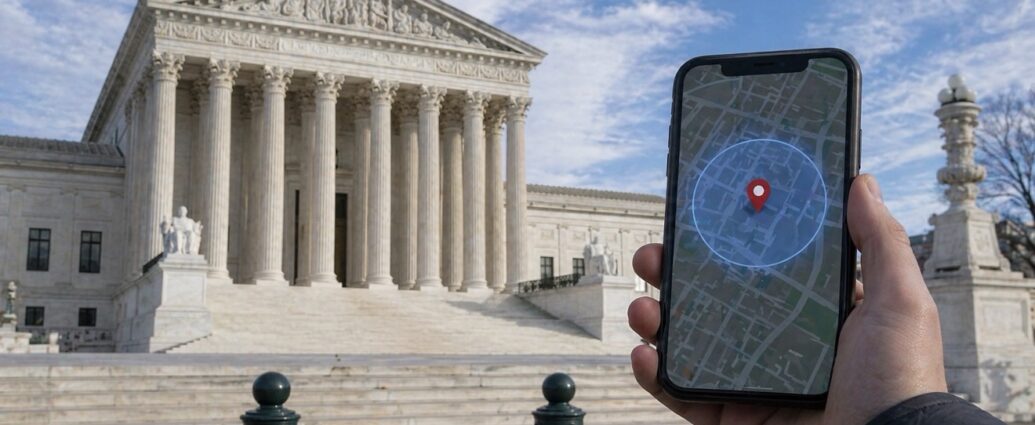
The U.S. Supreme Court is set to hear a closely watched dispute over police use of geofence warrants, a case that could reshape how investigators obtain location data from technology companies and how far Fourth Amendment protections extend in the smartphone era. In court filings reviewed through the Supreme Court docket and lower-court records, Okello Chatrie argues that the government’s demand for location data tied to a bank robbery investigation crossed a constitutional line, while the U.S. Department of Justice has said investigators acted lawfully under a warrant approved by a judge.
At issue is a once-common investigative tool that let law enforcement seek anonymized location data for devices detected within a defined area and time window, typically from Google, whose legal compliance process and public statements have drawn repeated scrutiny in recent years. In a 2023 update on location history, Google said it had begun changing how such data is stored and processed, adding that the move would “better protect your privacy,” according to the company’s official blog, a shift widely interpreted by legal analysts and reported by Reuters and other outlets as a response to mounting pressure over geofence requests.
The case stems from the 2019 conviction of Chatrie, who challenged a geofence warrant used after a 2019 bank robbery in Virginia, according to opinions from the U.S. Court of Appeals for the Fourth Circuit. In its ruling, the appeals court said the warrant implicated Fourth Amendment concerns but allowed the evidence under the good-faith exception, with the judges explaining that officers relied on a warrant approved by a magistrate. That split outcome turned the case into a major test for digital privacy because, as the court put it in substance, location data can reveal “deeply revealing” details about a person’s life, language that echoed broader Supreme Court privacy reasoning in earlier cases.
The constitutional fight turns heavily on the Supreme Court’s 2018 decision in Carpenter v. United States, where Chief Justice John Roberts wrote for the majority that people hold a legitimate expectation of privacy in historical cell-site location information, even when that data sits with a third party. Roberts said then that granting the government “near perfect surveillance” through digital records demanded constitutional limits, according to the court’s opinion. Lawyers for Chatrie have argued in current filings that geofence warrants present an even broader privacy threat because they begin with a place and sweep in many devices, including those of people with no connection to a crime.
The government has countered that the search here unfolded through a warrant process and that investigators narrowed the request in stages, a position laid out in briefs filed by the Solicitor General. The Justice Department has argued that users voluntarily shared location information with Google through account settings and app services, invoking the long-debated third-party doctrine that historically limited privacy claims over business records held by others. That argument faces skepticism from privacy advocates and some judges, who have said modern digital services collect data on a scale that older legal precedents never contemplated, as reflected in amicus briefs from groups including the Electronic Frontier Foundation and the American Civil Liberties Union.
The business stakes reach well beyond criminal procedure because the ruling could affect compliance costs, data-retention practices and product design across the technology sector. In public statements over the past two years, Google has said it is “committed to keeping user data private and secure,” and its redesign of location history storage aimed to reduce the amount of centrally accessible data available in the first place. That shift matters for companies facing rising legal demands for user information, and analysts cited by Bloomberg and Reuters have said a tougher constitutional standard could accelerate industry moves toward on-device storage, shorter retention periods and narrower default data collection.
Law enforcement agencies, meanwhile, have warned in court papers and public commentary that geofence data can help solve violent crimes quickly when investigators lack suspects, witnesses or usable surveillance footage. Prosecutors in the Chatrie matter said the location search formed one part of a broader investigation, not the sole basis for the case, according to appellate records. But civil-liberties lawyers say the method reverses the traditional logic of warrants by identifying everyone near a scene first and sorting out suspicion later, a concern that several judges in the Fourth Circuit highlighted in separate opinions.
The timing also matters because geofence warrants already have become less available in practice even before a final constitutional answer arrives. Google indicated in prior public disclosures that changes to location history architecture would make many such requests harder or impossible to fulfill in the same way, and reporting from CNBC and Reuters has noted that the company’s policy shift altered a key pipeline long used by police. Even so, the Supreme Court’s ruling could still set a durable national standard for digital searches involving app data, cloud records and future forms of location tracking beyond the specific tool at issue here.
What comes next carries unusual weight for both Silicon Valley and criminal investigators. Oral arguments on April 27 will give the justices a chance to test whether Carpenter extends to geofence warrants and whether a place-based digital dragnet fits within the Fourth Amendment’s requirement that warrants describe with particularity what officers may search and seize. A decision by the end of the court’s term could determine not only the fate of one conviction, but also how much latitude police retain in the data economy and how aggressively technology companies redesign systems to limit what they can hand over when the government comes calling.
JBizNews Desk