April 27, 2026 | JBizNews Desk
U.S. budget airlines are escalating their appeal to Washington. Frontier Group Holdings and Avelo Airlines are leading a coalition seeking $2.5 billion in federal relief, as surging jet fuel prices push the low-cost carrier model toward a potential breaking point — with Spirit Airlines facing a make-or-break April 30 deadline that could trigger the first major U.S. airline liquidation in a generation.
According to a report first published by The Wall Street Journal, airline executives met in Washington last week with Transportation Secretary Sean Duffy and FAA Administrator Bryan Bedford to press their case. The proposal under discussion would structure government support as warrants convertible into equity stakes — echoing pandemic-era rescue frameworks.
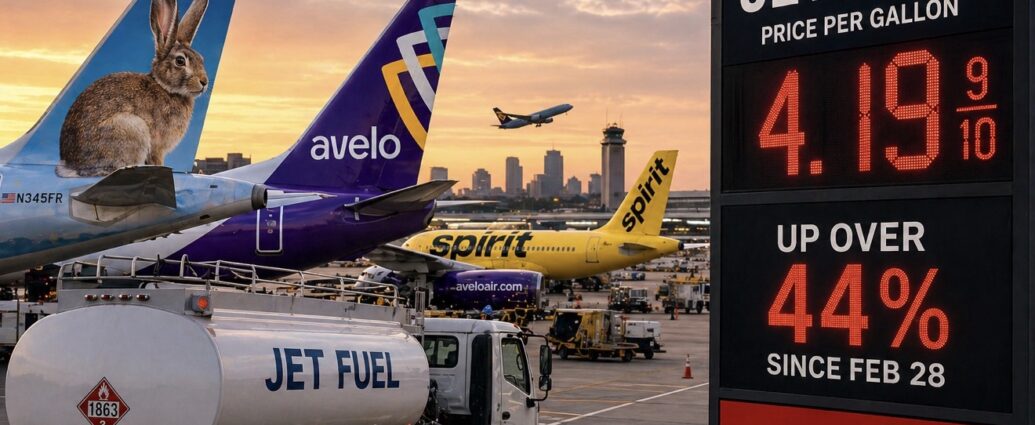
The $2.5 billion figure reflects a simple reality: fuel costs have blown past projections. Airlines estimate jet fuel will remain above $4 per gallon through 2026. Data from Airlines for America shows prices already at $4.19, a level that is rapidly compressing margins across the sector.
Fuel Shock Hits the Weakest First
The driver is geopolitical. The ongoing Middle East conflict has disrupted flows through the Strait of Hormuz — a channel responsible for roughly 20% of global oil supply — pushing Brent crude up about 44% to near $105 per barrel and effectively doubling jet fuel costs.
For budget airlines, the impact is immediate and severe.
Conor Cunningham, airline analyst at Melius Research, said ultra-low-cost carriers are “disproportionately exposed” to fuel volatility, given their limited hedging strategies and dependence on ultra-low base fares. Simply put, they lack the pricing power of legacy airlines.
That divide is already visible. United and American Airlines have trimmed forecasts but successfully passed higher fuel costs onto passengers. Budget carriers don’t have that flexibility — raising fares undermines their core model — leaving them squeezed between rising costs and price-sensitive customers.
Avelo said it “emphatically agrees that a healthy airline industry with strong competition is important to the U.S. economy,” but declined further comment. Frontier and the White House did not respond.
Spirit’s $240 Million Deadline
The urgency is being driven by Spirit Airlines, now at the center of the crisis. The company needs access to $240 million in restricted cash by April 30 to continue operating. A bankruptcy court hearing that day could determine its fate.
A potential rescue package includes $500 million in federal support, structured as a loan that could convert into as much as a 90% government stake.
Behind the scenes, restructuring talks are intensifying. Marshall Huebner of Davis Polk, representing Spirit, and Mike Stamer of Akin, advising bondholders, are navigating a complex negotiation as creditors and policymakers weigh outcomes.
President Donald Trump has publicly backed intervention, stating: “We’re thinking about doing it… helping them out, meaning bailing them out, or buying it.” Spirit CEO Dave Davis said the airline is “grateful” for the administration’s support.
Labor groups are also pressing for action, warning liquidation would ripple through jobs, travel access, and regional economies.
Backlash Builds in Washington
The potential bailout is already triggering resistance. Secretary Sean Duffy has questioned the logic of intervention, warning against “putting good money after bad.”
On Capitol Hill, opposition is bipartisan. Sen. Ted Cruz called the proposal “an absolutely terrible idea,” while Sen. Tom Cotton said it would be “not the best use of taxpayer dollars.” Sen. Elizabeth Warren blamed the administration’s Iran policy for driving fuel prices higher and pushing airlines into distress.
Policy analyst Tad DeHaven of the Cato Institute warned that government intervention risks setting a dangerous precedent, creating expectations of future bailouts across the industry.
Industry Model Under Pressure
Aviation analyst Gary Leff highlighted a competitive contradiction: rescuing Spirit could weaken rivals like Frontier by preserving excess capacity in the ultra-low-cost segment.
Consultant Mike Boyd went further, arguing the crisis exposes a structural flaw. The ultra-low-cost model, he said, “struggles to function” when fuel remains elevated for extended periods.
Credit markets are already signaling concern. Joe Rohlena, senior director at Fitch Ratings, warned that sustained fuel pressure could lead to broader credit deterioration across budget carriers if conditions persist.
What Comes Next
The stakes extend beyond a single airline. During the pandemic, the U.S. government deployed $54 billion in airline support but recovered only a fraction through equity warrants — a precedent that continues to shape today’s debate.
Analysts at JPMorgan have cautioned that any bailout could trigger a wave of similar requests — a scenario now unfolding as Frontier and Avelo step forward.
The administration now faces a defining decision: allow market forces to play out — potentially leading to the first major airline collapse in decades — or step in and risk opening the door to sustained intervention in the aviation sector.
Secretary Sean Duffy has signaled that consolidation may be the preferred path, noting President Trump’s openness to large-scale deals — hinting that mergers, not bailouts, could ultimately reshape the industry.
For now, the timeline is clear.
April 30 is approaching — and the outcome may redefine the future of budget air travel in the United States.
— JBizNews Desk