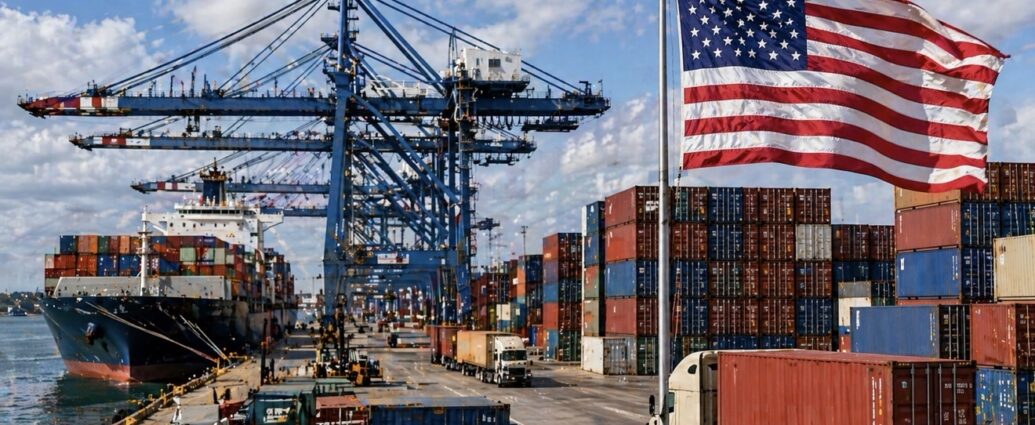
Trump’s Next Tariff Wave Begins Tomorrow: USTR Hearings Open On New Section 301 Duties As Radio Flyer, American Manufacturers Brace For Impact
April 27, 2026 | JBizNews Desk
The Trump administration’s trade strategy enters a new and more durable phase this week, as the U.S. Trade Representative (USTR) opens the first in a series of public hearings that will shape the next generation of American tariffs — this time built on legal authority that has already withstood judicial scrutiny.
The hearings, scheduled for April 28 and May 5, follow a major U.S. Supreme Court ruling in February that struck down tariffs imposed under the International Emergency Economic Powers Act (IEEPA). Writing for the majority in a 6–3 decision, Chief Justice John Roberts ruled that “the power to impose tariffs rests with Congress alone,” forcing the administration to rebuild its trade framework.
Now, that replacement is taking shape under Section 301 of the Trade Act of 1974 — a far more established and court-tested authority.
From Emergency Powers to Permanent Policy
In response to the court ruling, the administration quickly invoked Section 122 to impose a temporary 10% global tariff — a stopgap measure limited to 150 days — while launching sweeping Section 301 investigations targeting practices across more than 75 countries.
Those investigations focus on two core issues: failures to prevent forced labor in supply chains and structural overcapacity in global manufacturing. Unlike IEEPA, Section 301 provides a clear legal pathway for tariffs, with no statutory cap on rates and no expiration timeline, making it significantly harder to challenge in court.
Trade experts note that Section 301 was the same mechanism used to impose tariffs on China during Trump’s first term — measures that remain in place today at rates ranging from 7.5% to 100% on many goods.
Analysts at the Peterson Institute for International Economics say the current investigations are intentionally broad, covering an estimated 99% of U.S. imports, effectively replicating — and potentially expanding — the reach of the previous tariff regime under stronger legal footing.
The “Radio Flyer” Effect on Everyday Business
The real-world implications are already coming into focus.
Industry observers have pointed to Radio Flyer, the iconic American wagon brand, as a clear example of how deeply the new tariffs could reach into consumer markets. While the brand is American, much of its manufacturing is based overseas — particularly in China — making it highly exposed to sustained import duties.
For companies like Radio Flyer, the shift to Section 301 tariffs represents more than a temporary cost increase. It signals a long-term restructuring of supply chains, where sourcing decisions made decades ago may no longer be economically viable.
With limited short-term alternatives, many businesses face difficult choices: absorb higher costs, pass them on to consumers, or invest heavily in shifting production.
Hearings That Will Shape the Outcome
The hearings opening tomorrow will play a critical role in determining how these tariffs are applied. The USTR has already requested consultations with governments across dozens of countries, and companies have submitted written comments outlining the potential economic impact.
The first hearing, beginning April 28, will focus on forced labor enforcement, followed by a second session on May 5 addressing global manufacturing imbalances.
Businesses that participate will have a chance to influence how tariffs are structured — including which industries are targeted and at what rates.
The $160 Billion Legal Fallout
At the same time, the administration is dealing with the financial consequences of the Supreme Court’s earlier ruling.
More than 2,000 lawsuits have been filed by companies seeking refunds for tariffs previously collected under IEEPA, with total claims estimated between $160 billion and $175 billion.
U.S. Customs and Border Protection (CBP) is currently developing a system — known as the Consolidated Administration and Processing of Entries (CAPE) — to manage potential refunds, though no timeline has been announced.
Trade advisors are urging companies to pursue claims through both litigation and administrative channels, as the process remains uncertain.
Despite the legal challenges, Treasury Secretary Scott Bessent has indicated the administration intends to maintain overall tariff revenue levels by combining multiple authorities, including Sections 122, 232, and 301 — ensuring that even if refunds are issued, the broader tariff structure remains intact.
A Structural Shift for U.S. Business
For American companies, the message is increasingly clear: tariffs are not being rolled back — they are being rebuilt.
What began as a contested use of emergency powers is now evolving into a long-term trade framework grounded in established law, with the potential to reshape global supply chains and pricing structures for years to come.
As the hearings begin, businesses across sectors — from manufacturing to retail — are preparing for a future where tariffs are not a temporary disruption, but a permanent feature of the economic landscape.
The companies that engage now may help shape that future. Those that do not may find themselves adapting to it.
— JBizNews Desk