Major global consumer goods companies are entering a new phase of pricing pressure as surging oil prices ripple through supply chains, threatening to derail a fragile recovery in consumer demand just months after inflation showed signs of easing.
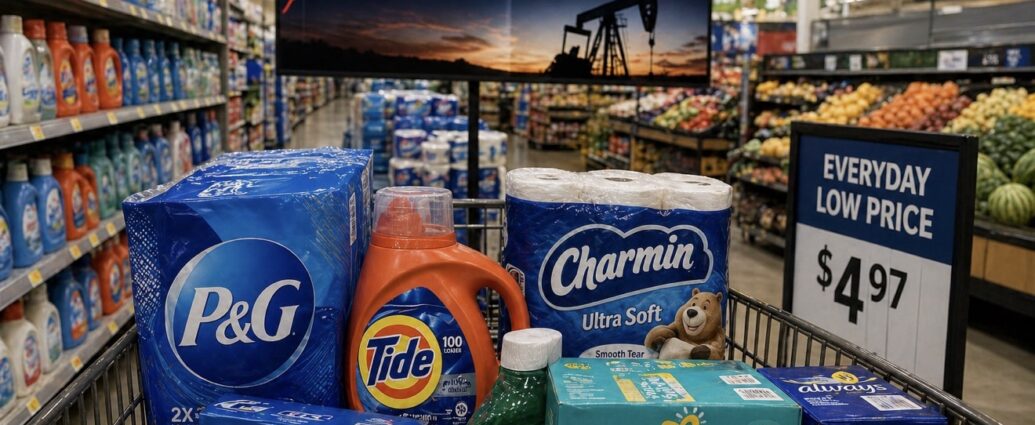
Procter & Gamble Co. (NYSE: PG) warned that higher energy costs could cut roughly $1 billion from its fiscal 2027 profits, underscoring how deeply crude oil prices—now hovering above $106 per barrel—are feeding into packaging, transportation, and raw material costs. Company executives signaled that the renewed pressure is arriving at a particularly sensitive moment, as consumers had only recently begun stabilizing spending patterns after years of inflation.
The warning reflects broader stress across the consumer packaged goods sector. Reckitt Benckiser Group Plc (LSE: RKT) and Keurig Dr Pepper Inc. (NASDAQ: KDP) both reported a noticeable shift in consumer behavior, with shoppers increasingly trading down to private-label alternatives as price sensitivity resurfaces. Analysts say the trend raises the risk that further price increases could suppress volumes, reversing the modest demand recovery seen earlier in 2026.
“The fragile demand recovery is at risk of stalling if companies pass on higher input costs too aggressively,” Savyata Mishra, a consumer goods reporter, noted in recent sector coverage, highlighting the delicate balance companies now face between protecting margins and maintaining sales volumes.
The renewed cost pressures are closely tied to geopolitical developments. Oil markets have tightened amid ongoing disruptions linked to Iran and rising tensions surrounding key shipping routes, particularly the Strait of Hormuz. Helima Croft, Head of Global Commodity Strategy at RBC Capital Markets, said the impact is already cascading through global supply chains. “Sustained energy shocks from the Strait of Hormuz are amplifying cost pressures for everyday consumer goods, forcing companies to navigate a delicate balance between margins and volume,” Croft explained.
At the same time, consumer sentiment remains fragile. Recent data shows U.S. household confidence hovering near multi-year lows, with persistent concerns about affordability and economic uncertainty. Early corporate earnings are reinforcing that caution. Domino’s Pizza Inc. (NYSE: DPZ) lowered its full-year same-store sales guidance to low single digits, citing what it described as an “intensifying macro and competitive environment,” a move that sent shares sharply lower and signaled weakening discretionary spending.
“Verizon showed resilience in essentials like wireless, but Domino’s caution on discretionary spending highlights pockets of pressure among consumers,” said Brooke DiPalma, senior reporter at Yahoo Finance, reflecting the uneven nature of current consumption trends.
Against this backdrop, financial technology firms are attempting to cushion the impact. Affirm Holdings Inc. (NASDAQ: AFRM) announced the rollout of what it calls “agentic credit,” an AI-driven underwriting system designed to evaluate each transaction in real time rather than relying on traditional credit scores. The company says the model allows it to extend credit more dynamically while managing risk in an environment of higher borrowing costs.
“Agentic credit flips the economics by repricing risk at the transaction level, saying yes to more consumers banks traditionally overlook and no to overextended buyers instantly,” said Libor Michalek, President of Affirm, describing the system as a fundamental shift away from decades-old lending frameworks.
The move comes as consumers face mounting financial pressure from both elevated interest rates and rising costs tied to energy. Payment networks are also adjusting to shifting expectations. Executives at Visa Inc. (NYSE: V) emphasized in recent remarks that financial services must increasingly operate “at the speed of need,” reflecting a demand for more flexible, real-time access to credit and payments.
Market strategists say such innovations could play a key role in sustaining spending levels, even as macroeconomic headwinds intensify. “Innovations like this could help sustain consumer spending resilience even as macro headwinds from energy costs persist,” said Mark McCormick, Head of Equity Strategy at BMO Capital Markets.
Still, the broader global picture remains mixed. In the United Kingdom, retail sales posted their sharpest year-over-year decline in more than four decades, according to the Confederation of British Industry, with inflation fears tied to Middle East tensions weighing heavily on consumer activity. The divergence between essential and discretionary spending continues to widen, creating an increasingly complex landscape for global brands.
Investors are now turning their attention to upcoming earnings from major retailers and technology giants for clearer signals on pricing power and demand durability. “How Amazon, Walmart, and others discuss pricing power and demand will be critical,” said Lori Calvasina, Head of U.S. Equity Strategy at RBC Capital Markets, pointing to this week’s earnings cycle as a key inflection point.
The interplay between rising energy costs, cautious consumers, and evolving financial tools is shaping a new phase for the global economy—one where resilience is being tested in real time. Whether companies can successfully navigate this environment without triggering a broader demand slowdown will likely define the trajectory of consumer markets in the months ahead.
JBizNews Desk