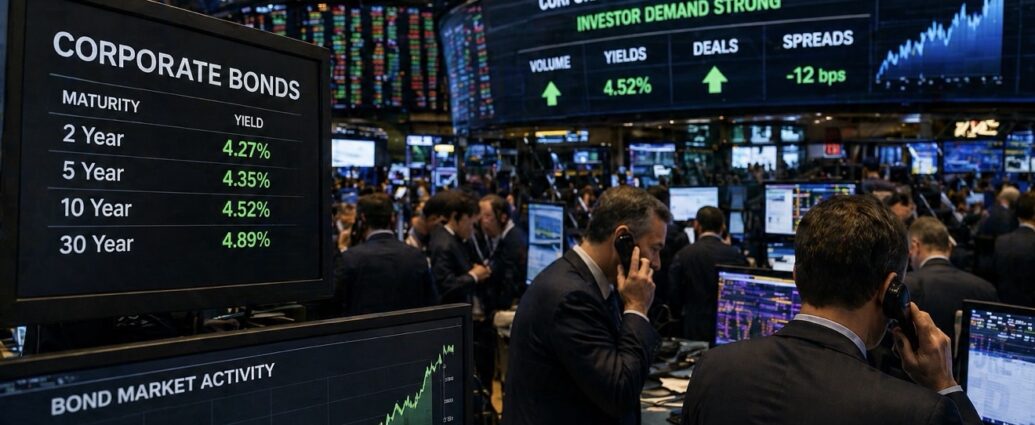
Companies moved aggressively on Monday to raise fresh money in the U.S. bond market, taking advantage of a short-lived opening in credit conditions before a packed calendar of corporate earnings and major central-bank decisions. According to Bloomberg on Monday, issuers accelerated debt sales to lock in funding costs while markets weighed persistent uncertainty tied to the Middle East and the path of interest rates, a dynamic credit strategists said often pushes borrowers to act quickly when spreads stabilize.
Bankers said the timing reflected a familiar calculation: issue before volatility returns. In comments reported by Reuters in recent coverage of primary debt markets, syndicate desks at major banks have said borrowers tend to “front-load” issuance when macro risks threaten to crowd the market later in the week, especially ahead of policy meetings from the Federal Reserve and other major central banks. That backdrop matters because Treasury yields, credit spreads and investor risk appetite can all shift sharply after earnings guidance or rate signals, changing the economics of a deal within hours.
The immediate attraction for issuers lay in the chance to secure funding before any fresh repricing in rates. Officials at the Federal Reserve, including Chair Jerome Powell, have repeatedly said policy decisions remain data dependent, and in public remarks the central bank has stressed that inflation still needs to move sustainably toward target before easier policy can gain traction. That message, reflected in recent reporting from CNBC and Bloomberg, has kept borrowers sensitive to every move in benchmark yields, with finance chiefs preferring certainty over waiting for a potentially better market that may never arrive.
Investors, for their part, have continued to show demand for high-grade corporate paper even as geopolitical risk lingers. Market participants cited by Bloomberg said order books remained healthy for well-known issuers, a sign that large money managers still have cash to deploy and remain willing to buy new bonds when concessions look reasonable. Analysts at major banks, according to recent notes covered by MarketWatch and Reuters, have argued that all-in yields remain attractive enough for institutional buyers to support issuance despite concerns over growth, inflation and oil prices.
The Middle East overhang has not disappeared, but credit desks said it has not fully shut the market either. Reporting from Reuters and the Financial Times in recent sessions showed that investors continue to monitor the risk that a wider regional conflict could lift energy prices, revive inflation pressure and unsettle global risk assets. Those concerns can quickly feed into corporate borrowing costs, and bankers told clients, according to people cited by Bloomberg, that any period of relative calm should be treated as an issuance opportunity rather than a guarantee of stable conditions.
The rush also comes at a moment when corporate treasurers face a practical funding agenda beyond market timing. Companies across sectors need to refinance maturing debt, fund acquisitions, support capital spending and preserve liquidity buffers. In recent earnings calls and filings, a range of U.S. issuers have said balance-sheet flexibility remains a priority as borrowing costs stay above the ultra-low levels of the pandemic era. That broader financing need, highlighted in reporting by Dow Jones and Bloomberg, helps explain why the primary market can fill quickly even when executives remain cautious about the economic outlook.
For investors, the surge in supply offers both opportunity and a test of market depth. Portfolio managers quoted by Reuters in recent debt-market coverage said new issues often come with a premium that makes them attractive relative to outstanding bonds, but they also warned that too much supply in a compressed window can pressure spreads if demand thins. That balance between strong inflows and issuance fatigue has become central to how the market prices risk, particularly when Treasury yields remain elevated and economic data continue to send mixed signals.
The calendar ahead could determine whether Monday’s burst of activity extends or fades. Traders and bankers said upcoming earnings reports, fresh inflation and growth data, and any policy signals from the Federal Reserve and other central banks could either reinforce confidence or close the market window just as quickly as it opened. As Bloomberg reported, issuers appear to understand that the current opening may prove narrow, and the next few sessions will show whether investor demand can absorb the wave of supply without forcing companies to pay materially more for capital.
JBizNews Desk