Markets & Economy | April 27, 2026 | JBizNews Desk
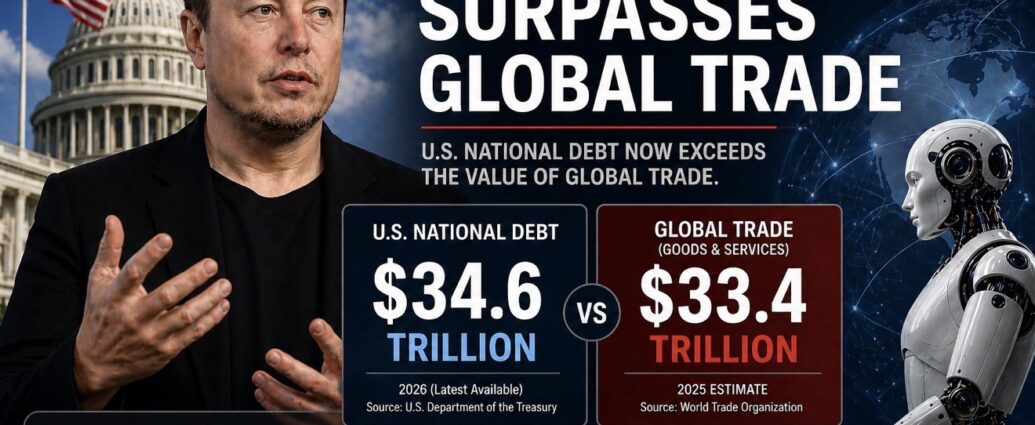
Has the United States crossed a line that markets and policymakers can no longer ignore? With federal borrowing now roughly $34–35 trillion, and the total value of global trade hovering near $33–34 trillion annually, the world’s largest economy has entered a symbolic — and for some, alarming — new phase. The comparison is not a perfect one, but it raises a fundamental question: how sustainable is America’s fiscal trajectory when its debt rivals the scale of global commerce itself?
The figures, drawn from the U.S. Department of the Treasury and estimates compiled by the World Trade Organization, highlight just how rapidly U.S. borrowing has expanded in the post-pandemic era. While the U.S. continues to benefit from the dollar’s reserve currency status and deep capital markets, the pace of debt accumulation is forcing a renewed debate in Washington and on Wall Street.
Few have framed the issue more starkly than Elon Musk, CEO of Tesla Inc. and SpaceX, who has increasingly warned that only a dramatic leap in productivity — driven by artificial intelligence and automation — can offset what he sees as an unavoidable fiscal crisis. Speaking on the Dwarkesh Podcast, Musk delivered a blunt assessment that is now echoing across business and policy circles.
“We are 1,000% going to go bankrupt as a country and fail as a country… without AI and robots,” Musk said. “Nothing else will solve the national debt. We just need enough time to build the AI and robots to not go bankrupt before then.”
Musk’s comments reflect a growing view in parts of the technology sector that traditional policy levers — taxation, spending adjustments, and monetary tools — may not be sufficient to counter the scale of the problem. Instead, proponents argue, only transformative productivity gains can meaningfully shift the equation.
But is that realistic — or is it an overreliance on future innovation?
Jerome Powell, Chair of the Federal Reserve, has taken a more measured tone in recent public remarks, emphasizing that while U.S. debt is on an “unsustainable path,” the immediate focus remains on inflation control and economic stability. At the same time, Powell and other policymakers have repeatedly noted that long-term fiscal sustainability ultimately falls to Congress, not the central bank.
Meanwhile, economists at the Congressional Budget Office have projected that federal debt will continue rising as a share of GDP for decades under current law, driven largely by entitlement spending and interest costs. In its latest outlook, the CBO warned that higher debt levels could slow economic growth, increase borrowing costs, and limit the government’s ability to respond to future crises.
Janet Yellen, U.S. Treasury Secretary, has defended the resilience of the U.S. financial system, pointing to strong demand for Treasury securities and the continued dominance of the dollar in global trade and finance. Still, even Treasury officials acknowledge that the trajectory of debt cannot rise indefinitely without consequences.
Adding a global and demographic perspective to the discussion, Duvi Honig, Chief Economist and Founder of the National Roundtable for Presidents of Chambers of Commerce in Washington, D.C., and Founder & CEO of the Wall Street–based Orthodox Jewish Chamber of Commerce, framed the imbalance in stark terms.
“Think about it — the world’s population is roughly 8.3 billion, while the United States has about 349 million people. That means America represents just about 4% of the global population, yet we are carrying approximately $34–35 trillion in debt, while total global trade is only about $33–34 trillion annually — effectively the economic activity tied to the remaining 96% of the world.
It’s unsustainable. It’s financial lunacy — and we’re in denial. Eventually, it will catch up to us.”
The comparison between national debt and global trade is, by definition, imperfect — one is a cumulative stock, the other an annual flow. But analysts say the symbolism is difficult to ignore. It reflects the extent to which U.S. fiscal expansion has outpaced not just domestic growth, but global economic benchmarks.
On Wall Street, reactions are mixed. Some investors continue to view U.S. Treasurys as the world’s safest asset, particularly in times of geopolitical uncertainty. Others are beginning to question whether persistently high deficits and rising interest costs could eventually erode that confidence.
Larry Summers, former U.S. Treasury Secretary, has repeatedly warned that the U.S. is entering a period where fiscal policy is becoming increasingly constrained. In recent remarks, Summers argued that higher real interest rates could make it significantly more expensive to service the debt, compounding the challenge over time.
At the same time, major asset managers, including BlackRock Inc., have pointed to structural demand for U.S. debt from global investors, pension funds, and central banks — a factor that continues to support the system, even as headline debt levels rise.
So where does that leave policymakers — and markets?
Is Musk right that only a technological leap can prevent a crisis? Or will traditional fiscal tools, combined with steady economic growth, prove sufficient to stabilize the trajectory?
For now, the answer remains uncertain. What is clear is that the scale of U.S. borrowing has reached a point where it is no longer just a domestic issue — it is a central pillar of the global financial system.
And as debt levels continue to climb, the stakes are rising. Interest costs are consuming a larger share of federal spending. Fiscal flexibility is narrowing. And the margin for error — whether economic, political, or geopolitical — is shrinking.
The question is no longer whether the United States can carry high levels of debt. It is whether it can continue to do so indefinitely without triggering a broader reckoning — and whether innovation, policy, or markets themselves will ultimately force the adjustment.
— JBizNews Desk