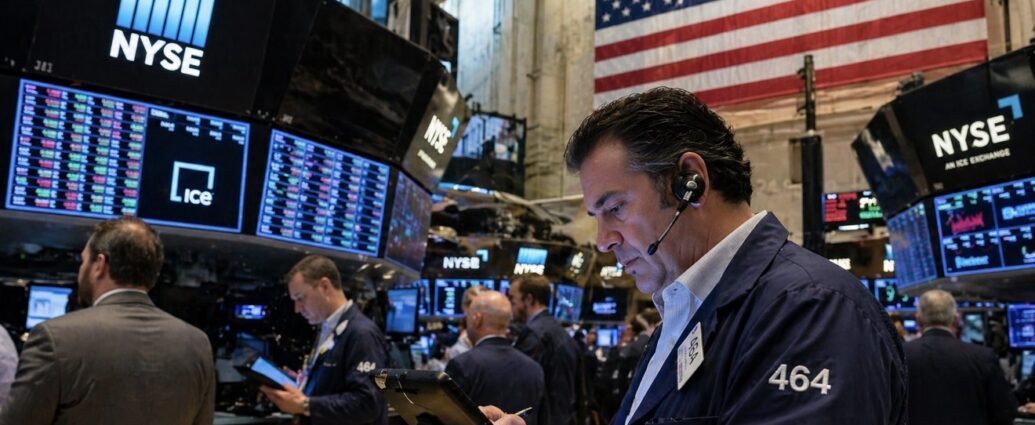
New York, April 27, 2026 — U.S. equities closed at fresh record highs Monday, capping a session shaped by geopolitical tension, artificial intelligence-driven momentum, and mounting anticipation ahead of a pivotal week for monetary policy and Big Tech earnings.
The S&P 500 rose 0.12% to 7,173.91, notching a record close, while the Nasdaq Composite advanced 0.20% to 24,887.10, also finishing at an all-time high after touching new intraday peaks earlier in the session. The Dow Jones Industrial Average slipped 62.92 points, or 0.13%, to 49,167.79, reflecting continued pressure in more cyclical sectors even as growth stocks pushed higher.
Markets opened under the weight of a complex global backdrop. The U.S.-Iran conflict entered its ninth week, with the Strait of Hormuz effectively shut, constraining global oil flows and keeping energy markets on edge. West Texas Intermediate crude climbed 2.38% to $96.65 per barrel, extending gains as supply disruptions persisted. At the same time, traders were positioning ahead of Wednesday’s Federal Reserve rate decision, where policymakers are widely expected to hold interest rates steady.
Sentiment shifted mid-session following a report that Iran had submitted a new proposal through Pakistani mediators aimed at reopening the Strait of Hormuz while deferring nuclear negotiations. While details remain limited and U.S. officials have not formally responded, the development introduced a measure of cautious optimism that helped lift equities into record territory.
Volatility eased as the CBOE Volatility Index (VIX) fell 3.69% to 18.02, signaling a modest reduction in market anxiety. Gold prices declined 0.97% to $4,694.70, while Bitcoin slipped 1.54% to $77,008, reflecting a mixed response across alternative assets.
Energy markets remain central to the macro outlook. Analysts at Goldman Sachs, including Daan Struyven and Yulia Zhestkova Grigsby, estimated that current disruptions are removing approximately 14.5 million barrels per day of Persian Gulf crude supply, driving global inventories to draw at a pace of 11 to 12 million barrels per day. The firm described the pace as “not sustainable,” underscoring the fragility of current supply-demand dynamics.
Within equities, technology and AI-linked names once again led gains, reinforcing investor conviction in the long-term earnings potential of artificial intelligence. Sandisk (SNDK) rose more than 7%, while Micron Technology (MU) gained roughly 5%, after Melius Research analyst Ben Reitzes initiated coverage with Buy ratings on both companies. Reitzes set price targets implying double-digit upside, arguing that AI-driven demand for memory and data infrastructure will persist through the end of the decade and reshape how investors value the sector.
Corporate developments also drove notable moves. Organon (OGN) surged 17% after announcing its acquisition by Sun Pharmaceutical Industries, a deal the company said would deliver “immediate and compelling value to shareholders.” Verizon Communications (VZ) added approximately 3% after raising its fiscal 2026 earnings outlook, citing stronger-than-expected performance in its core wireless business. Lionsgate Studios gained about 4% following a record-setting opening weekend for its latest film release, highlighting resilience in entertainment demand.
On the downside, losses were more pronounced in select names. POET Technologies (POET) plunged nearly 50% after disclosing the cancellation of key purchase orders tied to a major customer relationship. Domino’s Pizza (DPZ) dropped 9% after reporting U.S. same-store sales growth of 0.9%, well below analyst expectations. Adobe Inc. (ADBE) edged lower after a downgrade from Mizuho, which cited rising competitive pressures and potential margin headwinds. Meanwhile, Northland Capital Markets downgraded Advanced Micro Devices (AMD), pointing to valuation concerns amid intensifying competition in AI infrastructure from rivals including Intel Corp. and Taiwan Semiconductor Manufacturing Co.
Analyst activity remained robust across sectors. TD Cowen initiated coverage of DoorDash (DASH) with a Buy rating and a $225 price target, calling the company a long-term share gainer in digital commerce. Mizuho upgraded CrowdStrike Holdings (CRWD) to outperform, citing “very healthy demand across the platform,” while Wolfe Research raised its rating on Visteon Corp., projecting improved margins and stronger organic growth in the second half of 2026.
Market strategists continue to highlight the tension between macroeconomic risks and technology-driven optimism. JPMorgan analyst Fabio Bassi said in a client note that “financial markets remain jittery but broadly resilient,” pointing to the outperformance of technology, communication services, and consumer discretionary sectors in recent weeks.
Looking ahead, investors are bracing for a convergence of critical catalysts. The Federal Reserve’s policy decision on Wednesday will be closely watched for signals on the path of interest rates, particularly as elevated oil prices complicate the inflation outlook. At the same time, earnings reports from Alphabet Inc., Amazon.com Inc., Meta Platforms Inc., Microsoft Corp., and Apple Inc. are expected to provide fresh insight into the strength and sustainability of the AI-driven growth narrative.
Wedbush Securities analyst Dan Ives described the upcoming earnings cycle as a defining moment for the market, stating that “this is a monster week for Big Tech, and we expect continued strong demand driven by the AI revolution.”
Despite closing at record highs, markets remain finely balanced. Geopolitical uncertainty, elevated energy prices, and the trajectory of monetary policy continue to present risks, even as technological innovation and corporate earnings support valuations.
As investors navigate this environment, the central question is whether the current momentum — fueled by AI and resilient corporate performance — can withstand the mounting pressures from global instability and macroeconomic uncertainty.
— JBizNews Desk
© JBizNews.com. All rights reserved.