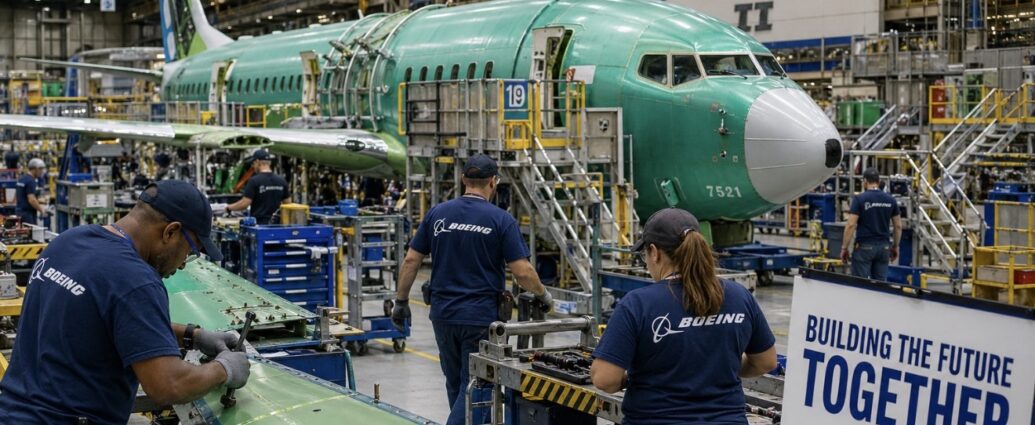
Boeing is ramping up factory hiring at its fastest pace in nearly two years, signaling renewed industrial momentum as the aerospace giant works to scale production across key aircraft programs while offsetting a wave of retirements among its most experienced workers. The expansion reflects both immediate operational demands and a longer-term effort to rebuild workforce capacity after a turbulent period marked by labor disruptions and regulatory scrutiny.
Jon Holden, Vice President of Training and Apprenticeships at the International Association of Machinists and Aerospace Workers (IAM), said Boeing is currently onboarding between 100 and 140 unionized factory workers per week. “This is more, I think, a sustained ramp that I feel good about, as long as the economy continues to go, as long as airlines continue to keep their orders,” Holden said, describing the hiring pace as durable rather than cyclical. Unionized factory headcount in the Pacific Northwest has now surpassed 34,000 workers, up from roughly 33,000 during the IAM’s 2024 strike, underscoring the scale of Boeing’s workforce rebuild.
Boeing confirmed the hiring push as part of a broader production strategy. “We’re seeing strong interest as we hire in Puget Sound and across the enterprise to support our production rate increases,” a Boeing spokesperson said, noting that recruitment is extending beyond assembly lines into logistics, warehousing, and tooling operations. The company’s hiring spans multiple divisions, reflecting the complexity of scaling modern aerospace manufacturing.
At the center of the expansion is Boeing’s narrowbody production system, particularly the 737 MAX program, which remains the backbone of global airline fleets. The company is building out a fourth Seattle-area production line—known internally as the North Line—to support higher output. Boeing is currently producing 42 aircraft per month and plans to increase that rate to 47 this summer, with a longer-term target of 53 jets per month by the end of 2026, according to comments from CEO Kelly Ortberg during the company’s latest earnings call.
Regulatory alignment is helping clear the path for that growth. Bryan Bedford, Administrator of the Federal Aviation Administration (FAA), said regulators have not identified any obstacles that would prevent certification of the 737 MAX 7 and 737 MAX 10 variants before the end of 2026. “We have not seen issues that would block certification timelines,” Bedford said in recent remarks, reinforcing Boeing’s expectation that both aircraft will be approved this year, with first deliveries anticipated in 2027. Boeing confirmed that the 737-10 has entered the Type Inspection Authorization 2 phase of flight testing, a key milestone toward certification.
Beyond narrowbody jets, Boeing is also advancing its long-delayed widebody flagship, the 777X. The 777-9 variant has progressed into the FAA’s Type Inspection Authorization 4a phase, bringing it closer to certification after years of delays tied to safety reviews and engineering adjustments. Boeing continues to target first delivery of the 777X in 2027, a timeline that requires parallel workforce scaling to support eventual production increases.
The hiring surge is not limited to aircraft assembly. Boeing is investing heavily in workforce development pipelines, including apprenticeship programs designed to train workers in specialized aerospace disciplines such as composite materials and advanced manufacturing techniques. Holden said enrollment has already exceeded the 125-participant cap established under Boeing’s 2024 labor agreement with the IAM, reflecting both immediate labor shortages and a strategic push to rebuild technical expertise. “We’re seeing demand not just for workers, but for skilled workers who can support next-generation production systems,” Holden said.
The broader labor market in Washington State—home to Boeing’s largest manufacturing base—is also showing signs of recovery. According to the Washington State Employment Security Department, aerospace employment fell to approximately 79,000 jobs in August 2025 before rebounding to around 81,800 by February 2026. The recovery aligns with Boeing’s hiring push and suggests improving stability across the regional supply chain.
Ortberg, who took over as CEO during a period of operational and reputational challenges, has prioritized restoring production discipline and rebuilding trust with regulators and customers. “Our focus is on stability, quality, and predictable output,” Ortberg said during Boeing’s recent earnings call, emphasizing that workforce readiness is central to achieving those goals. The company’s aggressive hiring reflects an acknowledgment that labor capacity—not demand—is now one of the primary constraints on growth.
Boeing’s expansion also extends into its space and satellite division, where the company is targeting 26 satellite deliveries in 2026, up sharply from just four in 2025. That increase requires additional hiring and training beyond commercial aviation, highlighting the breadth of Boeing’s operational ramp.
With a commercial aircraft backlog exceeding 5,500 planes valued at more than $435 billion, Boeing faces sustained pressure from airlines to accelerate deliveries. The scale of that backlog underscores the urgency behind the company’s hiring strategy. By rapidly expanding its workforce while investing in training and apprenticeships, Boeing is attempting to position itself for a multi-year production cycle driven by global travel demand and fleet modernization.
Looking ahead, the key variable will be execution. Boeing’s ability to integrate thousands of new workers, maintain quality standards, and meet certification timelines will determine whether this hiring surge translates into sustained operational recovery. If successful, the current workforce expansion could mark a turning point—shifting Boeing from a period of constraint and disruption into one of disciplined growth and industrial scale.
JBizNews Desk