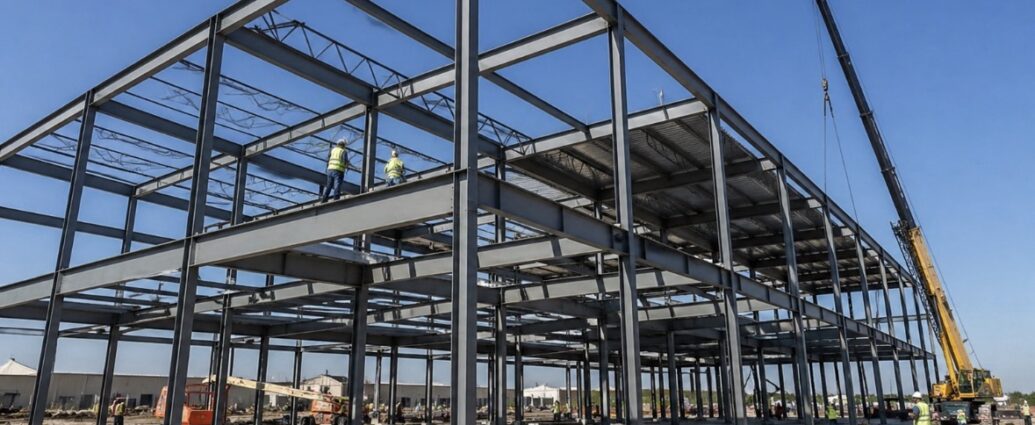
The U.S. construction industry is running into a growing problem that is no longer just about rising prices—materials are increasingly unavailable. Contractors across the country report they cannot secure enough steel, copper, and aluminum to meet project timelines, forcing delays, redesigns, and cancellations. Nearly 43% of contractors have postponed or canceled projects due to material costs and availability, according to the Associated General Contractors of America, while input prices for nonresidential construction rose at a 12.6% annualized rate early in 2026. “The challenge right now is not just cost—it’s whether you can get the material at all,” said Jeffrey D. Shoaf, Chief Executive Officer of the Associated General Contractors of America, adding that supply uncertainty is now “a primary driver of project disruption across multiple sectors.”
The shortage is being driven in part by federal policy that is redirecting supply away from civilian markets. Under the Defense Production Act, government contracts receive priority access to materials, placing defense and infrastructure projects ahead of private construction orders. “When a contract is rated under the Defense Production Act, it must be filled before any private-sector demand,” said William LaPlante, Under Secretary of Defense for Acquisition and Sustainment at the U.S. Department of Defense, describing how priority access is reshaping supply chains. Contractors say this is translating directly into delayed deliveries, with some reporting that orders cannot be fulfilled within required timelines regardless of price.
Steel availability has tightened the most, with mills and fabricators increasingly allocating production to government-backed projects. Domestic tariffs—reaching as high as 50% on imports—have reduced alternative supply options, leaving contractors dependent on constrained domestic production. “Firms are telling us they cannot lock in delivery timelines, which makes it impossible to commit to construction schedules,” said Ken Simonson, Chief Economist of the Associated General Contractors of America, noting that lead-time uncertainty is now as disruptive as cost increases. Specialty steel producer Metallus Inc. confirmed in its most recent SEC filing that “lead times continue to extend,” with order backlogs rising sharply.
Copper supply is also tightening, driven by both long-term demand growth and government stockpiling. Contractors report particular difficulty sourcing copper for electrical and mechanical systems, where substitutes are limited. “Copper is essential to energy systems, infrastructure, and advanced technologies, and supply is not keeping up,” said Carlos Pascual, Senior Vice President for Energy at S&P Global. At the same time, federal initiatives are directing copper into strategic reserves. “Strengthening domestic access to critical minerals is a national priority,” said Reta Jo Lewis, President of the Export-Import Bank of the United States, referring to financing programs supporting supply security.
Aluminum markets are facing similar constraints, with tariffs, energy costs, and global disruptions reducing supply while demand remains elevated. Contractors report delays in obtaining materials for windows, structural components, and electrical systems. “We are seeing supply constraints layered on top of cost pressures, which is amplifying the impact on projects,” said Simonson, Chief Economist of the Associated General Contractors of America, highlighting the combined effect of pricing and availability issues.
Across the industry, project timelines are being extended as a matter of necessity. “Longer lead times are now being built into project planning as a baseline assumption,” according to analysis from the Construction Today, reflecting how firms are adjusting expectations in response to supply constraints. In some cases, contractors say projects are being delayed indefinitely because materials cannot be secured at any price.
The shortages are expected to persist. Analysts at the Center for Strategic and International Studies say rebuilding U.S. reserves and expanding production capacity could take years. “Restoring stockpiles and scaling industrial output is a multi-year effort,” said Seth G. Jones, Senior Vice President at the Center for Strategic and International Studies, pointing to long-term structural constraints.
Contractors are attempting to adapt by ordering earlier, increasing inventory, and revising contracts, but those strategies are unevenly available. Smaller firms, in particular, lack the capital to secure materials far in advance. “Many contractors simply cannot afford to carry large inventories or absorb delays,” said Shoaf, Chief Executive Officer of the Associated General Contractors of America.
For the construction sector and broader economy, the shift is immediate: availability—not just price—is now the defining constraint. As government demand continues to take priority and global supply remains tight, securing steel, copper, and aluminum has become the central challenge facing projects across the country.
JBizNews Desk