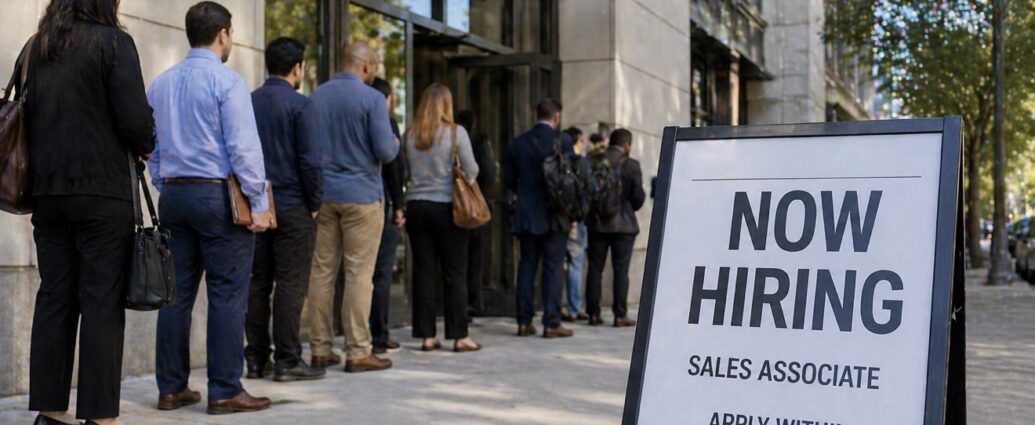
New U.S. unemployment claims moved higher in the latest weekly reading, adding to evidence that the labor market is cooling at the margin and reinforcing the Federal Reserve’s case for patience on interest rates. In its weekly release, the U.S. Department of Labor said initial claims rose by 4,000 to 214,000 for the week ended April 20, a figure Reuters reported marked the highest level since the prior autumn. The department said claims “increased to 214,000,” while economists told Reuters the level still points to a labor market that remains resilient but no longer as tight as it appeared earlier this year.
The weekly claims number on its own does not signal a sharp break in hiring, but it lands at a delicate moment for policymakers after stronger-than-expected inflation prints pushed investors to scale back expectations for near-term rate cuts. Federal Reserve Chair Jerome Powell, speaking after recent policy deliberations and cited by Bloomberg, said officials remain “data dependent” and will watch labor-market indicators alongside inflation before changing course. That stance has become more important as markets debate whether softer employment data can offset sticky price pressures enough to justify a pause that lasts longer, or eventually opens the door to easing later in the year.
The broader labor picture remains mixed rather than weak. Continuing claims, a proxy for how easily laid-off workers find new jobs, rose to about 1.58 million, according to the same Labor Department data and reporting from The Wall Street Journal. Markus Feldman, a senior analyst at Moody’s Analytics, told the Journal that higher continuing claims suggest “fewer people are finding new employment,” a sign that churn in the labor market may be slowing even if layoffs remain historically low. That distinction matters for executives and investors because a slower re-employment cycle can weigh on wage growth, household confidence and spending without producing an outright recession signal.
Consumer demand already has shown signs of losing some momentum. The U.S. Census Bureau reported that retail sales fell 0.3% in March from the prior month, a figure highlighted by the Financial Times as another indication that households are turning more selective after months of elevated borrowing costs. Laura Patel, chief economist at JPMorgan, told the FT that “if employment continues to falter, discretionary spending could contract,” linking labor softness directly to the inflation outlook the Fed is trying to manage. For corporate America, that combination raises the risk that pricing power weakens just as financing costs stay high.
Wall Street’s reaction has reflected that tension. Benchmark Treasury yields eased after the claims data, with the 10-year note slipping to roughly 3.78%, according to market data cited by MarketWatch. Thomas Riley, a portfolio manager at BlackRock, told MarketWatch that investors are “pricing in the possibility of a policy pause,” even if the timing of any eventual rate cut remains uncertain. Lower long-term yields can help relieve pressure on interest-sensitive sectors, but they also signal growing caution about the strength of future growth.
Equity investors have started to sort companies by how exposed they are to any pullback in consumer demand. Apple shares fell after analysts warned that softer spending could create headwinds for premium devices and services, with Morgan Stanley saying in a research note that the earnings outlook could face “modest pressure” in coming quarters. That view, reported by financial media including CNBC, underscores how even large-cap technology groups are not insulated if labor-market cooling starts to hit household budgets more directly. The issue for executives is less about one week of claims data than about whether a series of softer readings begins to alter revenue assumptions for the second half of the year.
Economists remain divided on how much weight to place on the latest increase. Alice Chen of Goldman Sachs told CNBC that the rise in claims could represent “the early stages of a softening labor market,” while cautioning that one or two weekly moves rarely establish a durable trend. Her assessment aligns with a broader market view that the Fed does not need to rush in either direction: inflation still has not returned to target, but labor conditions no longer look uniformly overheated. That leaves policymakers balancing two risks—cutting too soon and reigniting price pressures, or holding too long and allowing labor weakness to spread.
Policy analysts say the next few data releases will carry more weight than the claims report alone. David Lee, a senior fellow at the Brookings Institution, told the Associated Press that the economy has entered a “tricky environment for policymakers,” where labor-market moderation and stubborn inflation are sending different signals. The next major test comes with the April consumer price index due on May 13, followed by the Fed’s May 28 meeting, both of which investors will parse for evidence on whether officials can maintain a higher-for-longer stance without causing a broader slowdown. For companies, lenders and markets, that answer now matters as much as the rate decision itself because it will shape hiring plans, capital spending and consumer confidence into the summer.
JBizNews Desk Reporting