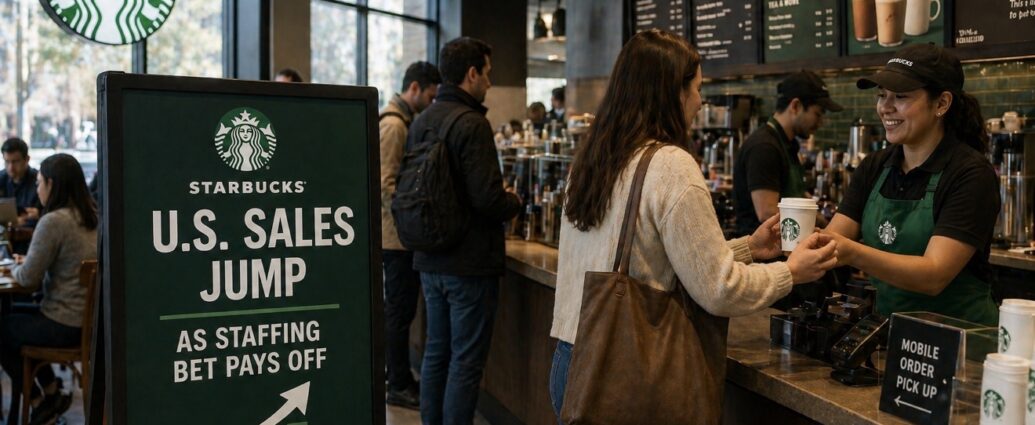
Starbucks delivered a stronger-than-expected rebound in U.S. sales, giving investors an early sign that its costly push to add labor and improve store operations is starting to gain traction. According to Reuters, the coffee chain reported U.S. comparable sales growth of 7.1% for the quarter ended March 31, well ahead of analysts’ 4.5% estimate, while the company said in its earnings release that the gain “reflects the impact of deeper staffing and enhanced partner benefits.”
The result matters because Starbucks has spent heavily to stabilize its core U.S. business after a period of uneven traffic, slower service and labor tension. On the company’s earnings call, chief executive Laxman Narasimhan said, “We have committed $500 million to our partners, from wage lifts to expanded health, parental and education benefits, because we believe a thriving workforce fuels a thriving brand,” according to the company transcript and filings. In the same quarterly disclosure filed with the SEC, Starbucks said average total compensation for baristas is now close to $30 an hour.
Management tied the sales improvement directly to better execution inside stores rather than to broad price increases alone. In comments reported by Fortune, chief operating officer Mike Grams said, “It really comes from the coffee houses and the partners who empower them, which has been a focal point of this turnaround all along,” adding that higher staffing levels helped stores “run more consistently.” That operational message aligned with company foot-traffic data cited by Bloomberg, which reported a 4.4% increase in U.S. store visits, marking a second straight quarter of growth.
The company’s finance team also pointed to a more basic retail advantage: customers are returning when service improves. In a statement reported by Bloomberg, Starbucks finance leadership said “higher customer frequency is a direct result of reduced wait times and more reliable order fulfillment,” linking the gain to a peak-hour staffing model introduced under Narasimhan. For a chain that depends on repeat morning traffic and mobile-order reliability, that claim carries weight beyond one quarter because it suggests the company’s labor investment is improving throughput, not simply raising costs.
Profit growth added to the argument that the spending is producing measurable returns. According to MarketWatch, citing the company’s quarterly filing, Starbucks posted net income of $560 million, its first quarterly profit increase in two years, while the earnings release said “operating margins benefited from better labor efficiency and reduced waste.” That combination of stronger same-store sales and improving margins is closely watched on Wall Street because it suggests the chain may be finding a way to protect profitability even as wages and benefits rise.
Still, the labor story remains unsettled, and that could shape the next phase of the turnaround. Michelle Eisen, a spokesperson for Starbucks Workers United, told Fortune that “the reality of working at Starbucks is that stores are understaffed, workers are struggling to get by, and lack critical on-the-job protections.” Her comments came as the union and Starbucks moved back toward talks after agreeing to return to the bargaining table, a development widely covered by major outlets and one that investors view as critical to future labor costs and store-level stability.
Analysts say the quarter strengthens management’s case that better staffing can drive both traffic and customer spending, but they also caution that the model still faces a cost test. Bloomberg cited retail analyst Emily Chiu saying that “the staffing investment should translate into higher average ticket size and lower churn among high-performing stores,” while noting that a higher cost base still needs to be justified through sustained sales momentum. That balance matters for Starbucks because the company is trying to prove that service-led growth can offset inflationary pressure across labor, ingredients and occupancy.
Operational consistency appears central to that effort. In his interview with Fortune, Grams said, “Our highest-performing coffee houses are far more likely to have leaders who’ve been in the role over a year,” and he added that 95% of partners now receive preferred schedules while 98% of shifts are filled. Those figures, attributed to Starbucks management, suggest the company is trying to reduce turnover and improve store leadership depth, two issues that have weighed on service standards across the broader restaurant sector.
The next question for investors is whether one strong quarter can develop into a durable pattern. A note reported in the source material said analysts at Goldman Sachs expect upcoming quarters to test whether bargaining talks, payroll inflation and service investments can stay aligned, with a spokesperson saying investors should watch “the outcome of bargaining talks and the company’s ability to keep bonus targets aligned with customer-experience goals.” If Starbucks can keep traffic rising while preserving margin gains, the company’s $500 million labor bet could become a rare example of higher retail staffing directly supporting growth rather than simply protecting the brand.