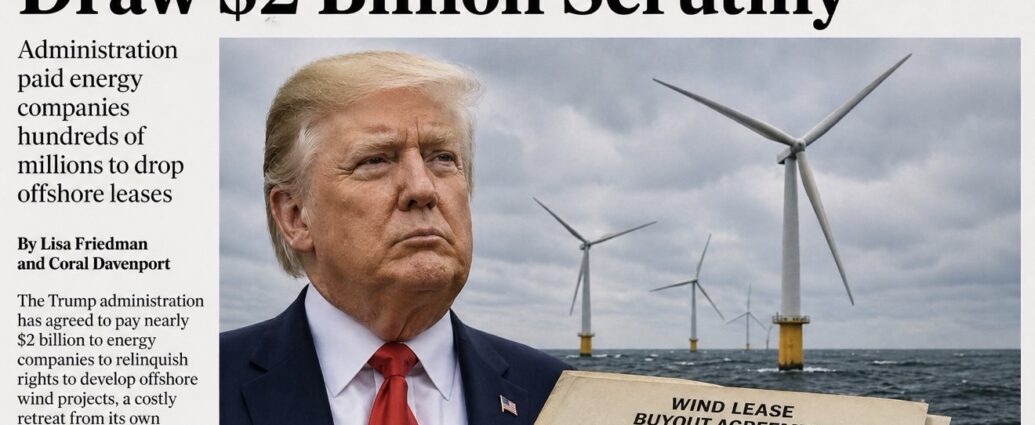
The Trump administration is facing intensifying scrutiny over agreements that could send nearly $2 billion to offshore wind developers to terminate federal leases, a move critics say shifts public money away from renewable energy and into fossil-fuel investment. Representative Jared Huffman, the top Democrat on the House Natural Resources Committee, called the arrangement “a scam,” according to reporting by the Associated Press, arguing taxpayers could end up “lighting a lot of federal taxpayer money on fire” if the deals move ahead as structured.
At the center of the dispute sits a March agreement involving TotalEnergies, which said in a company statement that it had “renounced U.S. offshore wind development in exchange for the reimbursement of the lease fees, considering that the development of offshore wind projects is not in the country’s interest.” Reuters cited that statement from Chief Executive Patrick Pouyanné in reporting on the arrangement, which involves roughly $1 billion tied to lease areas off North Carolina and New York and conditions directing capital toward oil and gas activity instead.
The controversy widened this week after additional agreements involving Bluepoint Wind and Golden State Wind, units of Ocean Winds, surfaced in reporting from the Associated Press and other outlets. In a letter reviewed by the AP, Democratic lawmakers said they want records showing how the Interior Department justified the payouts and whether federal officials assessed the cost to taxpayers before negotiating lease exits. Huffman said lawmakers “need every document” tied to the deals, the AP reported, as Democrats pressed for details on valuation, legal authority and any related commitments to conventional energy development.
The administration has framed its broader energy policy as a reset toward what President Donald Trump repeatedly calls “American energy dominance,” a phrase the White House and Interior Department have used in public statements since January to defend support for oil, gas and mining. In executive actions and agency guidance published this year, the administration said it aims to remove barriers to fossil-fuel production and reconsider federal support for wind projects, especially offshore developments that officials argue face permitting, cost and grid-integration challenges.
That policy turn marks a sharp break from the prior federal push behind offshore wind, which the Biden administration promoted as a pillar of industrial policy and decarbonization. Former Interior Secretary Deb Haaland said in agency statements during 2023 and 2024 that offshore wind could “power millions of homes” and support domestic manufacturing, while the Bureau of Ocean Energy Management spent the past several years auctioning lease areas and advancing environmental reviews. The new buyout approach, if expanded, could unwind part of that pipeline even where developers already paid substantial lease fees.
The financial stakes matter beyond energy policy because federal offshore leases typically involve multiyear planning, transmission studies and supply-chain commitments that ripple through ports, shipbuilders and turbine suppliers. Analysts cited by Bloomberg and Reuters in recent offshore wind coverage have said the U.S. sector already faced high interest rates, inflation in equipment costs and vessel shortages before the latest political reversal. By offering reimbursements for lease exits, the government could create a precedent that changes how developers price regulatory risk in future federal auctions.
The legal and budget questions now appear likely to dominate the next phase. Congressional Democrats, according to the Associated Press, are seeking to determine whether the administration relied on existing lease-termination authority or crafted a novel settlement mechanism that effectively compensates companies for abandoning projects. Public finance specialists quoted in AP reporting said the central issue is not only whether the government can cancel leases, but whether it can do so while attaching conditions that favor investment in oil and gas over competing energy uses.
For TotalEnergies and Ocean Winds, the deals also underscore how global energy groups are recalibrating U.S. exposure amid shifting policy signals. Pouyanné has said publicly that capital allocation follows market conditions and political clarity, and Reuters noted that major European developers have already taken write-downs or delayed U.S. offshore wind projects because economics deteriorated. If Washington now pays companies to leave, rivals may conclude that federal support for large-scale offshore wind no longer offers durable value under the current administration.
What comes next could determine whether this remains a limited set of settlements or becomes a broader rollback tool. Lawmakers on Capitol Hill are expected to press the Interior Department for contracts, legal memos and payment terms in the coming weeks, according to the Associated Press, while industry participants watch for any sign that additional leaseholders could receive similar offers. The outcome matters not only for taxpayers, but for the credibility of U.S. energy policy, because companies deciding where to place billions in long-lived infrastructure need to know whether federal commitments can shift from subsidy to buyout with a change in administration.
JBizNews Desk