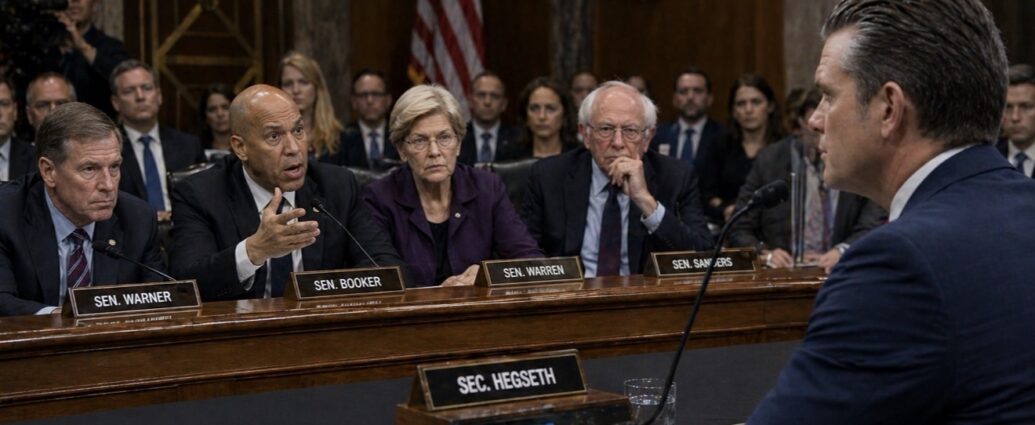
Defense Secretary Pete Hegseth faced one of his sharpest Capitol Hill confrontations yet on Wednesday as House Democrats challenged the cost, legal basis and military consequences of the U.S. conflict with Iran, with lawmakers zeroing in on a Pentagon estimate that the war has already consumed about $25 billion. Reuters reported the hearing marked Hegseth’s first extended public defense of the campaign before the House Armed Services Committee, where members argued the spending surge could complicate the administration’s broader defense budget push.
The $25 billion figure emerged as part of Pentagon budget discussions tied to the administration’s fiscal 2027 defense proposal, and John Calhoun, identified in the hearing as deputy comptroller at the Department of Defense, said, according to the committee proceedings and reporting from Reuters, that “our current estimate puts the total at $25 billion.” That number quickly became a political fault line, with Democrats arguing the conflict’s cost now reaches beyond military planning and into fiscal policy, especially as the administration seeks a much larger national security budget.
Democrats also used the hearing to question whether the campaign has strained key U.S. weapons inventories, particularly air-defense systems. Rep. John Garamendi, a California Democrat, accused the administration of misleading the public, saying, as quoted by the Associated Press, “Secretary Hegseth, you have been lying to the American public about this war from day one and so has the president.” Garamendi called the operation a “geopolitical calamity” and a “strategic blunder,” according to AP, reflecting broader concern that the war has drained munitions stockpiles at a time of rising global security demands.
Hegseth rejected that line of attack and framed the criticism as politically motivated. In remarks published in the official transcript by the U.S. House of Representatives, Hegseth told lawmakers, “The biggest challenge, the biggest adversary we face at this point are the reckless, feckless and defeatist words of congressional Democrats and some Republicans.” His response underscored how the administration intends to defend the campaign not only on strategic grounds but also as a test of political resolve.
A particularly tense exchange came when Rep. Adam Smith of Washington, the committee’s top Democrat, pressed Hegseth on what he described as conflicting administration claims about Iran’s nuclear program. According to AP News, Smith said, “We had to start this war, you just said 60 days ago, because the nuclear weapon posed an imminent threat,” questioning how that rationale aligned with earlier assertions that Iranian nuclear facilities had already been crippled. The exchange highlighted a central issue for lawmakers: whether the administration’s public case for military action has remained consistent.
Hegseth answered that Iran still poses a serious threat despite earlier military action. According to the hearing record cited in the source material, Hegseth said Iran “still retains thousands of missiles and has not abandoned its nuclear ambitions,” arguing that continued operations remain strategically justified. That defense goes to the heart of the White House position that the conflict, while costly, aims to prevent a broader regional escalation and deter future attacks.
The hearing also widened into a debate over leadership turmoil inside the Pentagon. Rep. Chrissy Houlahan of Pennsylvania challenged Hegseth over the removal of senior officers, including Army Chief of Staff Gen. Randy George, saying, according to the committee exchange cited in the source material, “You have no way of explaining why you removed one of the most decorated and remarkable men.” Hegseth replied that “new leadership” remains necessary to build what he has repeatedly described in public remarks as a “warrior culture” inside the department, linking personnel changes to his broader effort to reshape military command.
Even some Republicans signaled discomfort with that approach. Rep. Don Bacon of Nebraska said, as quoted by Bloomberg, “We had a huge bipartisan majority here that had confidence in the Army chief of staff and the secretary of the navy,” adding that while the dismissals may be lawful, they “do not make them right or wise.” That criticism matters because it suggests unease inside the president’s own party over whether wartime leadership changes could disrupt military continuity at a sensitive moment.
Outside the hearing room, the conflict’s economic and geopolitical effects continue to build. The source material says a fragile ceasefire remains in place while disruption around the Strait of Hormuz has pushed fuel prices higher, adding pressure on consumers and on lawmakers heading into the midterm cycle. In comments cited by CNBC, John Kirby of the White House National Security Council said, “We remain committed to a diplomatic solution while ensuring regional security,” signaling that the administration wants to preserve room for negotiations even as it defends military operations.
What comes next could prove as consequential as the hearing itself. Lawmakers from both parties are expected to pursue new war-powers measures and demand more detail on how the Pentagon plans to finance the conflict and replenish depleted weapons inventories, according to the source material and reporting tied to the hearing. For businesses, markets and defense contractors, the next phase matters because it will shape not only the trajectory of U.S. policy toward Iran but also the scale of future military spending, supply-chain pressure in munitions production and the political durability of the administration’s national security agenda.
JBizNews Middle East Desk