By JBizNews Desk — April 30, 2026
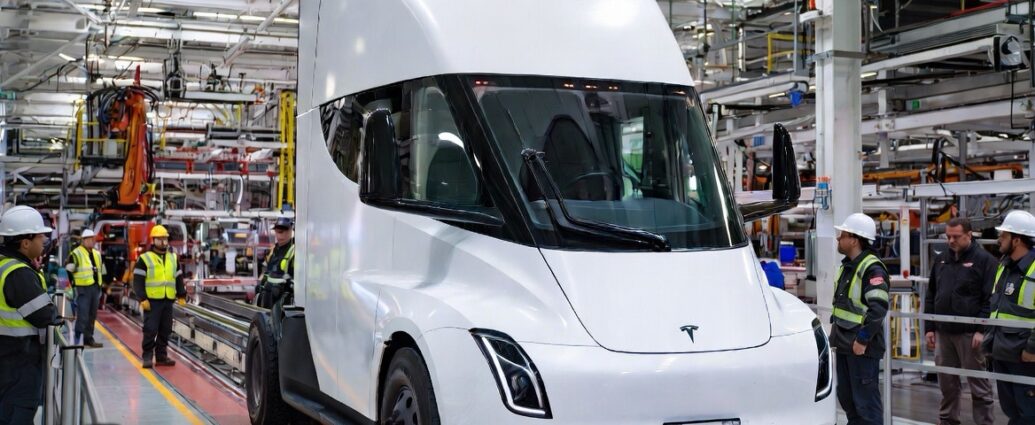
Tesla has delivered a major milestone in the push toward electrifying long-haul trucking. Late Wednesday, the company announced on X that the first Tesla Semi has rolled off its dedicated high-volume production line at a new facility adjacent to Gigafactory Nevada. The post, which included an image from inside the plant, marks the official start of scaled manufacturing for the long-awaited Class 8 electric truck and signals that volume deliveries to customers could begin later this year.
This development comes directly from Tesla itself, confirming what the company outlined in its Q1 2026 shareholder update: the Semi remains on schedule for volume production starting in 2026, with the Nevada factory built specifically to ramp output toward a long-term target of up to 50,000 units annually. The announcement builds on ongoing real-world pilots, including a new three-week port drayage test launched today by Southern California operator MDB Transportation, and partnerships such as the recent agreement with Pilot Travel Centers to expand Megacharger infrastructure.
For everyday businesses and supply chains that rely on trucking — from small manufacturers shipping goods across the Midwest to regional distributors facing high diesel costs — the news carries immediate practical weight. Lower operating expenses could eventually ease pressure on freight rates, helping offset some of the broader cost challenges tracked throughout today’s coverage, including cautious consumer spending and energy prices.
What the Milestone Means for Fleets and Small Businesses
• The Semi’s estimated 500-mile range and roughly 1.7 kWh per mile efficiency promise dramatically lower fuel and maintenance costs compared with diesel trucks, potentially cutting per-mile expenses by up to 70 percent once charging infrastructure matures.
• Early high-volume output will initially focus on fulfilling Tesla’s own internal needs before expanding to external customers, with analysts projecting 5,000 to 15,000 deliveries in 2026 before scaling higher.
• The dedicated Nevada factory, spanning 1.7 million square feet, is designed for efficient production, supporting Tesla’s goal of making electric trucking economically competitive for a wider range of operators.
Economists weighed in on the broader implications, with Diane Swonk, chief economist at KPMG, describing the development as a pivotal step in reshaping freight economics as diesel’s cost advantage continues to erode amid volatile fuel prices, making fleets — including smaller operators — increasingly open to electric alternatives that offer predictable long-term savings; Heather Long, chief economist at Navy Federal Credit Union, pointed out the ripple effects for Main Street businesses, noting that many small manufacturers and distributors reliant on regional trucking could see gradual relief in shipping costs especially as more charging networks come online through partnerships like the one with Pilot; Oliver Allen, senior U.S. economist at Pantheon Macroeconomics, emphasized that while the ramp will be gradual, the confirmation of high-volume production removes a key uncertainty that has lingered since the Semi’s original 2017 unveiling and aligns with broader trends of big players investing in scale to make clean technology accessible beyond just large fleets; Nicole Bachaud, economist at ZipRecruiter, added that the production push could create new manufacturing and technician jobs in Nevada while prompting trucking companies to rethink hiring and training for electric vehicle operations; and Gina Bolvin, president of Bolvin Wealth Management Group, advised business clients to monitor the rollout closely, saying early adopters among small and mid-sized fleets may gain a competitive edge on costs but success will depend on access to reliable charging and the ability to integrate the trucks into existing routes without major disruptions.
Real-World Momentum Already Building
The announcement arrives as operators put early Semis to work in demanding environments. MDB Transportation’s pilot, for instance, is testing the truck on active port container routes — one of the toughest applications in freight — tracking everything from energy use to driver experience. Combined with Tesla’s expanding Megacharger network, these efforts are helping prove the Semi’s readiness for everyday commercial use.
Outlook
Tesla’s first high-volume Semi represents more than just another factory milestone; it brings the company closer to delivering on the promise of electric trucking at scale. For businesses of all sizes, the potential benefits include meaningfully lower operating costs, reduced emissions, and greater predictability in freight expenses — advantages that could matter a great deal amid today’s mixed economic signals and persistent pressure on household and business budgets.
The coming months will show how quickly production scales and whether the economics hold up in real-world fleets. For business enthusiasts following supply-chain and transportation trends, this is a story worth watching closely. Tomorrow’s updates on fleet adoption, charging infrastructure, and related earnings will offer the next clues about how quickly the Semi could reshape the roads.
JBizNews Desk
© JBizNews.com. All rights reserved. This article is original reporting by JBizNews Desk. Unauthorized reproduction or redistribution is strictly prohibited