WASHINGTON April 29 – JbizNews Desk
After 74 days of the longest partial government shutdown in American history, the House of Representatives took a pivotal step Wednesday toward reopening the Department of Homeland Security, approving a Republican budget plan that sets the stage for restoring funding to Immigration and Customs Enforcement and U.S. Customs and Border Protection — without a single Democratic vote — following one of the most chaotic legislative days on Capitol Hill in recent memory.
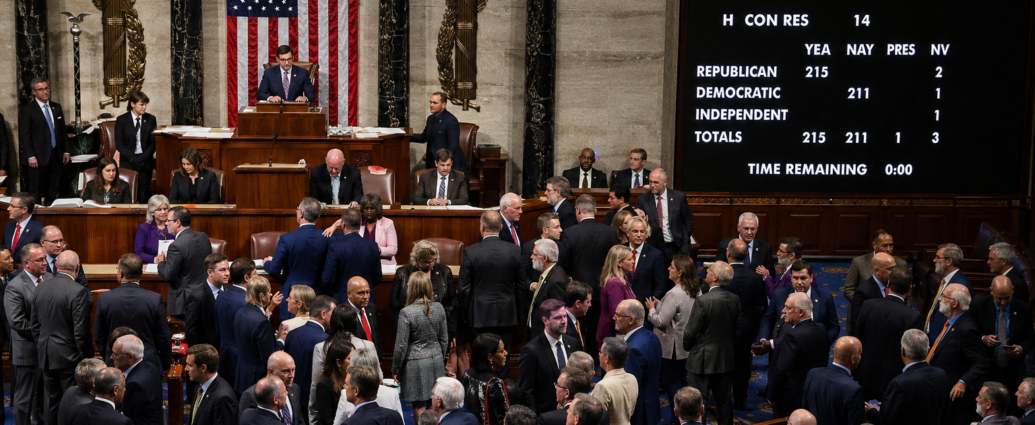
The measure passed in a razor-thin 215–211–1 vote, with Rep. Kevin Kiley (I-Calif.) voting present, underscoring the deep partisan divide that has defined the standoff since DHS funding lapsed on February 14. While the resolution does not directly fund the agency, it initiates the budget reconciliation process, allowing Republicans to advance a final funding bill through the Senate with a simple majority — bypassing the 60-vote filibuster threshold and avoiding Democratic demands for policy concessions.
Rep. Jim McGovern (D-Mass.), when asked to describe the day’s proceedings, responded bluntly: “S—show,” capturing the dysfunction that unfolded as conservative hard-liners temporarily blocked a key procedural vote earlier in the day. That move stalled multiple pieces of legislation tied to President Donald Trump’s broader agenda, forcing Speaker Mike Johnson (R-La.) into hours of tense, closed-door negotiations. According to lawmakers present, discussions grew so heated that raised voices could be heard outside the room before leadership ultimately secured enough votes to move forward.
At the center of the impasse is a fundamental policy divide over immigration enforcement. Republicans are now preparing a reconciliation package that would inject approximately $70 billion into ICE and CBP, effectively circumventing Democratic efforts to condition funding on new restrictions. Those proposed conditions include mandating body cameras for federal agents and limiting enforcement actions in sensitive locations such as schools and hospitals — provisions that were excluded from the GOP framework.
The shutdown’s origins trace back to mid-February, when Senate Democrats blocked appropriations bills funding ICE and Border Patrol following the fatal shootings of two protesters involving federal agents, a development that intensified calls for oversight and accountability. Since then, negotiations have repeatedly collapsed, even as operational pressures mounted across DHS.
The consequences have been felt nationwide. Tens of thousands of DHS employees missed multiple paychecks earlier in the shutdown, prompting higher absentee rates among Transportation Security Administration officers and triggering hours-long screening delays at major airports. While the administration implemented temporary measures to continue paying workers, those stopgaps are nearing their limit.
According to the White House Office of Management and Budget, less than $1.4 billion remained in a special payroll fund as of April 19. DHS Secretary Markwayne Mullin warned that the department could exhaust its ability to pay employees by early May, a deadline that has intensified urgency on Capitol Hill and within the administration.
President Donald Trump has made clear he wants a final funding bill on his desk by June 1, signaling a compressed legislative timeline that now depends on how quickly congressional committees can convert Wednesday’s budget blueprint into a fully drafted reconciliation package. That process will determine not only funding levels but also the scope of enforcement authorities moving forward.
Even after Wednesday’s vote, the path to reopening DHS remains complex. House leadership is considering a parallel track that would fund other components of the department — including the Federal Emergency Management Agency, the Coast Guard, and the Transportation Security Administration — through traditional appropriations. A Senate-passed bipartisan bill covering those agencies could be brought to the House floor before lawmakers depart Washington, though Speaker Johnson had not committed to that approach as of Wednesday evening.
Senate Minority Leader Chuck Schumer (D-N.Y.) has already warned that a House Republican plan to extend funding at current levels would be “dead on arrival” in the Senate, while House Democratic leaders argue that the bipartisan Senate bill could have ended the shutdown weeks ago if it had been allowed to come to a vote.
Internal Republican divisions also threatened to derail progress. Members of the House Freedom Caucus pushed to consolidate all DHS funding into a single bill and expand the reconciliation package to include additional priorities such as defense spending and healthcare reforms. Speaker Johnson ultimately rejected that broader approach, instead advancing a narrower, immigration-focused strategy after quashing a separate revolt tied to a farm bill provision — a maneuver that proved critical to securing final passage.
For now, Republican leadership is pursuing a two-step framework: fund the bulk of DHS through standard appropriations while using reconciliation to deliver targeted funding for ICE and CBP. The strategy represents the GOP’s most viable path to ending the shutdown without conceding to Democratic policy demands, though it risks prolonging negotiations in the Senate.
With airport disruptions mounting, federal workers facing renewed uncertainty over their pay, and critical national security functions operating under strain, the coming weeks will determine whether Congress can translate Wednesday’s procedural breakthrough into a lasting resolution — or whether one of the most disruptive shutdowns in modern U.S. history will continue to test the limits of Washington’s ability to govern.
JBizNews Desk